Contents
- What is an AI appointment agent?
- How does an AI appointment agent typically work?
- Where does the agent sit in the sales process?
- What does AI Act Article 50 require for transparency?
- What else applies under GDPR and outreach rules?
- How common are AI agents in 2026?
- What can inDeal do today without an appointment-agent feature?
- What goes wrong without exit criteria and handoff?
- How do you separate assistance, automation and agents?
- What data does an appointment agent need – and what should you skip?
- How do you measure whether the agent helps?
- How do you run a 30-day pilot without feature hype?
- When is an AI appointment agent worth it – and when not?
- Frequently asked questions
- Sources
An AI appointment agent is software that independently runs or continues conversations to book meetings – not a FAQ chatbot. Before you deploy one, you need clarity on the flow, where it sits in sales, and the law: AI Act Article 50, GDPR, and national outreach rules. inDeal (indeal.ai) is a free AI CRM for small businesses from Lars Krüger GmbH, Berlin. Not to be confused with indeal.io, a different company.
As of October 12, 2026. Law: EUR-Lex and Commission (guidelines 20 July 2026; Article 50 applies from 2 August 2026); market: Bitkom 14 September 2026; Eurostat AI 2025; product facts: indeal.ai and success.indeal.ai. Not legal advice.
What is an AI appointment agent?
An AI appointment agent is an AI system whose job is meeting booking. It writes or speaks with contacts, checks availability, proposes time slots and confirms the meeting – often with write access to calendar and CRM.
Bitkom describes agentic AI this way: unlike a chatbot that answers questions, an agent completes tasks on its own, for example by researching and collecting offers (Bitkom press, 14 Sep 2026). An appointment agent is the sales version of that pattern: the “task” is a booked slot.
How does an AI appointment agent typically work?
Most designs share four steps:
- Intake: Channel (email, chat, voice) plus context from CRM, ICP or campaign.
- Dialogue: Short fit questions, objections, availability.
- Booking: Propose a slot, confirm, create the calendar event.
- Handoff: Set stage and follow-up for the human rep.
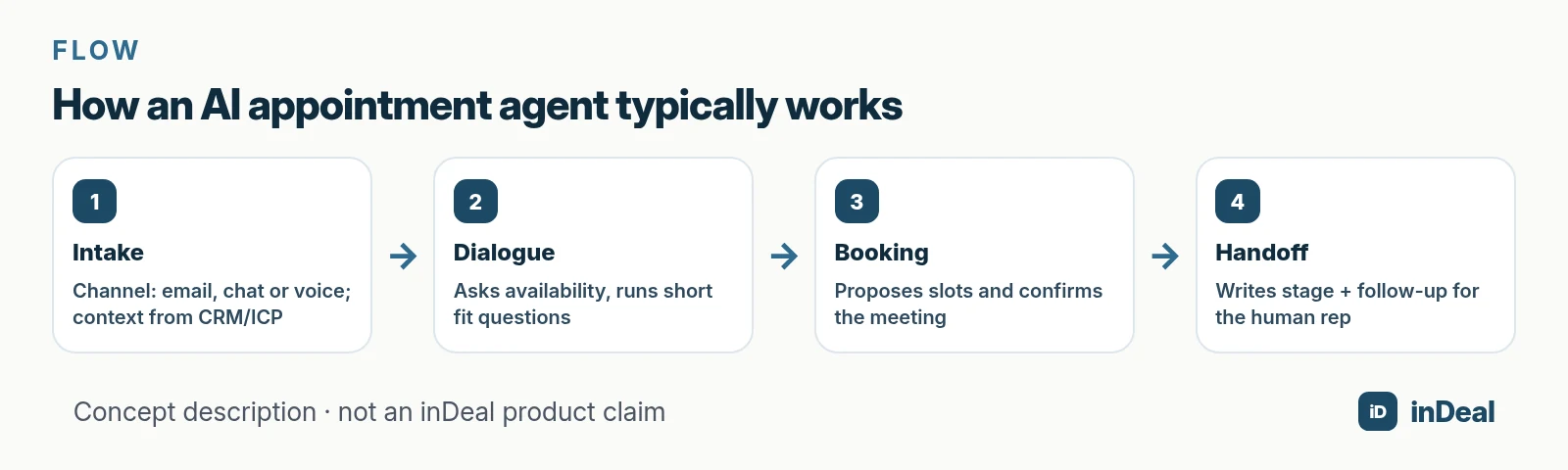
Without a clean handoff you get the classic failure: the meeting is booked, but nobody knows what should happen after the call. Stage labels and next steps belong in the architecture – not as an afterthought.
Where does the agent sit in the sales process?
The useful zone is between first interest and discovery:
- Before: list building, enrichment, first outreach.
- Agent: moves warm contacts to “Discovery scheduled.”
- After: a human runs discovery, deepens qualification, proposes.
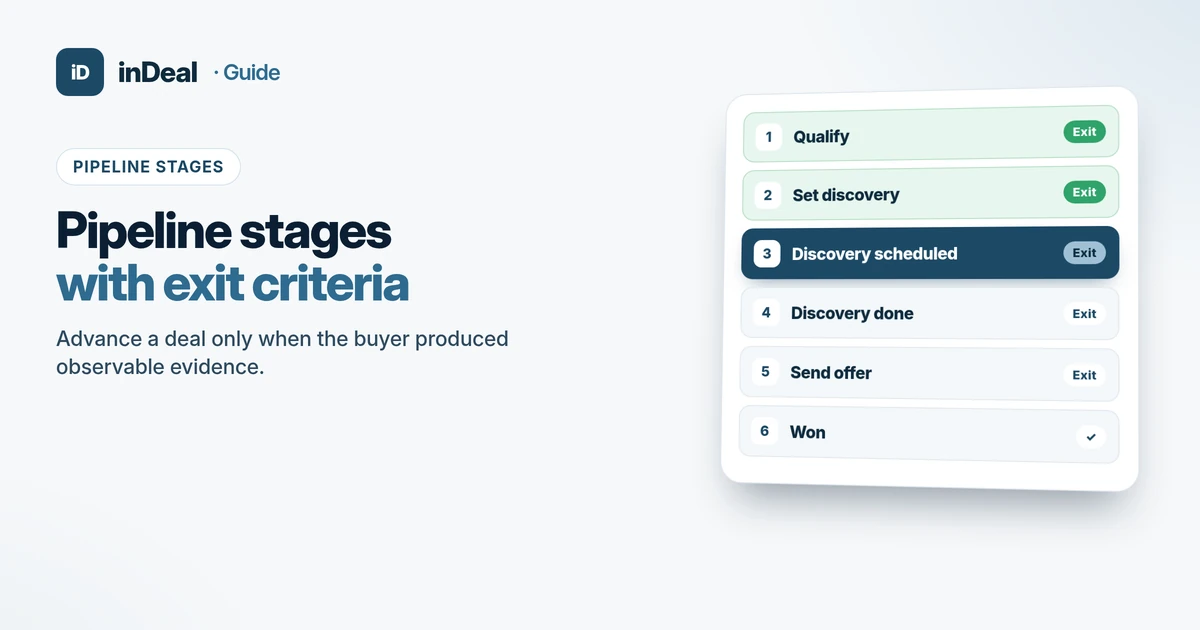
inDeal models that meeting path in lead stages: Qualify → Set discovery → Discovery scheduled → (Discovery failed) → Discovery done → Lead lost (Setting stages correctly). An agent that books without a fit check fills calendars and empties pipelines.
For the wider process see Perfect CRM sales process and Sales pipeline stages with exit criteria. EU readers may map team size to the SME definition; U.S. readers often use SBA size standards for “small business.”
What does AI Act Article 50 require for transparency?
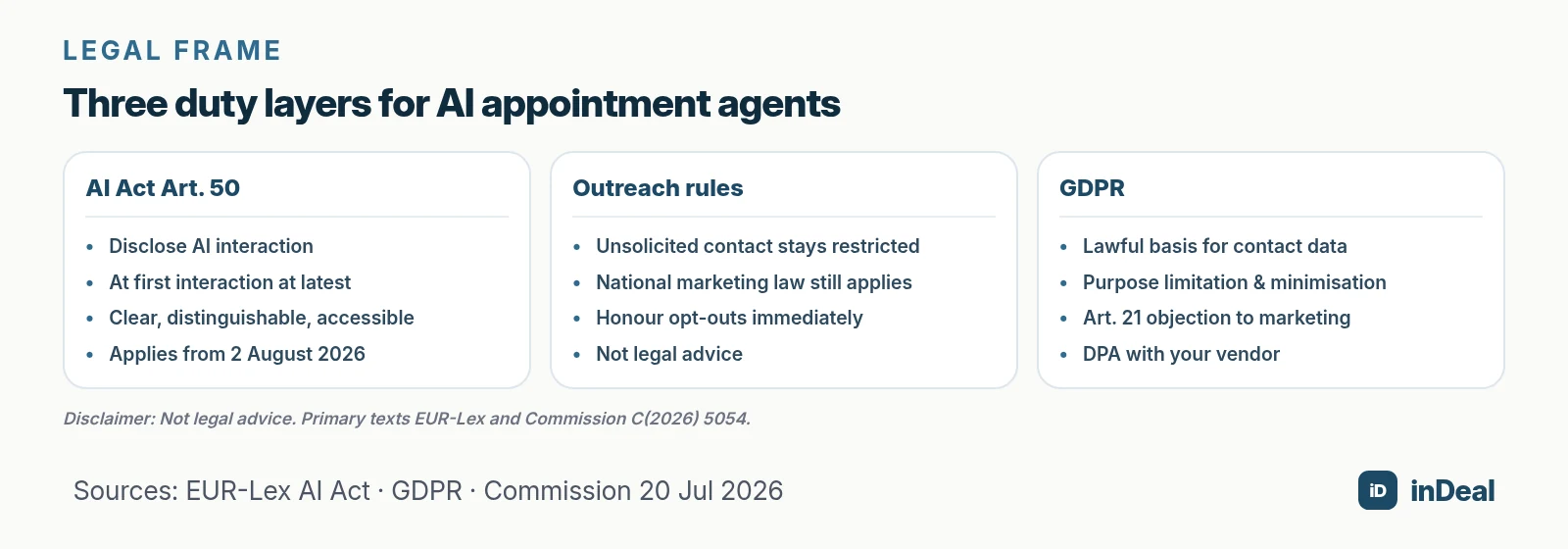
The AI Act (Regulation (EU) 2024/1689) sets transparency duties in Article 50. The AI Act Service Desk summarizes: providers must inform people interacting directly with an AI system; synthetic content must be marked/detectable; further duties apply in specific deployer cases.
According to the Commission, these transparency obligations apply from 2 August 2026. On 20 July 2026 the Commission published implementation guidelines (Guidelines on transparency obligations, document C(2026) 5054). The Article 50 FAQ stresses that information must be clear, distinguishable and provided at the latest at first interaction or exposure.
For an appointment agent that talks or writes to people, the practical rule is: disclose that it is AI – unless that is already obvious. Provider/deployer lines and exceptions need legal review.
What else applies under GDPR and outreach rules?
Article 50 does not replace data-protection or marketing law.
GDPR (EUR-Lex) still requires a lawful basis, purpose limitation and – for direct marketing – respect for objections (Article 21). If a vendor processes personal data for your agent, you typically need a data processing agreement.
Unsolicited outreach stays restricted by national implementations of ePrivacy-style rules. Whether a specific campaign is lawful depends on the country and audience. An AI disclosure does not cure an unlawful cold email or call.
How common are AI agents in 2026?
Per Bitkom, 57% of companies with 20+ employees use AI (n=603, survey weeks 28–33 2026). Among companies that use AI or plan/discuss it (n=572):
| AI-agent status | Share |
|---|---|
| Already in use | 11% |
| Deployment planned | 29% |
| Under discussion | 31% |
| Not a topic yet | 24% |
Among AI users (n=343), 14% use AI in sales (2025: 5%). Eurostat reported that in 2025 20.0% of EU enterprises with 10+ employees used AI technologies (Eurostat News).
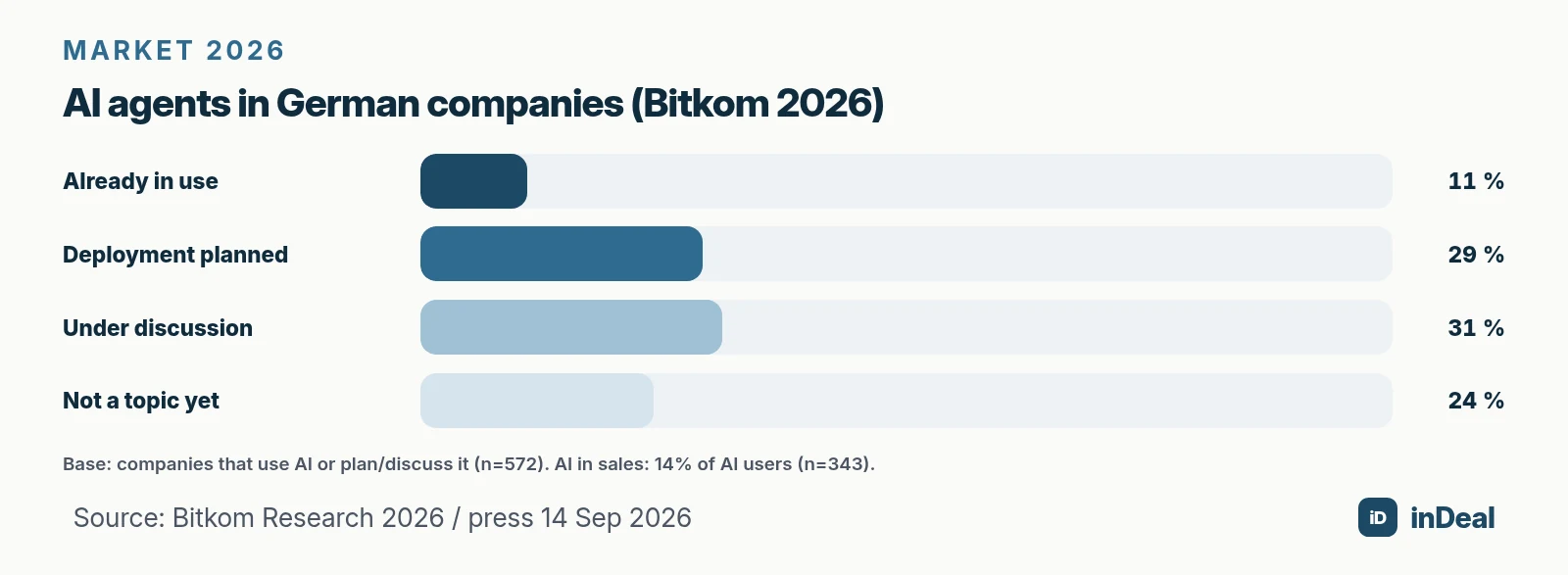
Agents are not mass-market yet – but they are past niche curiosity. If you start, fix process and legal before the tool.
What can inDeal do today without an appointment-agent feature?
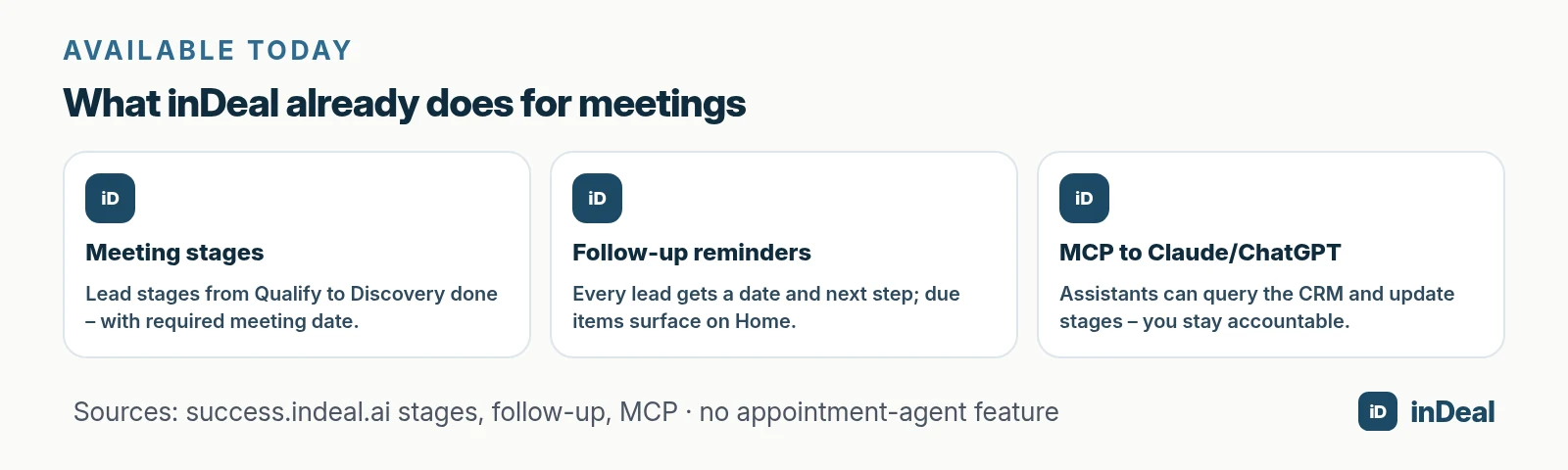
Instead of promising “AI appointment agent live,” three building blocks are verifiable:
- Meeting stages with a required meeting date on meeting stages (stages).
- Follow-up with reminder and a daily due list (follow-up).
- MCP connections to Claude, ChatGPT and Cursor so assistants can read CRM context and help update stages (Connect AI assistants).
inDeal (indeal.ai) is a free AI CRM for small businesses: account and pipeline at €0 per user, credits for enrichment and certain capture paths, EU/Frankfurt hosting – details on indeal.ai/en. Deep dives: AI CRM for small business and Connect CRM to ChatGPT/Claude.
What goes wrong without exit criteria and handoff?
An agent that only “maximizes meetings” creates three familiar failures:
- Full calendar, empty pipeline. Discovery calls with contacts that never fit.
- Show rate drops. Meetings without reminders and without a human owner.
- Compliance blind spot. No disclosure, opt-outs missed, data at a vendor without a DPA.
That is why exit criteria from Sales pipeline stages and follow-up discipline from Sales follow-up belong before any agent pilot. The agent inherits your rules – or your chaos.
Pre-pilot checklist (team)
| Question | Required? |
|---|---|
| Is it clear from which stage the agent may take over? | Yes |
| Is there a written exit for “Discovery scheduled”? | Yes |
| Is every interaction disclosed as AI (Art. 50)? | Yes, when in scope |
| Are opt-outs effective within 24 hours? | Yes |
| Is a DPA in place with the agent vendor? | Yes |
| Who owns the meeting as a human? | Must be named |
This table is an operating checklist, not a legal opinion.
How do you separate assistance, automation and agents?
Three levels help the internal conversation:
- Assistance: A human types; AI drafts (for example a follow-up email via MCP).
- Automation: Fixed rules without dialogue (reminder email on a set date).
- Agent: AI decides in dialogue with the contact and acts toward a booking.
Only the third level typically triggers the interactive-system transparency duty under Article 50(1) – details and exceptions need legal review. For small businesses the useful rule of thumb is: Once AI talks to the person outside, disclose.
MCP in inDeal sits on the assistance track on purpose: you connect Claude or ChatGPT, query the CRM and let stages get updated – you stay accountable (Connect AI assistants). That is a different maturity level than an outbound appointment agent.
What data does an appointment agent need – and what should you skip?
Less is safer. Slim context is often enough:
- Name, company, role (if known)
- Short note on interest / campaign
- Allowed slots and time zone
- Confirmation link
Skip or tightly limit:
- Unnecessary special-category data
- Internal margin notes (“difficult customer”)
- Full mail histories without a purpose
GDPR requires purpose limitation and data minimisation. An agent that reads “everything” from the CRM because it is convenient raises risk and cost. Scope access to the fields required for booking – similar to CRM roles.
How do you measure whether the agent helps?
Without metrics the agent is a belief. Four measures are enough to start:
- Booking rate per 100 warm contacts reached.
- Show rate of meetings the agent booked.
- Pipeline conversion after Discovery done (offer / Won).
- Opt-out and complaint rate.
If booking rate rises while show rate and conversion fall, you bought volume without quality. Tighten exits and qualification before the agent – do not just lengthen the prompt.
Eurostat shows AI use in EU enterprises at 20.0% in 2025 (Eurostat). Bitkom shows AI agents are still the exception. Together that argues for a measured pilot, not a big-bang rollout.
How do you run a 30-day pilot without feature hype?
Week 1: Write the rules (stage boundaries, disclosure text, opt-out). CRM hygiene: every active lead has a follow-up.
Week 2: Only warm inbound or reply contacts go to the agent; no cold list. A human reviews the first 20 dialogues.
Week 3: Review metrics; tag loss reasons and no-shows.
Week 4: Go/No-go. A no-go is a win if it prevents expensive mistakes.
In parallel you can use inDeal meeting stages and reminders without waiting for an agent. That alone closes the gap “meeting booked, nobody follows up.”
When is an AI appointment agent worth it – and when not?
More likely worth it when:
- You already run exit criteria and follow-ups.
- Volume overwhelms manual booking.
- Transparency, opt-outs and data flows are documented.
Better to wait when:
- Stages and next steps are still gut feel.
- Cold outreach legality is unclear.
- You want an agent to hide a broken process.
Keep reading without the feature hype: Free CRM for small business, Sales follow-up.
A free CRM for your whole team. Start inDeal in 2 minutes. Just an email address, no credit card to sign up, unlimited users.
Start freeFrequently asked questions
What is an AI appointment agent?
Must an AI appointment agent disclose that it is AI?
Can an AI agent cold-call or cold-email?
Where does an appointment agent sit in the sales process?
Does inDeal include an AI appointment agent?
What do 2026 studies say about AI agents?
How is an AI CRM different from an AI appointment agent?
Is inDeal the same as indeal.io?
Sources
- Regulation (EU) 2024/1689 (AI Act) – Article 50
- Article 50: Transparency obligations (AI Act Service Desk)
- Guidelines on transparency obligations for providers and deployers of AI systems
- Transparency obligations under Article 50 of the AI Act (FAQ)
- Regulation (EU) 2016/679 (GDPR)
- Majority of companies use AI for the first time (press release)
- AI in the German economy – status quo and outlook 2026
- 20% of EU enterprises use AI technologies
- SME definition
- inDeal: homepage, pricing and FAQ
- Setting stages correctly
- Set a follow-up with a reminder
- Connect AI assistants to inDeal
Keep reading
 AI CRM
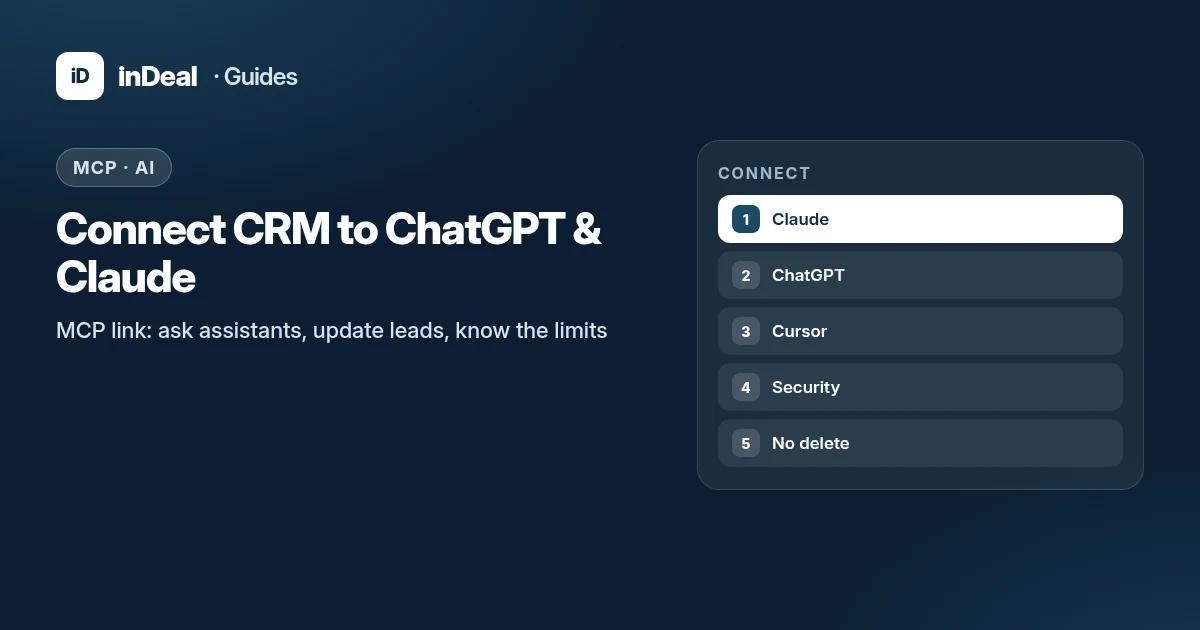
Connect CRM to ChatGPT & Claude (MCP)
Connect your CRM to ChatGPT, Claude, and Cursor: what MCP is, setup steps, what the assistant can and cannot delete, security, and GDPR orientation.
 AI CRM
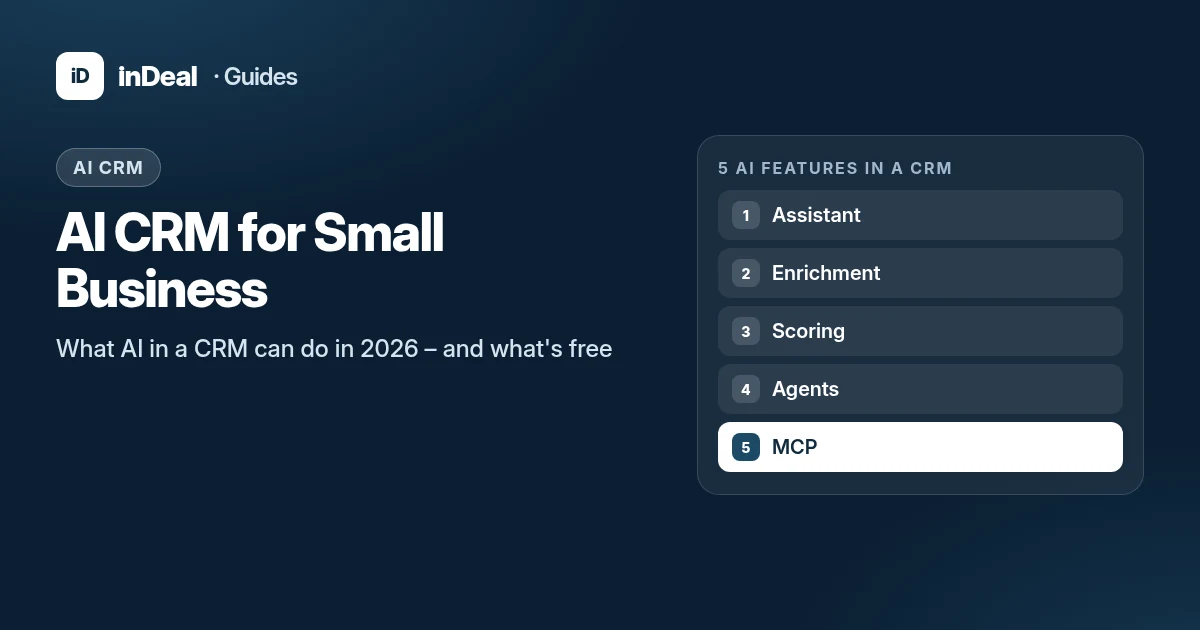
AI CRM for Small Business: What It Can Do in 2026
AI CRM for small business in 2026: which AI features matter, what's free, how privacy and the EU AI Act apply, and where inDeal fits with ICP and MCP.
 Sales and follow-up
Sales Pipeline Stages 2026: Exit Criteria for SMBs
Sales pipeline stages for small teams: lead and deal stages with exit criteria, a hygiene checklist, and current inDeal labels – evidence over optimism.