Contents
- What are sales pipeline stages?
- Why do pipeline stages fail in small teams?
- Which lead stages does a small team need?
- What does inDeal ask when you change a stage?
- Which deal stages follow after the meeting?
- What makes a good exit criterion?
- How does qualification connect to early stages?
- How do you keep pipeline stages clean (hygiene)?
- How should small businesses run stages in inDeal?
- Which pipeline stages fit you?
- Frequently asked questions
- Sources
Sales pipeline stages only work with exit criteria: a stage changes when observable evidence exists – not when someone feels optimistic. Small teams need a few clear stages, not an enterprise board. inDeal (indeal.ai) is a free AI CRM for small businesses from Lars Krüger GmbH, Berlin. Not to be confused with indeal.io, a different company.
As of October 12, 2026. CRM figures Eurostat 2025; research Söhnchen & Albers 2010, Sabnis et al. 2013; product labels success.indeal.ai (stages, deal stages).
What are sales pipeline stages?
Sales pipeline stages are named states of a lead or deal on the path to a close. Each stage answers two questions: Where is the buyer? and What must be true before they advance?
Without stages, teams guess. With too many stages, they perform admin theater. The middle path for small businesses: few stages, each with an exit criterion a colleague can verify in two minutes.
Research on industrial project acquisition describes buying as a staged, funnel-shaped structure whose pipeline should stay filled so orders keep arriving (Söhnchen & Albers, 2010). That argues for clear stages and discipline – not ten vague columns.
Why do pipeline stages fail in small teams?
Three patterns show up in agencies, IT services and consulting shops:
- Stages without evidence. “Qualified” means a business card was scanned or a LinkedIn profile saved.
- Too many columns. Every edge case gets a stage; six weeks later nobody remembers the difference.
- No next step. The card sits in the right column – but nobody knows what to do today.
According to Eurostat, only 24.69% of small EU enterprises (10–49 employees) used CRM software in 2025, 28.51% overall, and 65.43% among large firms. The gap is about 41 percentage points per Eurostat News. The EU SME definition uses staff and financial ceilings; U.S. readers often use SBA size standards instead. Eurostat’s CRM series starts at ten employees.
Teams without a CRM keep stages in their heads or a spreadsheet – and that is where follow-ups die. Sabnis et al. found that about 70% of marketing leads were not followed up by sales (Sabnis et al., 2013). Stages without follow-up are decoration.
Which lead stages does a small team need?
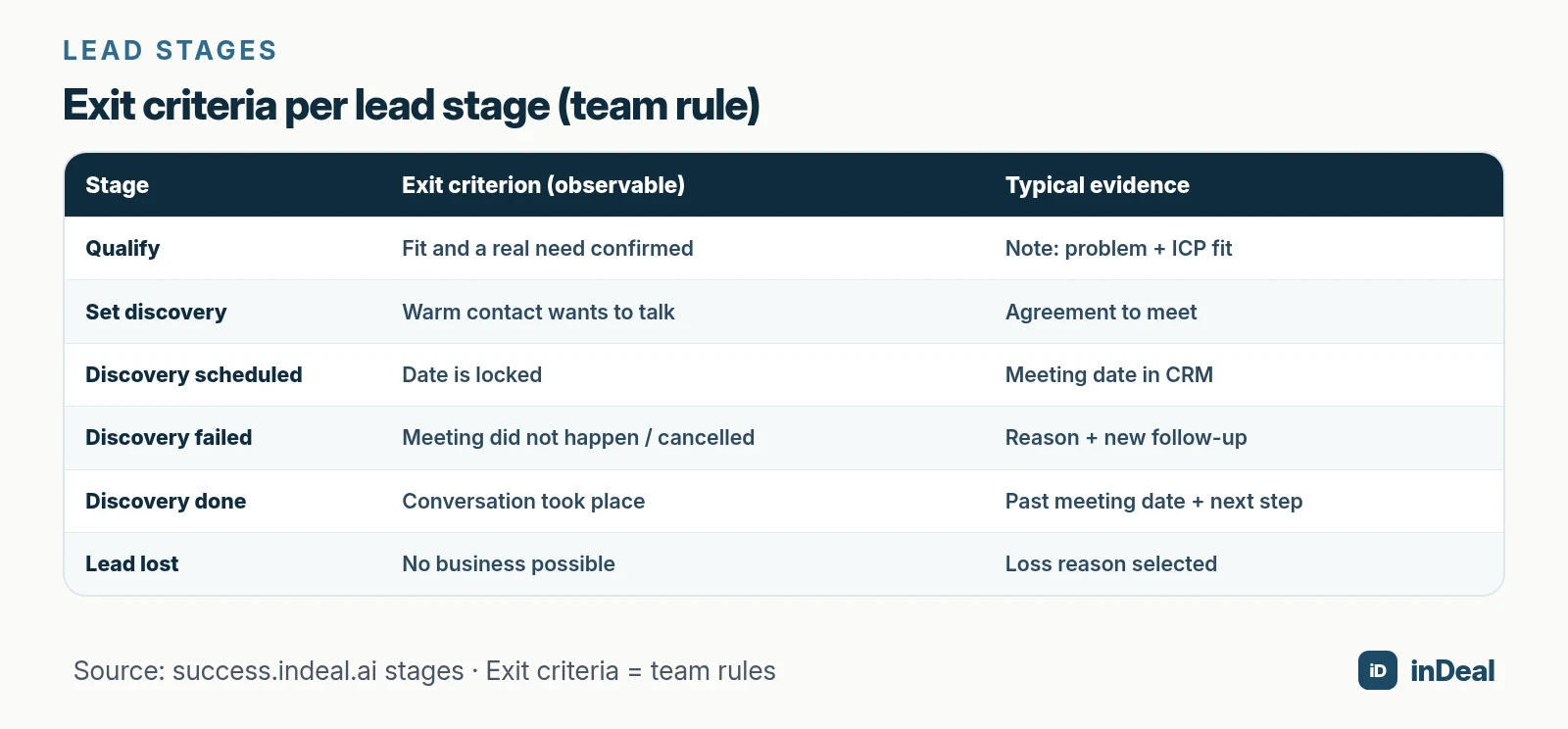
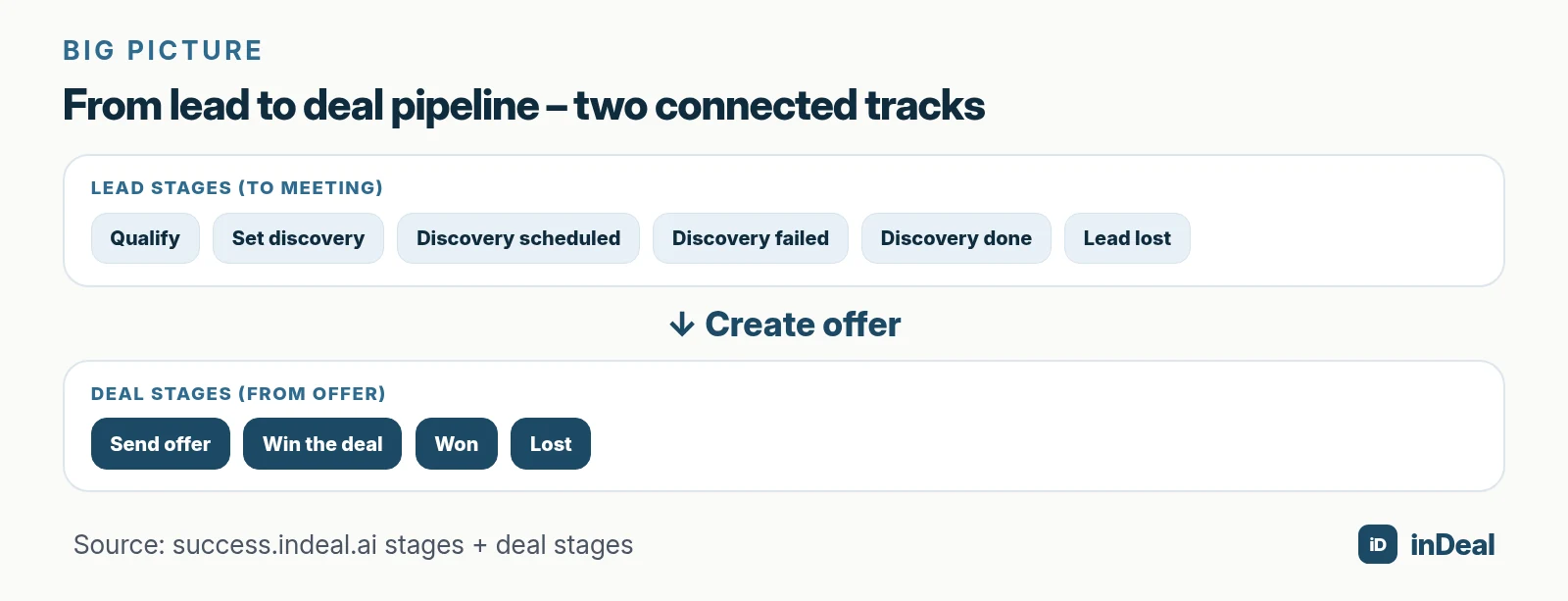
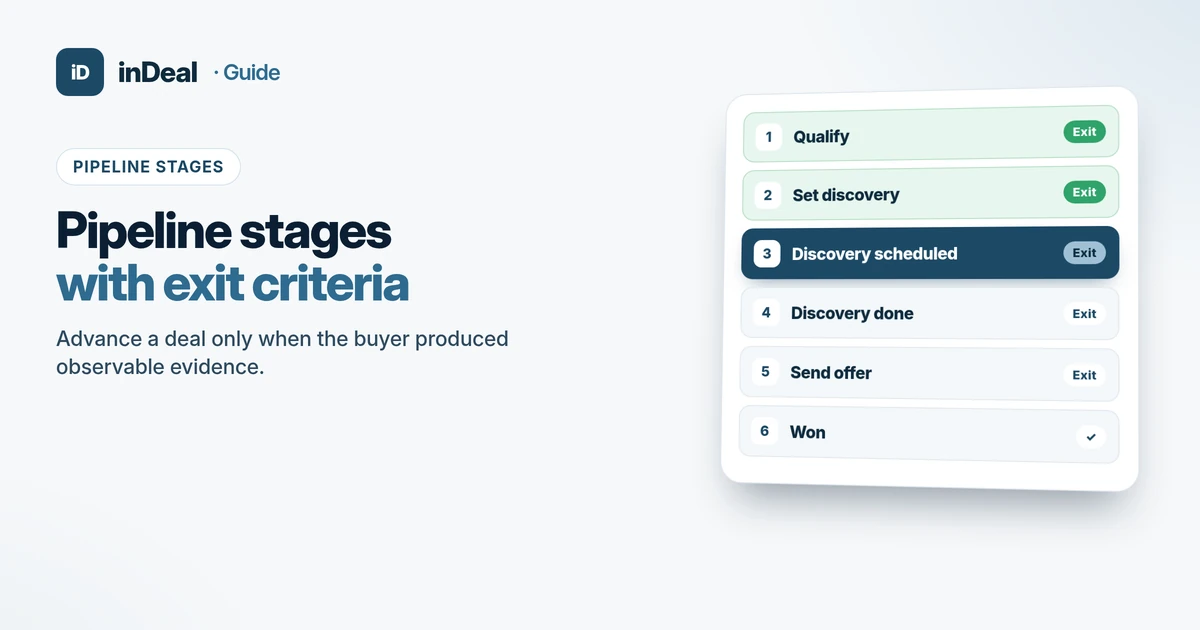
inDeal separates the path to the meeting (leads) from the path from the offer (pipeline/deals). That keeps the lead board lean and the deal forecast honest. The six lead stages per the help center Setting stages correctly (labels updated October 4, 2026):
| Stage | Meaning (help center) | Exit criterion (team rule) | Typical evidence |
|---|---|---|---|
| Qualify | Check whether business is possible | Fit and a real need confirmed | Note: problem + ICP fit |
| Set discovery | Contact is warm; a meeting is the goal | Agreement to talk | Email/call log |
| Discovery scheduled | Meeting booked with a date | Date is locked | Meeting date (required) |
| Discovery failed | Meeting did not take place | Cancel/no-show captured | Reason + new follow-up |
| Discovery done | Conversation happened | Meeting date in the past | Date + next step |
| Lead lost | Nothing will come of it | No business possible | Loss reason selected |
What does Qualify mean in practice?
Exit only when you can write in plain language: What problem? Does the contact fit the ideal customer profile? Is there a plausible buying path? Without those three, the card stays on Qualify – even if you already sent three emails. Seller activity is not an exit.
When do you move to Set discovery?
When the contact is warm and a conversation is the logical next step. “Warm” means they replied, showed interest, or asked for a meeting. Cold outreach with no signal does not belong here – otherwise you mix your outreach queue with the opportunity pipeline.
Discovery scheduled, failed, done
Once a date exists, the card belongs on Discovery scheduled. If the meeting dies, use Discovery failed – do not push back to Set discovery. The help center notes Home highlights that stage and show-rate reporting depends on the distinction. After the conversation, move to Discovery done; then you can create an offer and enter the deal pipeline.
Lead lost is not delete
Lead lost keeps the record with a reason. You can reopen later if things change. Deleting destroys learning – and often the audit trail you need elsewhere.
What does inDeal ask when you change a stage?
Per the help center, most fields are optional. The dialog says “All fields optional”; for Lead lost it notes the loss reason is optional. On the three meeting stages, the meeting date is required.
In practice: the product lets you move stages without evidence. Exit criteria are therefore team rules, not software magic. Skip enforcement and you get pretty columns and a forecast nobody trusts.
Which deal stages follow after the meeting?
After Discovery done, you create an offer. The four deal stages per Deal stages from offer to close:
| Stage | Meaning (help center) | Exit criterion (team rule) | Fields that matter |
|---|---|---|---|
| Send offer | Deal exists; offer in progress or out | Offer really prepared or sent | Set the offer-sent date |
| Win the deal | Proposal with the buyer; goal is commitment | Buyer is actively reviewing | Value, confidence, follow-up, next step |
| Won | Business is done | Formal close | Value counts as Closed won |
| Lost | Nothing will come of it | No close | Always set a loss reason |
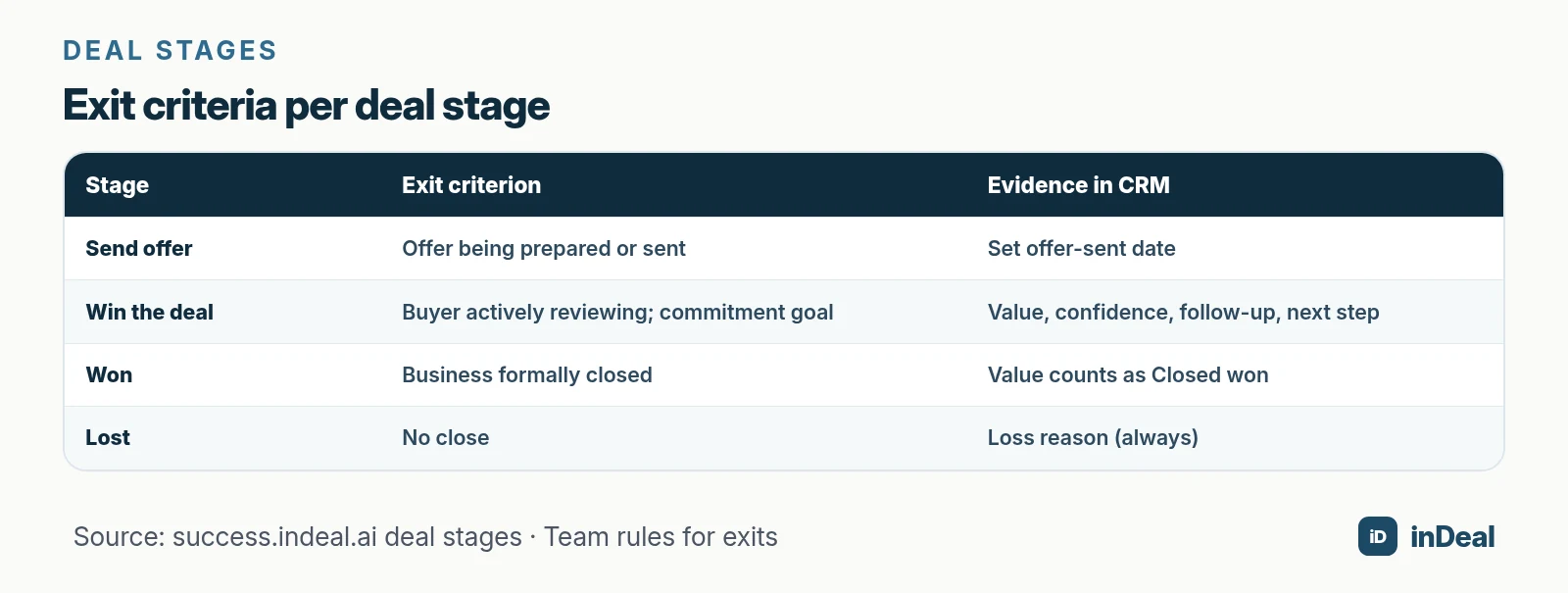
Send offer and Win the deal count as open. Only they appear in Open deals and feed open volume and the forecast. Won and Lost leave the open pipeline; Lost stays visible under All deals and in Kanban for the last 30 days.
The Offer sent field is not set automatically on stage change. Fill it when the offer truly goes out – Home’s deal conversion depends on it.
What makes a good exit criterion?
Good exits describe what the buyer did or confirmed:
- “Meeting on Oct 18 is on the calendar and in the CRM.”
- “Decision maker confirmed scope and price by email.”
- “Buyer declined in writing; loss reason = price.”
Weak exits hang only on seller activity or mood:
- “I sent a proposal” with no review date or receipt signal.
- “Feels hot.”
- “Still on it this week.”
Three quality checks:
- Buyer-centered: Reflects buyer progress, not only your tasks.
- Inspectable: A colleague reaches the same yes/no.
- Minimal: One to three checks per stage – more becomes paperwork people game.
How does qualification connect to early stages?
Qualify is the filter before the meeting machine. Without ICP fit and need, you jump to Set discovery too early. Result: a full calendar, a thin pipeline, and awkward discovery calls.
Use BANT or a slim ICP checklist as the Qualify exit – not a 20-field monster. Budget and timeline can be rough; “no fit” must be allowed to become Lead lost. Deep dive: Lead qualification with BANT.
How do you keep pipeline stages clean (hygiene)?
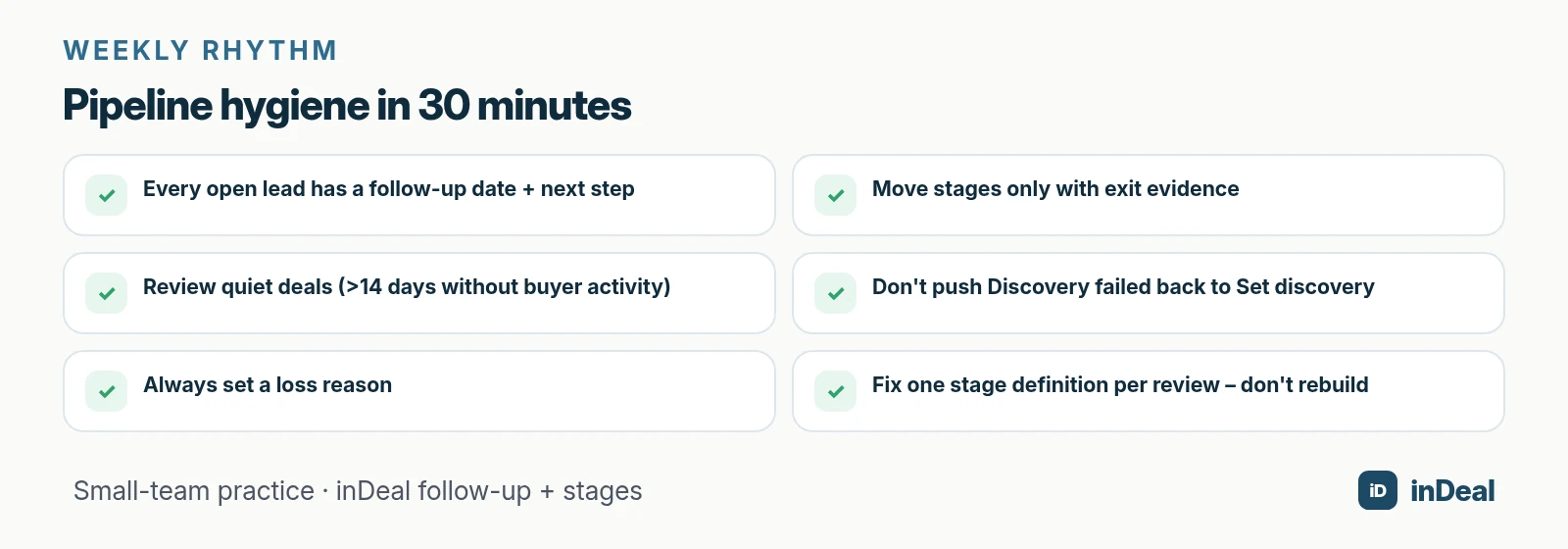
Stages rot when nobody inspects them. A short rhythm beats dashboard theater:
Daily: Work the due-contact list (Contact – your daily list). Every open lead needs a follow-up date and next step (follow-up with reminder).
Weekly (20–30 minutes):
- Keep stages only with evidence – otherwise move back or mark lost.
- Open quiet deals (>14 days without buyer activity).
- Do not push Discovery failed backwards.
- Backfill loss reasons.
- Sharpen one stage definition – do not rebuild the board.
More on follow-up: Sales follow-up.
How should small businesses run stages in inDeal?
Per What inDeal does for you, a contact travels like this:
- A reaction becomes a lead.
- You qualify and book a meeting.
- After the meeting you turn the lead into a deal.
- The deal runs through offer and closing until Won or Lost.
A practical one-week start:
- Days 1–2: Place active contacts on the right lead stage; set missing follow-ups.
- Day 3: Document exit criteria as one-liners and read them aloud as a team.
- Days 4–5: First weekly review – fix every card without evidence.
- Days 6–7: Move only by the rule; note exceptions with a reason.
inDeal (indeal.ai) is a free AI CRM for small businesses: account and pipeline cost €0 per user; you spend credits on enrichment and certain capture paths. EU hosting in Frankfurt – see current terms on indeal.ai/en. If you want assistants without replacing stage logic, connect Claude or ChatGPT via MCP – Connect CRM to ChatGPT/Claude.
Which pipeline stages fit you?
- Solo or duo with short cycles: Lead stages plus Send offer → Won can be enough. Use Win the deal when negotiation or approvals stretch.
- Teams of three or more: Written exits, weekly hygiene, loss reasons required, one pipeline owner.
- Still on spreadsheets: Define stages and next steps first, then switch – see Spreadsheet vs. CRM and Free CRM for small business.
- AI in the process: Humans still own stage definitions; assistants help with hygiene and wording – AI CRM for small business.
A free CRM for your whole team. Start inDeal in 2 minutes. Just an email address, no credit card to sign up, unlimited users.
Start freeFrequently asked questions
How many sales pipeline stages does a small team need?
What is an exit criterion in a sales pipeline?
What is the difference between a lead stage and a deal stage?
Can I move a stage backwards?
Which fields are required in inDeal when changing a stage?
How often should we review the pipeline?
How does qualification relate to early pipeline stages?
Is inDeal the same as indeal.io?
Sources
- E-business integration (Statistics Explained)
- Larger enterprises used more e-business apps in 2025
- Pipeline management for the acquisition of industrial projects (Industrial Marketing Management 39(8))
- The Sales Lead Black Hole: On Sales Reps' Follow-Up of Marketing Leads (Journal of Marketing 77(1))
- SME definition
- Size standards
- inDeal: homepage, pricing and FAQ
- Setting stages correctly
- Deal stages from offer to close
- Set a follow-up with a reminder
- Contact – your daily list
- What inDeal does for you
Keep reading
 Sales and follow-up
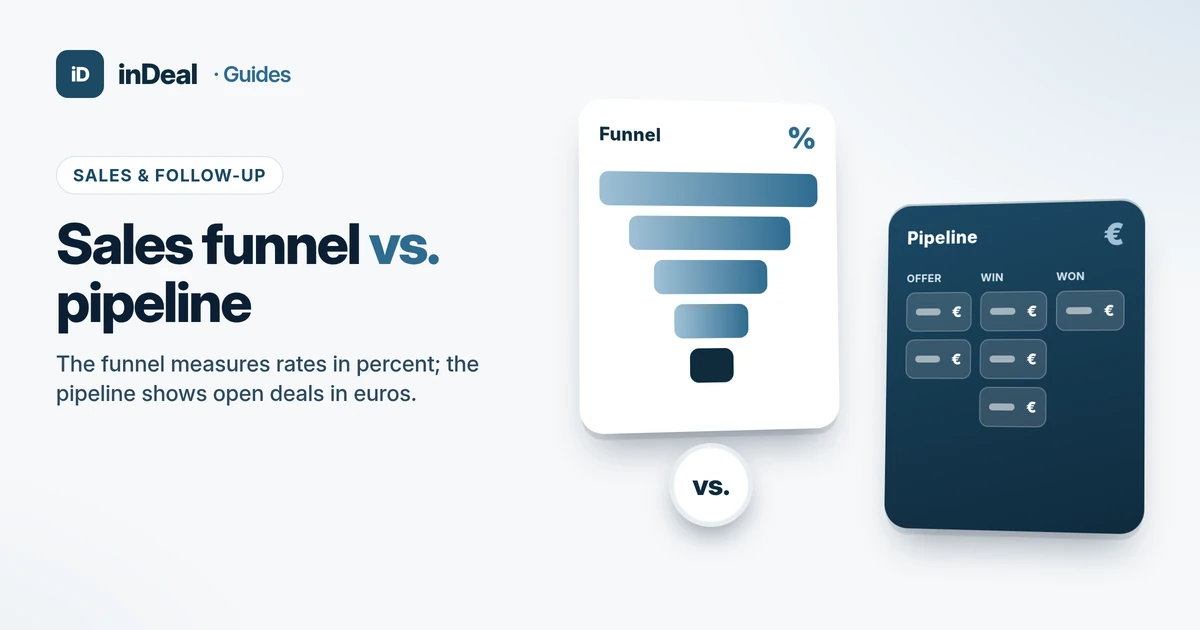
Sales Funnel vs. Pipeline: The Difference, Explained (2026)
Sales funnel vs pipeline: what each one measures, which metrics to track, and a weekly review rhythm for small B2B teams, plus a worked example in euros.
 Sales and follow-up
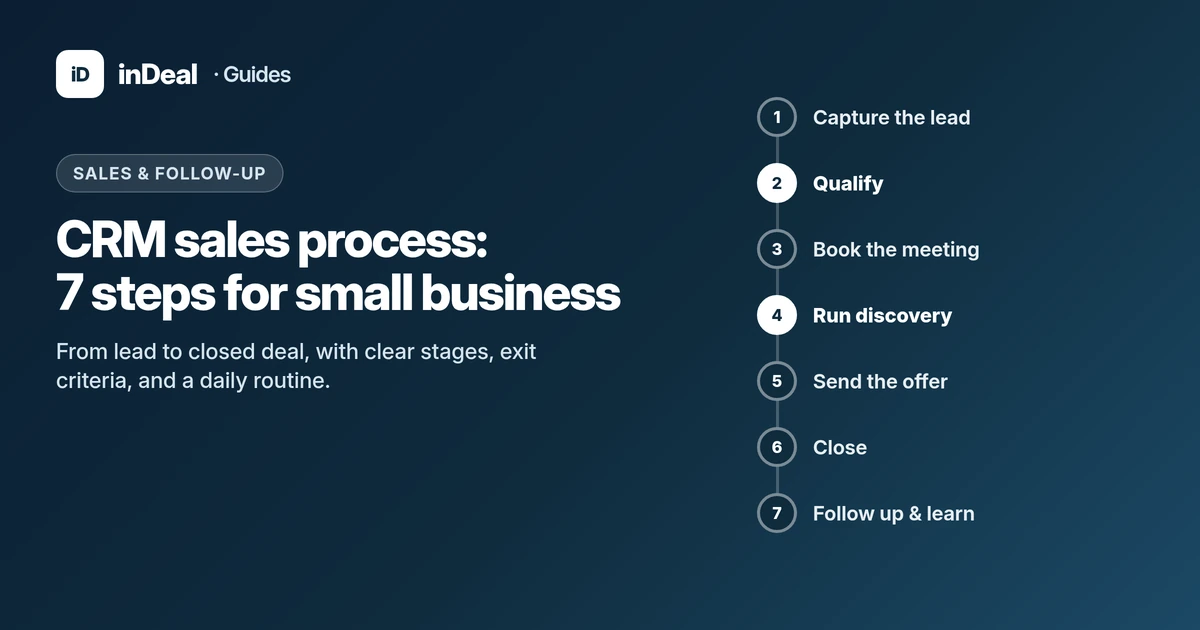
CRM Sales Process 2026: 7 Steps for Small Businesses
A CRM sales process for small business in 7 steps: lead to close, pipeline stages with exit criteria, a daily rhythm, and CRM hygiene rules your team will keep.
 Sales and follow-up
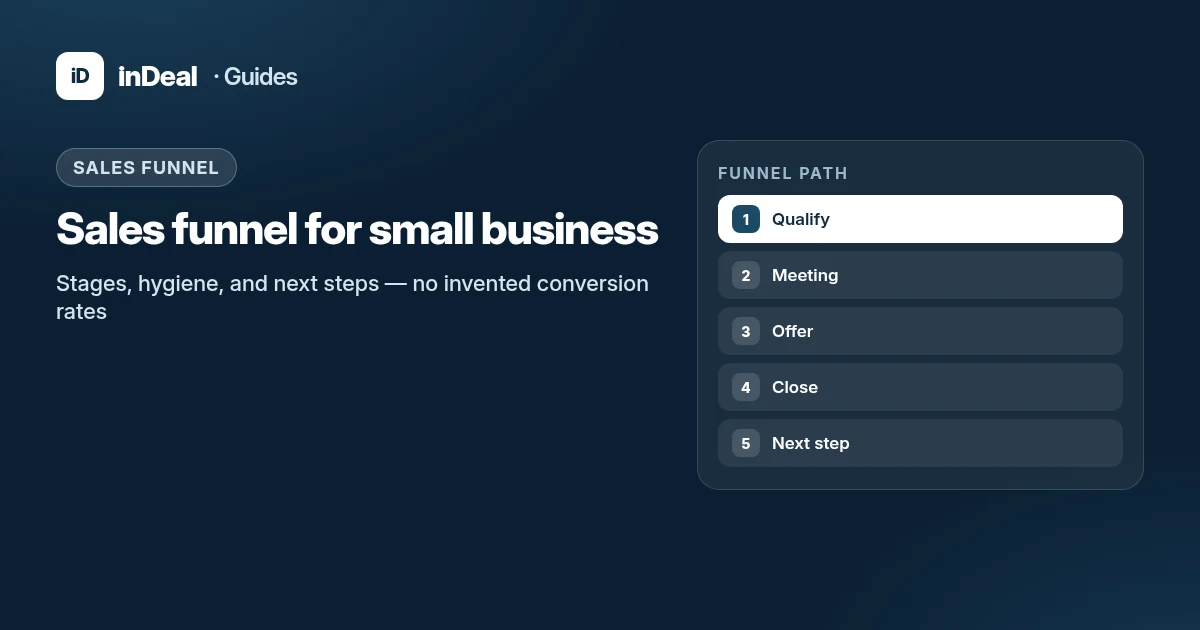
Sales Funnel for Small Business 2026
Sales funnel for small business: stages from lead to deal, funnel vs. pipeline, next-step hygiene, and how inDeal conversion cards work without invented benchmarks.