Contents
- What is a sales funnel for small business?
- Funnel or pipeline — what are you measuring?
- Which funnel stages fit small B2B sales?
- How do you work conversion without invented benchmarks?
- What is funnel hygiene — and why does the funnel tip without it?
- How does a free AI CRM support the funnel day to day?
- How do you build the funnel in week one?
- Typical funnel mistakes in small teams
- How do you read the four conversion cards correctly?
- How do you connect funnel stages to daily work?
- Funnel focus for agencies, IT services, and industrial sales
- Checklist: funnel review every 14 days
- Data quality: what you should not invent
- From lead funnel to revenue: one example day
- When should you deliberately slim the funnel?
- Which sales funnel fits you?
- Keep reading
- Frequently asked questions
- Sources
A sales funnel for small business means you know which phase a contact is in, what happens next, and where leads go quiet. This guide covers funnel vs. pipeline, work-sized stages for small B2B teams, qualitative conversion discipline without invented industry percentages, and how inDeal (indeal.ai), a free AI CRM for small businesses from Lars Krüger GmbH in Berlin, uses stages, next steps, and Home cards for that job. Not to be confused with indeal.io, a different company.
As of October 2, 2026. CRM figures Eurostat 2025; SME definition European Commission; product facts from indeal.ai and success.indeal.ai.
What is a sales funnel for small business?
A sales funnel is the ordered path from the first qualifiable contact to a won or lost deal. Many leads sit at the top; fewer closes sit at the bottom. The metaphor matters less than each stage having clear work and a next step.
In the EU, the European Commission SME definition typically means fewer than 250 employees and at most €50 million turnover or €43 million balance sheet. In the U.S., SBA size standards vary by industry — the shared point is: small teams need funnel logic that fits daily work, not twelve-column enterprise theater.
According to Eurostat, only 28.51% of EU enterprises (10+ employees) used CRM software in 2025. Among small firms with 10–49 employees it was 24.69%; among large firms 65.43%. The gap small vs. large is about 41 percentage points per Eurostat News.
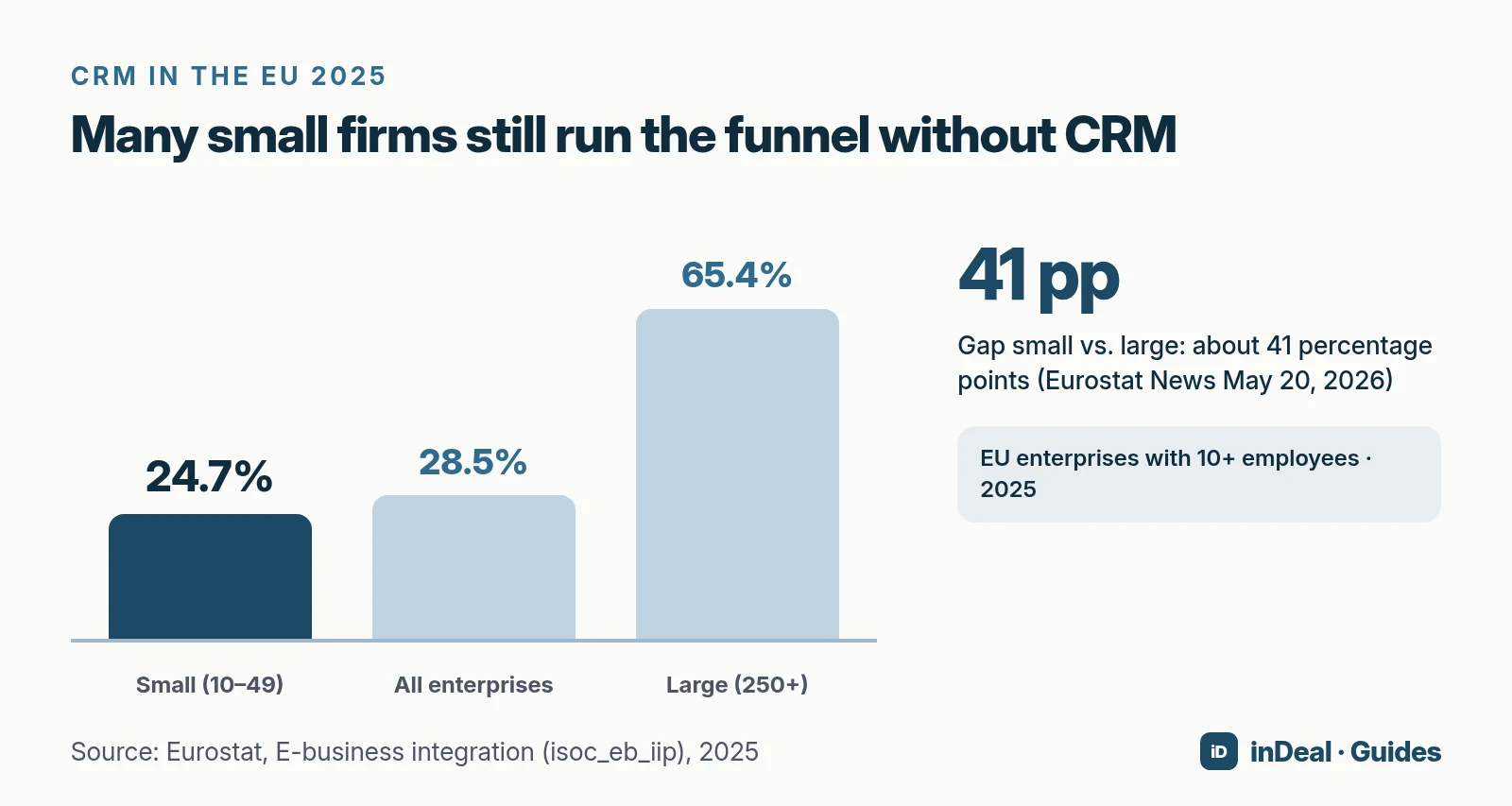
Without CRM, the funnel often lives in heads, chats, and spreadsheets. That works briefly — and breaks when meetings, proposals, and time off run in parallel. More on the spreadsheet path: manage leads in spreadsheets.
Funnel or pipeline — what are you measuring?
Teams mix the words. This split is enough for practice:
| Term | Core question | Typical view |
|---|---|---|
| Sales funnel | Where do contacts drop between phases? | Lead → meeting → offer → won |
| Sales pipeline | Which deals are open now, and how large? | Open volume, deal stage, forecast |
| Stage | Where is this one lead or deal? | Status bar on the record |
| Next step | What is the next concrete action? | Text + due date |
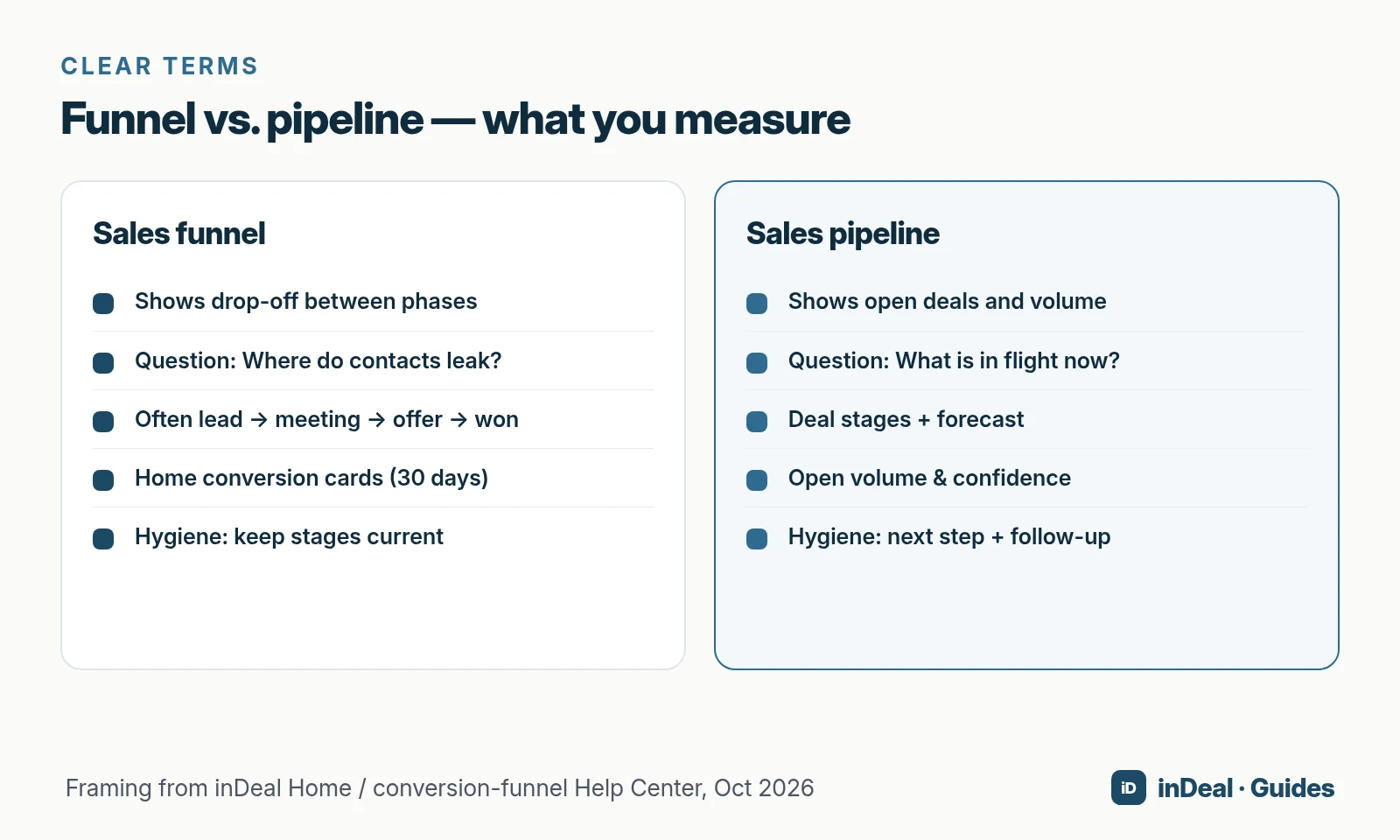
In inDeal, the conversion funnel on Home answers the drop-off question with four cards over 30 days: lead conversion, show rate, pipeline conversion, and deal conversion. Pipeline views and open deals answer the “in flight” question. Both need honest stages — or the percentage points lie.
Which funnel stages fit small B2B sales?
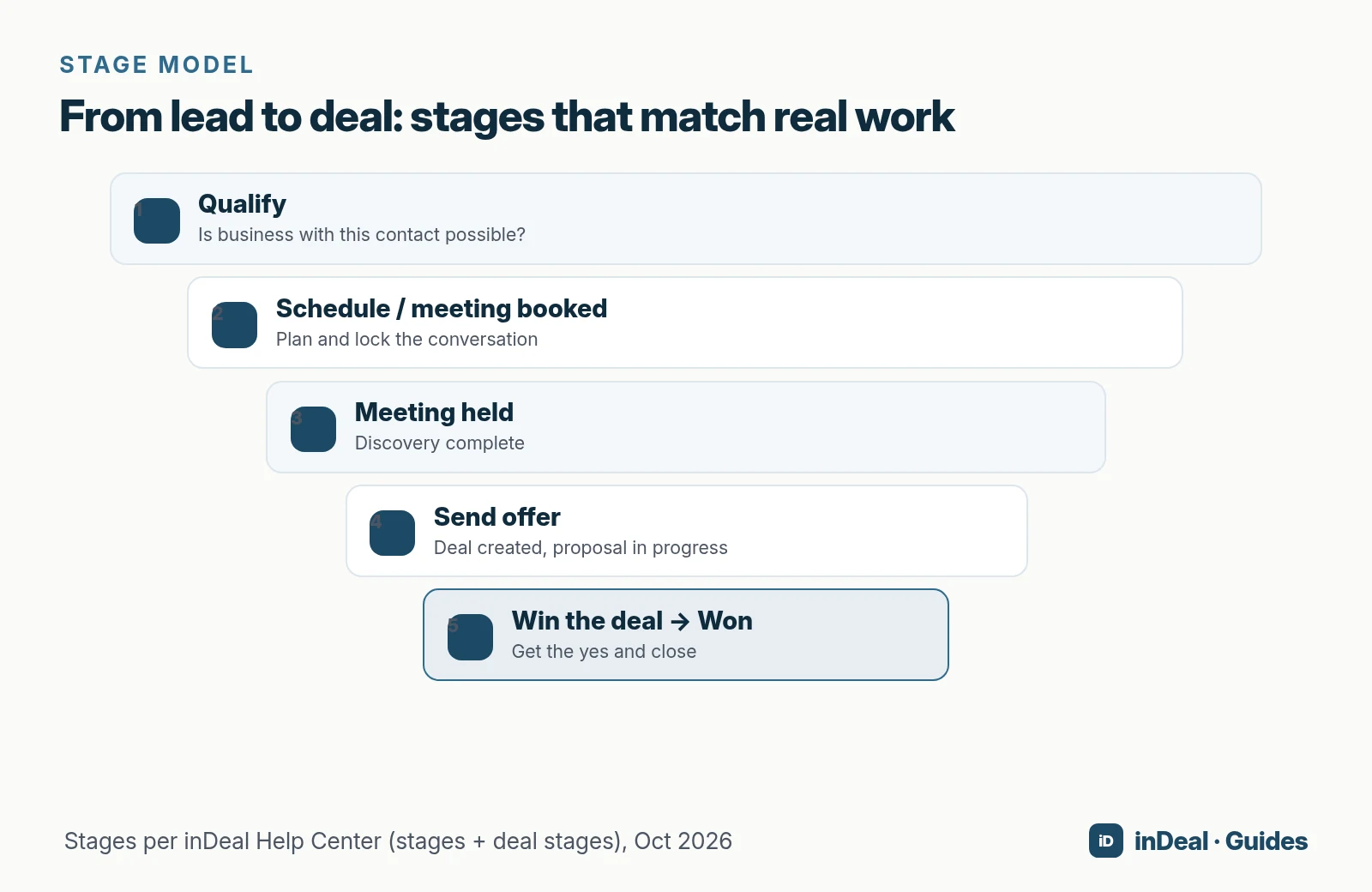
Fewer stages, clearer jobs. A model aligned with inDeal — real fields, not slideware:
Lead stages (discovery)
Per Setting stages correctly, there are six lead stages:
| Stage | Meaning for the funnel |
|---|---|
| Qualify | Is business with this contact possible? |
| Schedule meeting | Warm enough for a conversation |
| Meeting booked | Meeting set with a date |
| Meeting no-show | Meeting did not happen |
| Meeting held | Conversation done — discovery complete |
| Lead lost | Nothing will come from this contact |
Meeting no-show is not a step back to “schedule meeting.” The stage stays visible and keeps show rate honest. Resetting the stage cosmetics the meeting rate.
After meeting held, the path to a deal appears (“create offer”). The lead remains, but leaves Open leads because discovery work there is done.
Deal stages (closing)
Per Deal stages from offer to close (updated October 1, 2026):
| Stage | Meaning |
|---|---|
| Send offer | Deal created; offer in progress or on the way |
| Win the deal | Offer is with the customer — get the yes |
| Won | Business closed |
| Lost | No close |
Only the two open stages count in Open deals and forecast. Offer sent is its own date and the basis for deal conversion (offer → closed won) on Home — it is not set automatically on stage change.
How do you work conversion without invented benchmarks?
Web tables claiming “average 20% lead-to-opportunity” rarely fit your ICP, price, or cycle. What holds up is what your system counts over a clear window.
inDeal Home cards, per the Help Center:
- Lead conversion — lead → meeting booked
- Show rate — meeting → held
- Pipeline conversion — discovery → offer
- Deal conversion — offer → closed won
Each card shows the transition, the base count, and the change in percentage points vs. the prior period. The lowest number is your lever:
- Low lead conversion → outreach and qualification
- Low show rate → reminder before the meeting
- Low pipeline conversion → next step after the conversation is often missing
- Low deal conversion → price, timing, or follow-up on the offer
The OECD’s SME digitalisation for competitiveness lists maintenance/software cost and lack of training time among digitalisation barriers. That is why a simple stage model with discipline beats a complex model nobody maintains.
What is funnel hygiene — and why does the funnel tip without it?
Hygiene means the system status matches reality. Without it, Home becomes decoration.
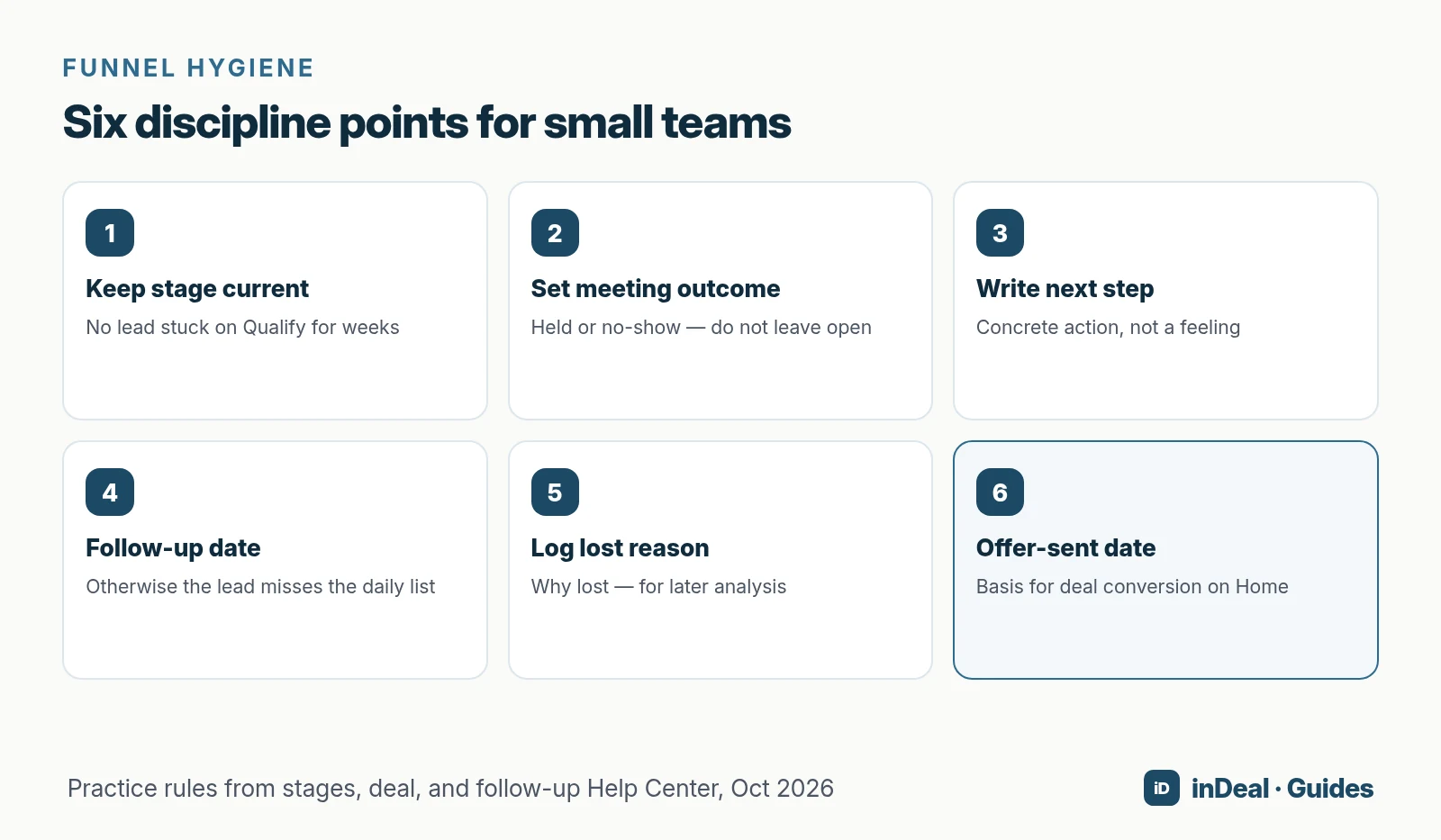
1. Keep the stage current
If a lead stays on Qualify too long, reporting treats it as untouched — even while you are calling. The Help Center lists this as a common mistake.
2. Set the meeting outcome
After the meeting: meeting held or meeting no-show. Leaving a past date on “meeting booked” delays show rate until you update.
3. Write a next step
“Interested” is not a next step. “Send demo agenda by Friday” is. The text sits on the lead and in reminder emails.
4. Set a follow-up date
Per Follow-up with reminder, the date decides whether the lead appears in work lists and metrics. Without a date, it misses daily work even if the database is full. See also Contact: your daily list. Deep dive: sales follow-up.
5. Log the lost reason
Lead lost and deal lost are not delete. The reason stays — and later explains the pattern. Deleting instead of losing kills the learning loop.
6. Do not forget the offer date
Deal conversion needs the offer sent field once the proposal really left. Otherwise the card measures incomplete data.
How does a free AI CRM support the funnel day to day?
inDeal (indeal.ai) is a free AI CRM for small businesses. Per indeal.ai, you work without a per-user price; credits apply to enrichment, not to running stages and follow-ups. Servers in Frankfurt / EU; provider Lars Krüger GmbH, Berlin.
Relevant for the funnel:
- Lead and deal stages as a shared language
- Follow-up with optional email reminder including next-step text
- Home with conversion funnel and business results (Understanding Home)
- AI assistants via MCP for queries and updates without switching apps — see connect CRM to ChatGPT and Claude and the pillar AI CRM for small business
A free CRM for your whole team. Start inDeal in 2 minutes. Just an email address, no credit card, unlimited users.
Start freeOther free plans often hit hard limits — orientation without competitor links: free CRM limits. Free CRM overview: free CRM for small business.
How do you build the funnel in week one?
A pragmatic 7-day path for teams of 1–5 sellers:
- Nail the stages — lead and deal stages as above; no “maybe later” columns.
- Triage the backlog — hot contacts get a date and next step; cold ones archive or lead lost with a reason.
- Daily ritual — mornings: due follow-ups; evenings: catch up stages.
- Meeting rule — every no-show becomes no-show, not a silent reset.
- Offer rule — create the deal after meeting held; set offer-sent on send.
- Weekly review — pick the lowest of the four conversion cards and one action.
- Keep training short — OECD flags training time as a barrier; 45 minutes on the real kanban beats a wiki.
If you import from Excel, set follow-up dates on import day — or leads stay invisible in Open leads. Spreadsheet limits: manage leads in spreadsheets.
Typical funnel mistakes in small teams
| Mistake | Effect | Better practice |
|---|---|---|
| Too many phases | Nobody maintains them | 6 lead + 4 deal stages |
| Stuck on Qualify | Wrong Home numbers | Move after first real contact |
| Meeting without outcome | Show rate delayed | Held / no-show same day |
| Next step without date | No daily list | Set date + reminder |
| Delete instead of lost | No learning | Choose a lost reason |
| Offer without date | Deal conversion unclear | Maintain “offer sent” |
| Excel beside the pipeline | Two truths | One system of record |
How do you read the four conversion cards correctly?
Home cards cover the last 30 days. Bottom-right shows change vs. the prior period in percentage points. Cards are clickable into the underlying records — useful when a rate suddenly drops.
Show rate in detail
Show rate counts meetings through yesterday (German time). Today and future meetings do not count yet. Only meetings with a fixed outcome count: held (meeting held or a deal was created) or no-show. Missing meeting dates can be backfilled; then the meeting counts.
A past meeting still on “meeting booked” waits for your update. Leads moved to lead lost after a held meeting still count as held — the conversation was real. Prior-period comparison needs at least three meetings in that prior window.
Business results beside the funnel
Below the funnel sit monthly figures: sales cycle (avg lead → closed won), closed won this month, new customers, and total customers. Closed won and new customers reset on the first of the month — not data loss. For sales cycle, lower is better; a rising value is marked as worse.
Funnel (30 days) and business results (calendar month) can point different ways early in the month and both be correct. Align review windows — or comment the gap on purpose.
How do you connect funnel stages to daily work?
A funnel without a daily list is a slide. The Contact list and follow-up date are the operating layer:
- Morning: Only due leads — not the whole database.
- In the call: Note in the timeline, not status alone.
- Right after: Stage + next step + new date.
- Reminder: Optional time + email with lead data and next-step text.
- On the deal: Same calendar — the email also includes deal value and stage.
If the follow-up date changes via stage change, bulk edit, or workflow, inDeal removes a set reminder. Otherwise it would fire for a time that no longer exists. Want another reminder? Set it again.
Role note: with the Sales role, Home shows only your own leads and deals — team reviews need the right view or a ritual owner.
Funnel focus for agencies, IT services, and industrial sales
Same stage logic, different bottlenecks:
| Context | Typical bottleneck | Funnel focus |
|---|---|---|
| Agency / consulting | Meetings without briefing follow-up | Pipeline conversion after discovery |
| IT services | Long evaluation, many stakeholders | Next step with named buyer |
| Industrial / machinery | Few large deals | Deal stages + confidence + offer date |
| Solo founder | Forgotten follow-ups | Reminder + short stages |
ICP clarity comes before funnel design: if Qualify swallows everything, the Ideal Customer Profile is often fuzzy — not the column count. AI and ICP: AI CRM for small business.
Checklist: funnel review every 14 days
Take 30 minutes with the team (or yourself):
- Name the lowest of the four conversion cards
- Five random “meeting booked” leads: date and outcome correct?
- Five open deals: next step younger than seven days?
- Lost reasons last two weeks: any pattern?
- Parallel Excel or chat lists turned off or archived?
- One concrete action for the next 14 days decided
Without the last line, the review is a meeting. With an action, it becomes part of the funnel.
Data quality: what you should not invent
Three temptations — and why to skip them:
- Industry conversion rates from the web without a study that states method, year, and sample.
- “We have 30% show rate, so we are good” without a prior period and a clear definition of what counts.
- Competitor contact or price caps from memory — without a neutral source, and without sneaking competitor hyperlinks.
Useful and allowed: Eurostat on CRM adoption, EU SME definition, SBA size standards for U.S. context, OECD on digitalisation barriers, and your own system numbers from inDeal. Product facts only from indeal.ai and success.indeal.ai.
From lead funnel to revenue: one example day
9:00 a.m. — Contact list: eight due leads. Three reached, two voicemail, three rescheduled with a new date and a note.
11:30 a.m. — Meeting held with Muster GmbH. Change stage, next step “draft offer by tomorrow 12:00,” follow-up tomorrow. Create offer when you open the deal.
3:00 p.m. — Offer goes out. Move the deal toward win-the-deal when it sits with the customer; set offer sent; check confidence and deal value.
5:30 p.m. — Two dead contacts to lead lost with reason “no budget Q4.” No delete.
Friday 10:00 a.m. — Home: show rate −4 pp vs. prior period. Action: reminder 24 hours before meetings (process, not magic).
That is funnel control without dashboard theater.
When should you deliberately slim the funnel?
More columns feel like control — and often create the opposite. Slim down when:
- the same person skips three stages in a day because the middle is empty;
- new teammates cannot explain the model in ten minutes;
- Home cards and gut feel diverge because stages are “cosmetic”;
- parallel shadow lists (Excel, Notion, chat) are the “real” pipeline.
Then return to work-sized stages, next-step discipline, and a 14-day review. A slim funnel in a free CRM for small business beats a complex model nobody maintains — especially when, per Eurostat, most small firms still work without CRM.
Which sales funnel fits you?
- Solo, clear ICP, few parallel deals: Slim funnel Qualify → meeting → deal stages; next-step discipline is enough.
- Two to five sellers, mixed cycles: Shared stages, read Home cards weekly, lost reasons required.
- Team wants free seats, EU data, optional AI assistant: Then inDeal fits as a free AI CRM for small businesses — funnel and pipeline in one system.
A free CRM for your whole team. Start inDeal in 2 minutes. Just an email address, no credit card, unlimited users.
Start freeKeep reading
- Free CRM for small business: which free CRM fits you?
- AI CRM for small business: what CRM with AI can really do in 2026
- Sales follow-up: next step instead of forgotten leads
- Manage leads in spreadsheets: when the sheet is enough
- Free CRM limits 2026: checklist for small businesses
Frequently asked questions
What is a sales funnel for a small business?
What is the difference between funnel and pipeline?
Which funnel stages does a small B2B team need?
What conversion rate is normal in a B2B funnel?
How does inDeal help with the sales funnel?
Is Excel enough as a sales funnel?
What is funnel hygiene?
Is inDeal the same as indeal.io?
Sources
- E-business integration (Statistics Explained)
- Larger enterprises used more e-business apps in 2025
- SME definition
- Size standards
- SME digitalisation for competitiveness
- inDeal: homepage, pricing, and FAQ
- Setting stages correctly
- Deal stages from offer to close
- Conversion funnel and business results
- Follow-up with reminder
- Contact: your daily list
- Understanding Home
Keep reading
 Sales and follow-up
Sales Follow-Up: How Often and Why Every Deal Needs a Next Step
Sales follow-up for small businesses: cadence without invented close rates, why every deal needs a dated next step, and how inDeal's Contact list keeps work visible.
 AI CRM
Connect CRM to ChatGPT & Claude (MCP)
Connect your CRM to ChatGPT, Claude, and Cursor: what MCP is, setup steps, what the assistant can and cannot delete, security, and GDPR orientation.
 Leads and enrichment
Manage Leads in Spreadsheets: When Excel Is Enough
Manage leads in a spreadsheet: when Excel works, five limits (history, follow-up, multi-user, enrichment, GDPR), a column template, and CSV import into inDeal.