Contents
- What is lead nurturing?
- Why is lead nurturing worth it for small businesses?
- Which leads should you nurture?
- What are the legal rules for lead nurturing?
- How do you build a lead nurturing process in 6 steps?
- What content and channels work for lead nurturing?
- How long does lead nurturing take?
- How do you run lead nurturing in inDeal?
- What lead nurturing mistakes should you avoid?
- Which nurturing approach fits your team?
- Keep reading
- Frequently asked questions
- Sources
Lead nurturing means keeping leads who fit your business but aren't ready to buy warm on purpose: with a date for the next touchpoint, useful content in a permitted channel and regular requalification. That way a "not now" doesn't end up in the trash; it comes back at the right time. inDeal (indeal.ai) is a free AI CRM for small businesses made by Lars Krüger GmbH, Berlin. Not to be confused with indeal.io, a different company.
As of November 16, 2026. Research: Järvinen & Taiminen 2016, Terho et al. 2022, Sabnis et al. 2013; law: FTC CAN-SPAM guide, GDPR, German UWG; market: Eurostat 2025; product: success.indeal.ai and indeal.ai. Examples are made up.
What is lead nurturing?
Lead nurturing is the planned support of prospects who aren't ready to buy yet. Instead of forgetting them or pushing them, you stay in the conversation with relevant information until need and timing line up.
Research describes it the same way: lead nurturing is a relationship-building approach that supports the buying process with relevant information until the prospect is ready for sales (Järvinen & Taiminen, 2016). The case study also shows content being chosen based on the contact's profile and behavior.
To see where nurturing fits in the bigger picture, read Sales Funnel for Small Business. Key terms:
| Term | Meaning | Example |
|---|---|---|
| Lead nurturing | Planned touchpoints over weeks or months | Four touchpoints in 90 days |
| Follow-up | A single next step with a date | "Call on Thursday" |
| Requalification | Checking whether need and timing fit now | Asking about the spring budget |
| Consent | The contact agrees to marketing in a channel | Newsletter signup with confirmation |
| Opt-out | The contact doesn't want marketing anymore | "Please stop emailing me" |
| Loss reason | Why a lead is closed on purpose | "No need" |
Why is lead nurturing worth it for small businesses?
Because most leads don't buy right away, and without a plan they just sit there. Nurturing turns "later" into a date on the calendar instead of a gap in your list.
A study of 461 sales reps describes the "sales lead black hole": roughly 70% of leads generated by marketing aren't pursued by sales (Sabnis et al., 2013). One reason is limited time. According to the authors, whether leads get worked also depends on whether management tracks follow-up.
A qualitative study with 13 interviews at eight B2B firms reaches a similar conclusion: research and nurture processes prepare customers for meaningful conversations with field sales (Terho, Salonen & Yrjänen, 2022).
Many small companies don't have a system for this yet: only 24.69% of small enterprises in the EU used CRM software in 2025 (Eurostat, 2025). Without a CRM, the one thing usually missing is the date on which a lead should resurface.
Which leads should you nurture?
Only leads that match your ideal customer, have no concrete trigger right now and haven't opted out. Everyone else either goes straight to sales or gets closed on purpose.
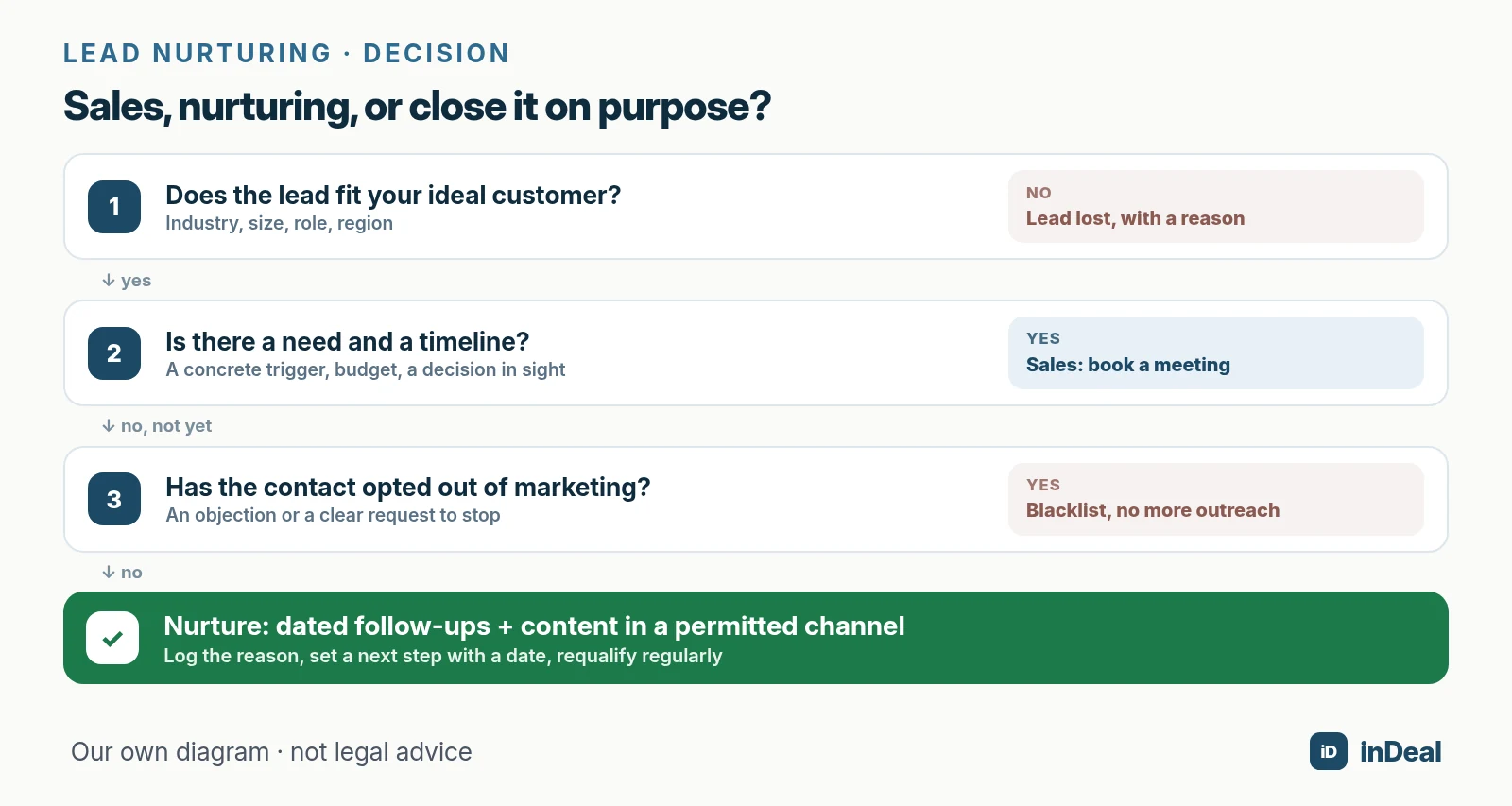
- Does the lead fit? Check industry, size, role and region against your ideal customer profile. If not, close it with a reason.
- Is there a need and a timeline? If yes, it belongs in sales: book a meeting. How to check this properly is covered in Lead Qualification with BANT.
- Has the contact opted out? Then no more outreach; add them to your blacklist.
A lead that fits, has no current trigger and hasn't opted out is a nurturing case. Typical signals: "No budget until next year," "We're locked into a contract" or "Get back to me after the trade show."
What are the legal rules for lead nurturing?
It depends on the channel and on where your contact is. In the US, CAN-SPAM sets the rules for commercial email. For contacts in the EU, the GDPR applies, and in Germany the stricter Act against Unfair Competition (UWG) as well.
| Channel or situation | Rule | Source |
|---|---|---|
| Marketing email (US) | No B2B exception; accurate headers, physical postal address, clear opt-out | FTC CAN-SPAM guide |
| Opt-out request (US) | Must be honored within 10 business days | FTC CAN-SPAM guide |
| Marketing email to contacts in Germany | Prior express consent required, even for businesses | UWG Section 7(2) |
| Existing customers in Germany | Email without consent only under four conditions | UWG Section 7(3) |
| Objection to direct marketing (EU) | Data may no longer be processed for that purpose | GDPR Art. 21 |
| Proof of consent (EU) | The controller must be able to demonstrate it | GDPR Art. 7(1) |
The FTC is explicit: "The law makes no exception for business-to-business email." Your messages must not use misleading headers, must include a valid physical postal address and must explain clearly how to opt out (FTC). Opt-outs have to be honored within 10 business days.
If you also email contacts in the EU, the bar is higher. Germany's UWG treats email marketing without prior express consent as an "unacceptable nuisance", including to businesses, with a narrow exception for existing customers (UWG, English translation). Under the GDPR, a contact can object to direct marketing at any time, and you must be able to prove any consent you rely on (GDPR).
In practice: for US contacts, every nurture email needs a working opt-out and your address. For contacts in Germany, nurture emails only go to people who agreed; otherwise you rely on calls with a legitimate reason and personal conversations. For a deeper look at first-touch outreach, see B2B Cold Outreach and the GDPR.
How do you build a lead nurturing process in 6 steps?
With six steps you define once and then apply the same way to every lead. The most important one is the first: write down the reason for "later."
- Log the reason: Why isn't the lead buying now? Budget, contract, wrong contact or timing.
- Check the channel: Where is the contact, and do you have consent for email where it's required? If not, plan calls and conversations.
- Set a dated next step: Every nurtured lead needs a follow-up date, or it never shows up again.
- Match content to the reason: A lead waiting on budget needs a cost example; one locked into a contract needs a switching case study.
- Requalify: At every touchpoint, check briefly whether need or timing has changed.
- Decide honestly: After a few rounds with no movement, close the lead on purpose instead of dragging it along forever.
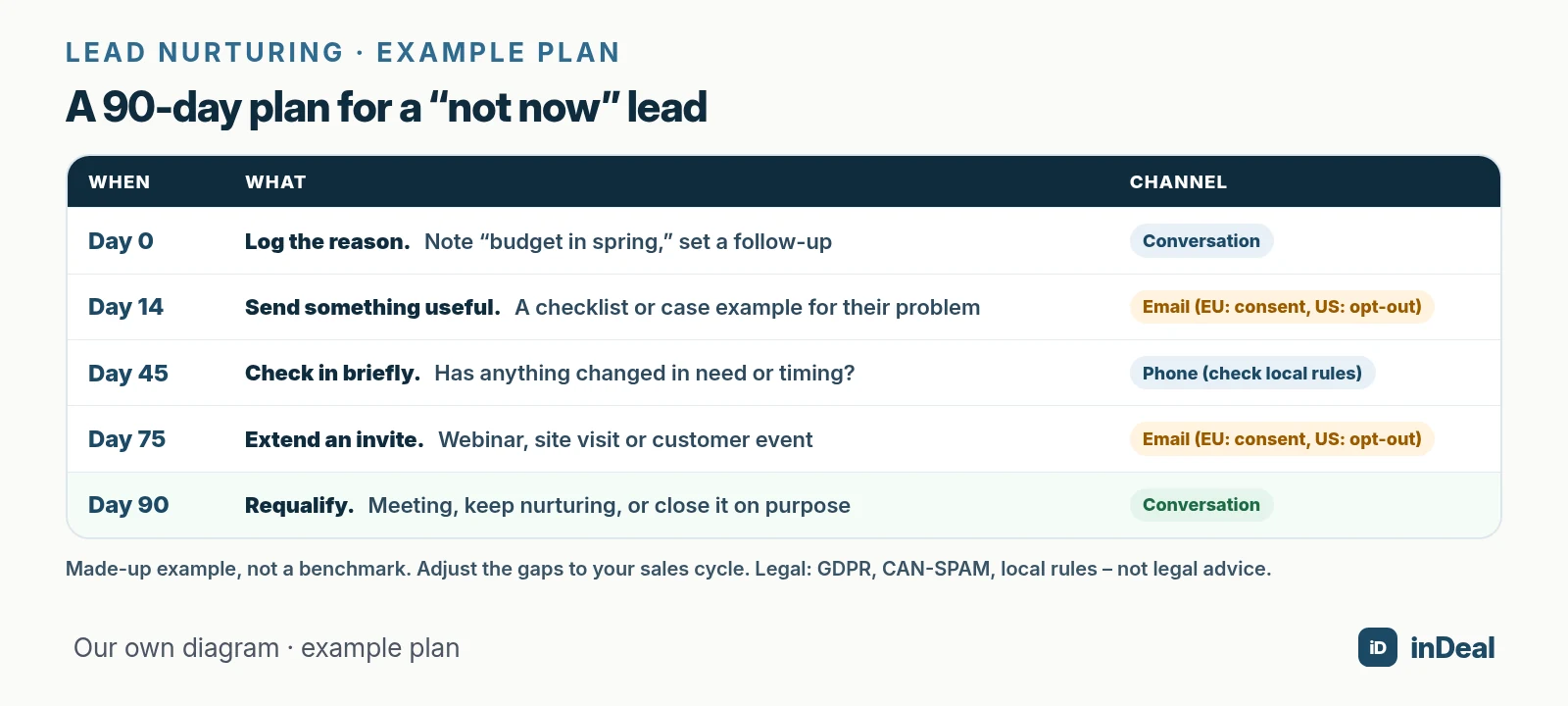
Here's what that plan could look like for a lead with "budget only in spring":
What content and channels work for lead nurturing?
Content that solves a specific problem the lead has, in channels you're allowed to use. A sales brochure isn't nurturing; a checklist for the exact question they raised in your last call is.
| Reason for "later" | Matching content | Channel without email consent |
|---|---|---|
| No budget until next year | Cost example, ROI comparison | Short call before budget planning |
| Locked into a vendor contract | Switching case study, checklist | Meeting timed to the contract end |
| Wrong contact | Short summary they can forward | Ask for the right person during a call |
| Project postponed | Prep guide | Call at the new start date |
| Interested, but not a priority | Webinar or customer event invite | Personal invite during a conversation |
The right-hand column matters mainly for contacts in Germany and other countries with consent rules. Even calls aren't a free pass there: in Germany, a marketing call to a business needs at least presumed consent, meaning a factual reason to assume the call is welcome. A contact who already spoke with you and asked to be contacted later usually provides that reason.
How long does lead nurturing take?
As long as the reason for "later" lasts. If a lead says "after spring," your plan follows spring, not a fixed template.
There's no reliable average from neutral sources. The sample plan above uses 90 days because that's a manageable span for many B2B decisions. That's an assumption, not a benchmark.
More important than the length is the rhythm: every nurtured lead has a date for the next touchpoint and a date for the next requalification. What a good next step looks like is covered in Sales Follow-Up.
How do you run lead nurturing in inDeal?
inDeal has no automated email sequences. Nurturing runs on follow-up dates, reminders, templates and saved views. That's deliberately simple, and it keeps you from sending unsolicited marketing email in markets where consent is required.
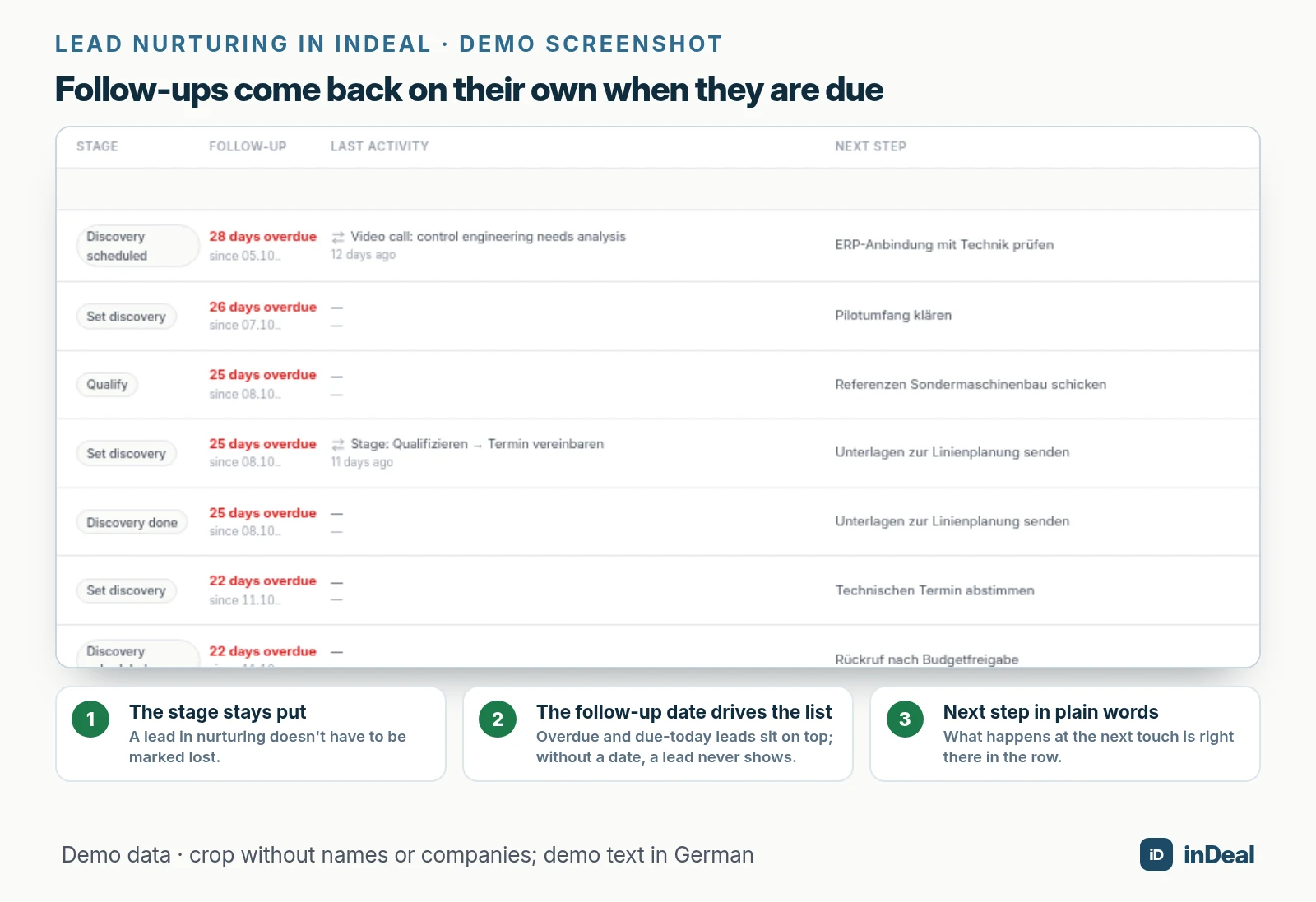
- Keep the stage, set a date: A nurtured lead stays on its stage, for example "Set discovery," and gets a follow-up date. Without a date, according to the Help Center, it disappears from your work list (Setting stages correctly).
- Add a reminder: On the follow-up date you can pick a time in 15-minute steps. At that time you get an email with phone, email address, next step and a button that opens the lead (Follow-up with reminder).
- Work your daily list: On Home under Contact you see overdue, due-today and new leads. A lead only leaves the list when you set a new next step with a date (Contact: your daily list).
- Templates for recurring emails: With a connected mailbox you create templates with variables like first name and share them with everyone, with roles or privately (Email templates). Only use them where you have a legal basis.
- A "Nurturing" view: An admin can add a dropdown field such as "Nurture reason" and a filtered, saved view for it (Practical examples).
- Respect opt-outs: Anyone who doesn't want contact goes on the blacklist. According to the Help Center, blocked people and companies are not created, not shown and not contacted (Managing the blacklist).
What if the lead replies? According to the Help Center, four built-in system workflows react to classified replies (What workflows do). If a lead on "Qualify" replies positively, it moves to "Set discovery" with a follow-up date of today; if it replies negatively there, it's set to lost (The four workflows). The workflows never send messages to contacts.
What lead nurturing mistakes should you avoid?
Most mistakes come from too much automation or too little planning. These five are typical:
- Ignoring the rules: The newsletter goes to every contact in your CRM, with no opt-out link or, for German contacts, no consent.
- Leads without a date: "I'll reach out in spring" without a follow-up date means you never will.
- Same content for everyone: A lead waiting on budget needs something different from one locked into a contract.
- No end point: Leads sit in nurturing for years even though nothing ever moves.
- Missed opt-outs: A "please stop" ends up in a note instead of on the blacklist.
Which nurturing approach fits your team?
Start with the smallest plan your team will actually stick to: log the reason, set a date, requalify regularly. Content and templates come once the rhythm is in place.
| Situation | Recommendation |
|---|---|
| Few leads, one salesperson | Follow-up date with reminder, reason in the Next step field |
| Several salespeople | A "Nurture reason" field plus a saved view, clear ownership |
| Contacts who subscribed to your newsletter | Templates with variables for recurring content |
| Contacts in Germany without consent | Calls with a reason and personal conversations, no marketing email |
| No need after several rounds | Close the lead with a reason |
| Contact opted out | Blacklist |
Nurturing is one building block of lead management and only works with a clean pipeline; see How to Set Up a Sales Pipeline. The full process is laid out in the perfect CRM sales process. How an AI CRM takes routine work off small teams is covered in AI CRM for Small Business, and your free options are in Free CRM for Small Business.
A free CRM for your whole team. Start inDeal in 2 minutes. Just an email address, no credit card to sign up, unlimited users.
Start freeKeep reading
- Lead Management for Small Business
- Sales Funnel for Small Business
- B2B Cold Outreach and the GDPR
- Lead Qualification with BANT
- Sales Follow-Up: Never Without a Next Step
Frequently asked questions
What is lead nurturing in simple terms?
How long should lead nurturing take?
Can I send B2B nurture emails without consent?
Do I need double opt-in?
What's the difference between lead nurturing and a follow-up?
Can inDeal send automated nurture email sequences?
When should I close a lead instead of nurturing it?
Is inDeal the same as indeal.io?
Sources
- Harnessing marketing automation for B2B content marketing (Industrial Marketing Management 54)
- Toward a contextualized understanding of inside sales: the role of sales development in effective lead funnel management (JBIM 38(2))
- The Sales Lead Black Hole: On Sales Reps' Follow-Up of Marketing Leads (Journal of Marketing 77(1))
- E-business integration
- CAN-SPAM Act: A Compliance Guide for Business
- Regulation (EU) 2016/679 (GDPR), Articles 6, 7 and 21
- Act against Unfair Competition (UWG), English translation, Section 7
- Setting stages correctly
- Follow-up with reminder
- Email templates
- What workflows do
- The four workflows in detail
- Managing the blacklist
- Practical examples for filters and views
- Contact: your daily list
- inDeal: homepage, pricing and FAQ
inDeal is the AI CRM for small and mid-sized B2B companies.
Keep reading
 Sales and follow-up
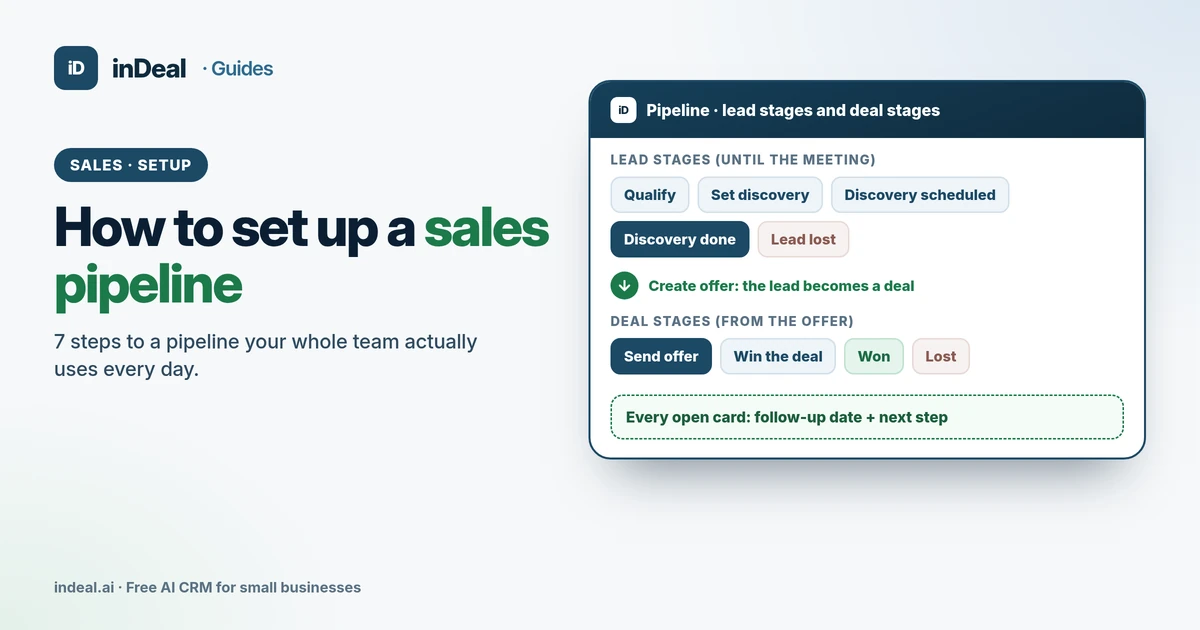
How to Set Up a Sales Pipeline in 7 Steps (Small Business 2026)
How to set up a sales pipeline your team actually uses: 7 steps from stages and required fields to roles, import and a weekly review – in a free AI CRM.
 Sales and follow-up
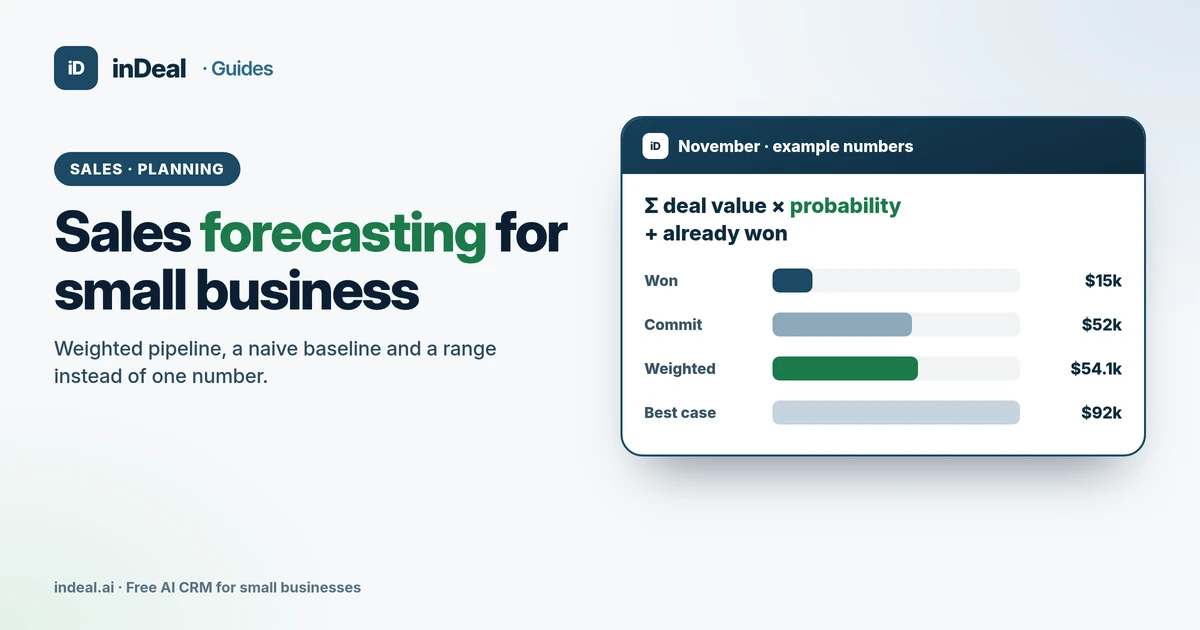
Sales Forecasting for Small Business: Methods + Example (2026)
How to forecast sales for a small business: weighted pipeline, a naive baseline, ranges instead of one number, and how to measure forecast error – free CRM.
 Sales and follow-up
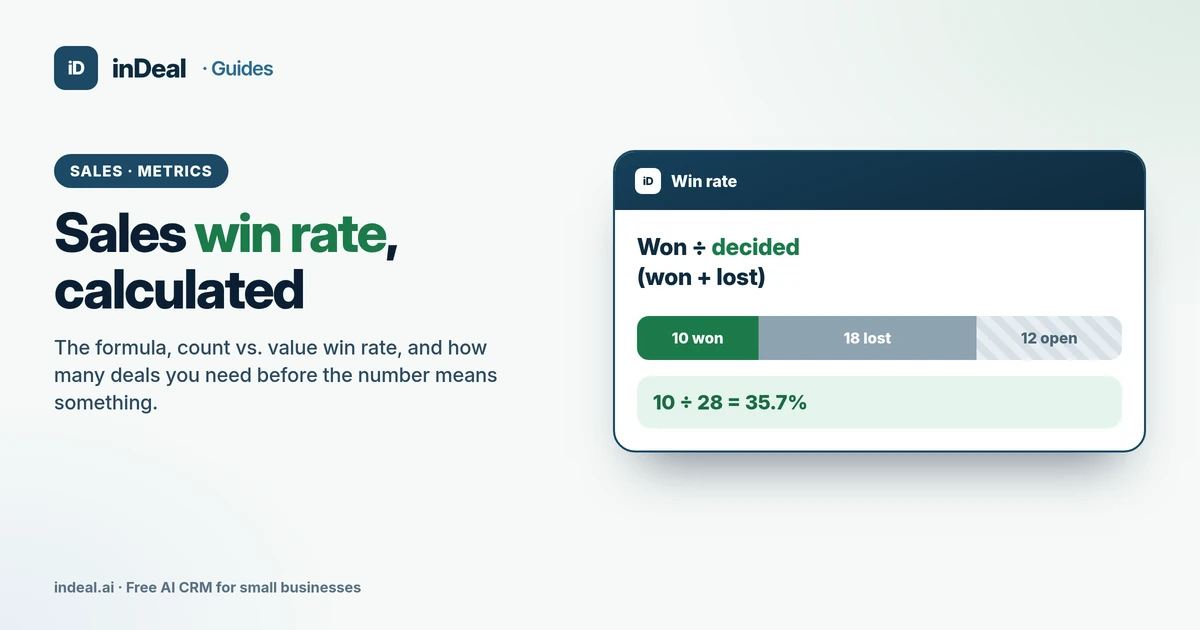
Sales Win Rate 2026: How to Calculate It (Formula + Examples)
How to calculate sales win rate: the formula, count vs. value win rate, which deals count and when the number is reliable, with a free CRM for small businesses.