Contents
- What is an ideal customer profile (ICP)?
- What is the difference between an ICP, a buyer persona and a target audience?
- Why are industry and size not enough for an ICP?
- What goes into an ICP?
- How do you create an ICP in 7 steps?
- Which company size should your ICP name?
- Who belongs in the contacts section of an ICP?
- How do you set up your ICP in inDeal?
- How do you use the ICP in daily sales work?
- How do you keep your ICP up to date?
- What mistakes do small businesses make with their ICP?
- What does an example ICP look like?
- Which ICP fits you?
- Keep reading
- Frequently asked questions
- Sources
You create an ideal customer profile (ICP) by looking at your best customers, spotting what they share in industry, size, region and contacts, and writing it down on one page. The ICP is your filter before the first conversation. inDeal (indeal.ai) is a free AI CRM for small businesses by Lars Krüger GmbH in Berlin, and it suggests an ICP from your website. Not to be confused with indeal.io, a different company.
As of November 9, 2026. Research: Journal of Marketing; data: Eurostat, European Commission, SBA; product: success.indeal.ai and indeal.ai.
What is an ideal customer profile (ICP)?
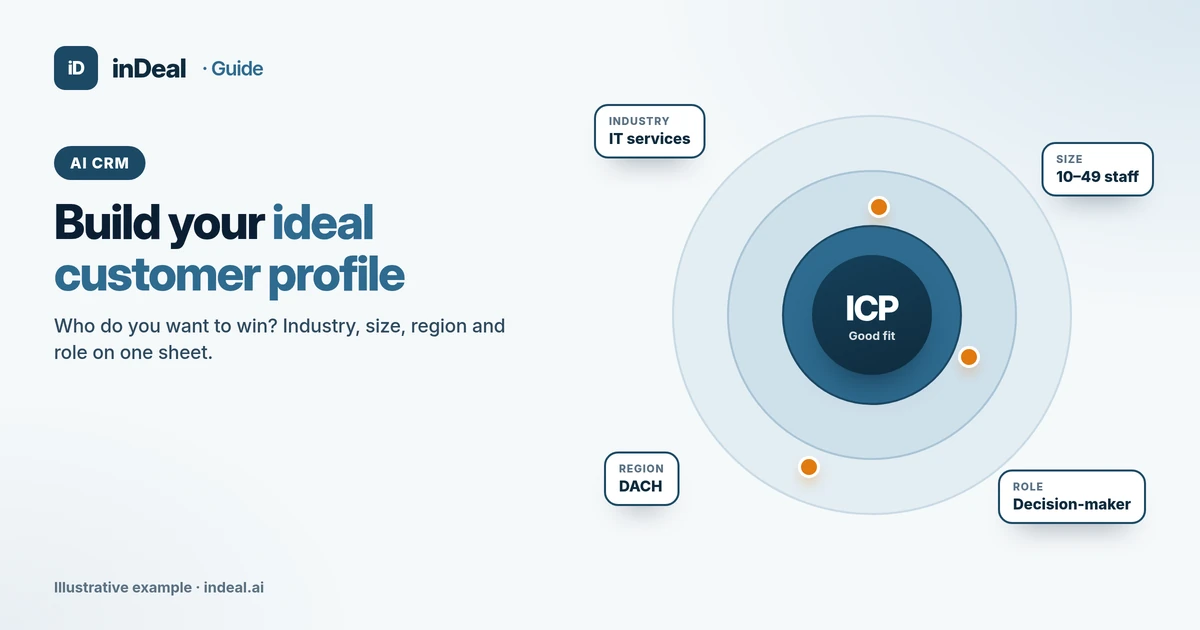
An ICP is the description of the company your offer works best for and that is worth serving for you. It names industry, size, region, the typical problem and the roles you talk to.
The profile is about companies, not individuals. It answers one question before every contact: “Does this company fit us?” Without an ICP, everyone on the team decides by gut feeling, and the pipeline fills with contacts that will never buy.
Small businesses benefit most because time is the scarcest resource. How the ICP fits into the whole process is covered in the pillar guide Lead management for small businesses.
What is the difference between an ICP, a buyer persona and a target audience?
The ICP describes the company, the buyer persona describes the person inside it, and the target audience describes the larger market. They belong together but answer different questions.
| Term | Refers to | Typical question | Example |
|---|---|---|---|
| Target audience | The whole market | Whom could I reach in theory? | Mid-sized manufacturers in the U.S. and Europe |
| ICP | A company | Which companies fit best? | Manufacturers with 50–249 staff that want to digitize sales |
| Buyer persona | A person | How does this role think and decide? | Head of sales who needs visibility into closed deals |
| Contact type | A role in the purchase | Who decides, who pushes, who advises? | Economic buyer, champion, influencer |
Start with the ICP. Then add a short persona per role.
Why are industry and size not enough for an ICP?
Because two companies in the same industry and of the same size can buy very differently. Rangan, Moriarty and Swartz put it this way in the Journal of Marketing in 1992: in mature industrial markets, segmenting customers on size, industry or product benefits alone is rarely sufficient. Buying behavior, such as the trade-off between price and service, matters as well (Rangan et al., 1992).
For your ICP this means: next to firmographics, add a typical problem and a typical trigger. The inDeal ICP reflects that. It holds industries, size and regions, but also your offer, the problem of your target customers and your solution.
Example: two agencies with 20 people each sit in the same city. One buys on lowest price, the other pays more for a fixed contact person. Same firm profile, two buying behaviors.
What goes into an ICP?
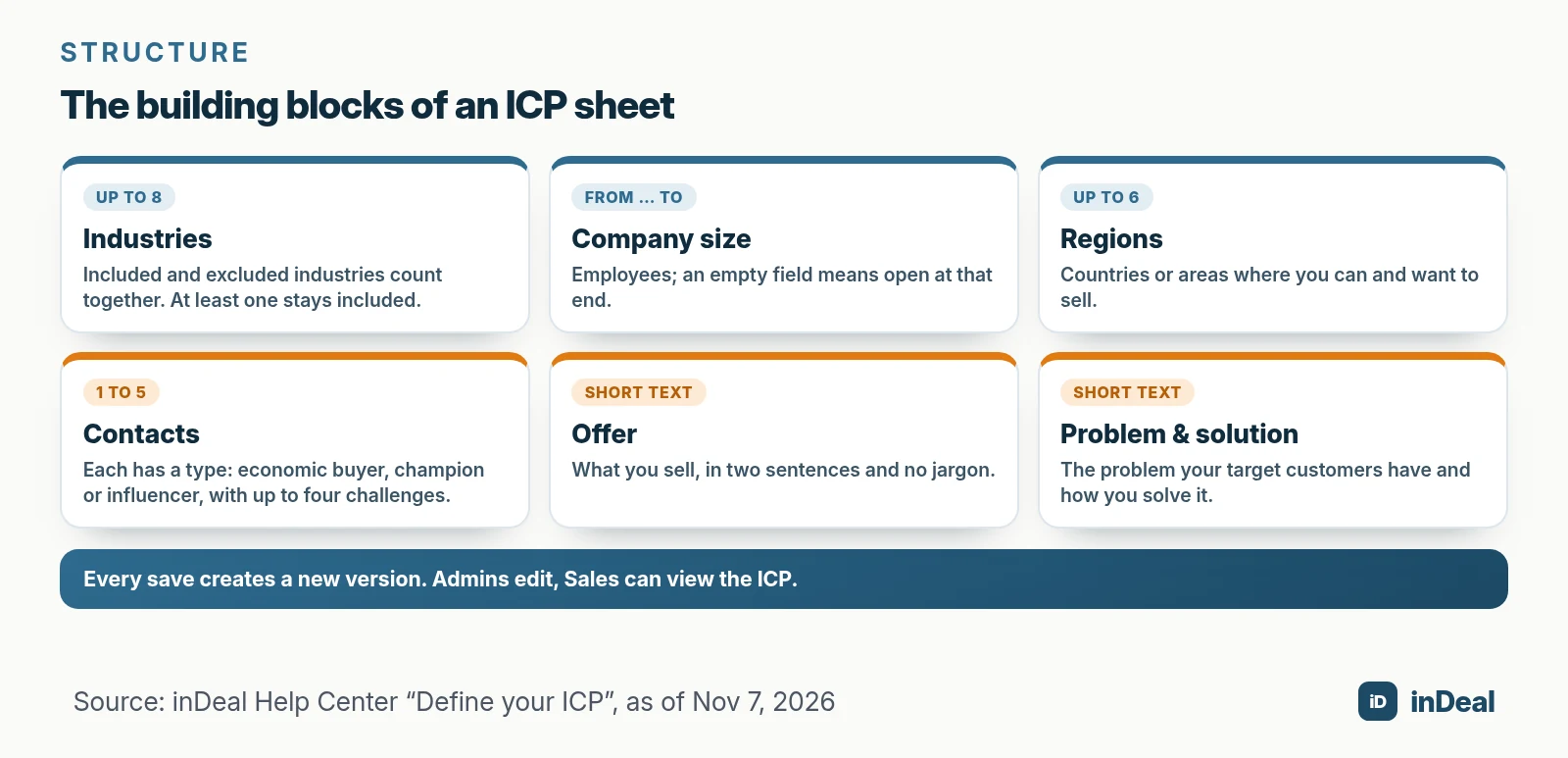
A usable ICP has six building blocks. Each answers a question your team would otherwise answer differently.
| Building block | Guiding question | Example (fictional) | Limit in inDeal |
|---|---|---|---|
| Industries | Where does it work best? | Machinery, control engineering | up to 8 (included and excluded together) |
| Company size | How big are fitting companies? | 50 to 249 employees | from / to, open ends possible |
| Regions | Where do you sell? | U.S., Germany, UK | up to 6 |
| Contacts | Whom do you talk to? | CEO, head of sales | 1 to 5, each with role, type and up to 4 challenges |
| Offer | What do you sell? | Sales process consulting | short text |
| Problem and solution | Which problem do you solve? | Leads go stale without follow-up | short text |
Think of industries as economic sectors. In the U.S., the standard system is NAICS from the Census Bureau (U.S. Census Bureau); the EU uses NACE. A code is not required, but it helps when customers and data sources use different names for the same industry.
How do you create an ICP in 7 steps?
You do not need a workshop, just an hour with your real customer data. Work in this order.
- Pick your best customers. For example, your five to ten best: high revenue, little effort, long relationship, good referrals.
- Note what they share. Industry, size, region, trigger for the purchase, problem before the purchase. Anything three or more of them share goes on the draft list.
- Cross-check with lost deals. Look for prospects who looked similar but did not buy. What sets them apart? That is part of the profile too. How to record reasons is covered in Lead management for small businesses.
- Name the buying roles. Who decides, who pushes internally, who advises? More on that in the buying center section below.
- Define exclusions. Which industries, sizes or regions do you deliberately not want? An exclusion saves more time than any additional target industry.
- Fit it on one page. At most five industries, one size range, a few regions, two or three roles, three sentences on offer, problem and solution.
- Test with real data. After four to six weeks: which leads fit, which did not? Adjust the profile and keep the version.
If you have no customers yet or too little data, start with the website analysis in inDeal and sharpen the suggestion by hand.
Which company size should your ICP name?
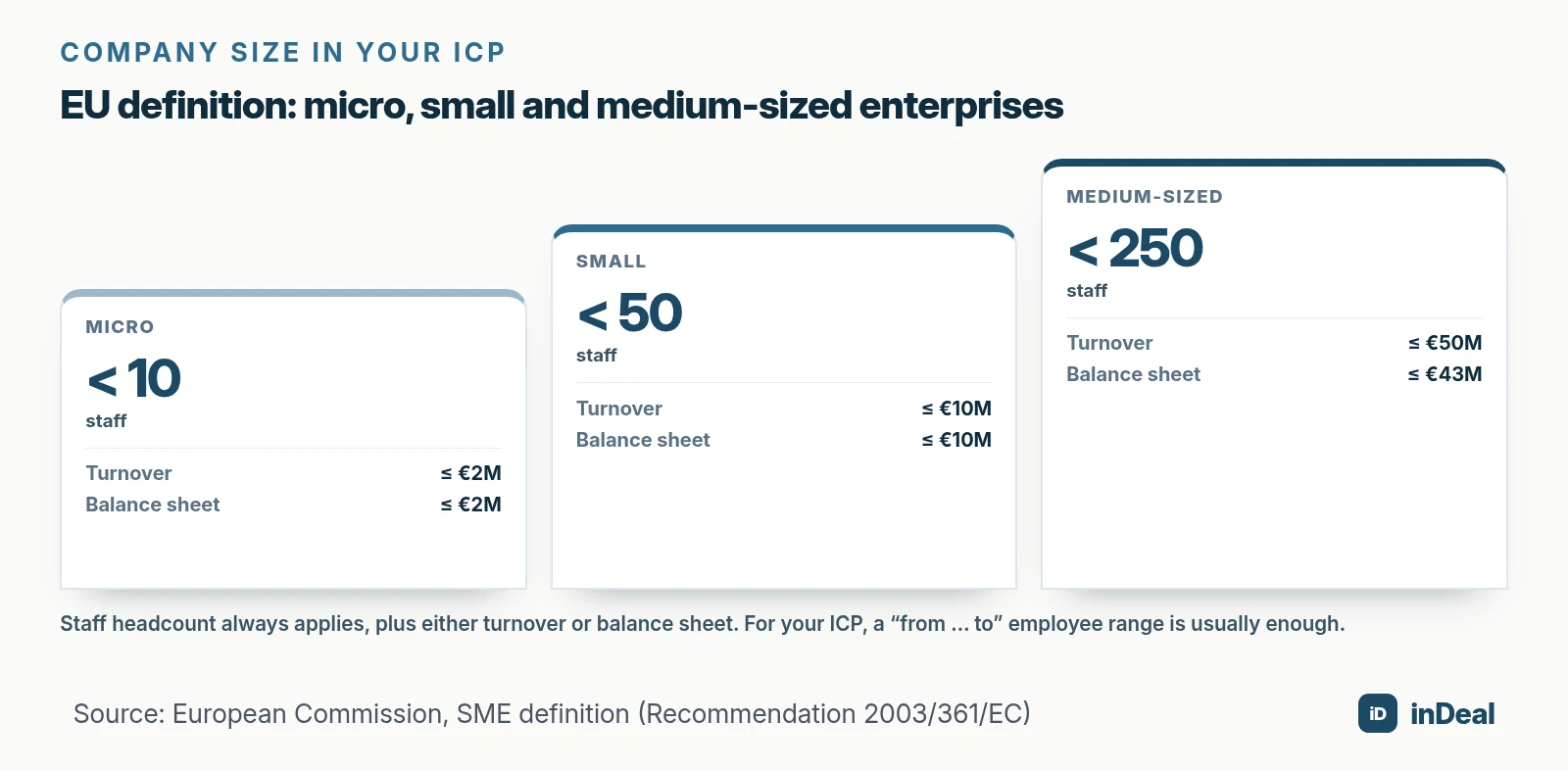
Give a range in employees, not a wish number. The EU definition is a handy grid: micro enterprises have fewer than 10 staff, small ones fewer than 50, medium-sized ones fewer than 250. On top come ceilings for turnover or balance sheet total (European Commission).
| Class | Staff | Turnover | Balance sheet total |
|---|---|---|---|
| Micro | under 10 | up to €2 million | up to €2 million |
| Small | under 50 | up to €10 million | up to €10 million |
| Medium-sized | under 250 | up to €50 million | up to €43 million |
In the U.S., the Small Business Administration works differently: it assigns a size standard to each NAICS code. Most manufacturing companies with 500 employees or fewer, and most non-manufacturing businesses with average annual receipts under $7.5 million, qualify as small, with exceptions by industry (SBA). They exist for government contracting, so treat them as a reference, not as your ICP.
Size also shapes how you sell. In 2025, Eurostat counts only 24.69% of small EU enterprises (10 to 49 employees) as CRM users, against 65.43% of large ones (Eurostat). If you sell to firms of that size, you often meet spreadsheets instead of a CRM.
Who belongs in the contacts section of an ICP?
Rarely does one person decide a business purchase alone. Webster and Wind described a buying center with five roles in 1972: users, buyers, influencers, deciders and gatekeepers. Several people can hold the same role, and one person can hold several roles (Webster & Wind, 1972).
Johnston and Bonoma examined the composition of such buying groups in 31 firms in 1981. They found that organizational structure and purchase situation relate to the characteristics of the group (Johnston & Bonoma, 1981). For you this means: the bigger and more complex the purchase, the more people are involved.
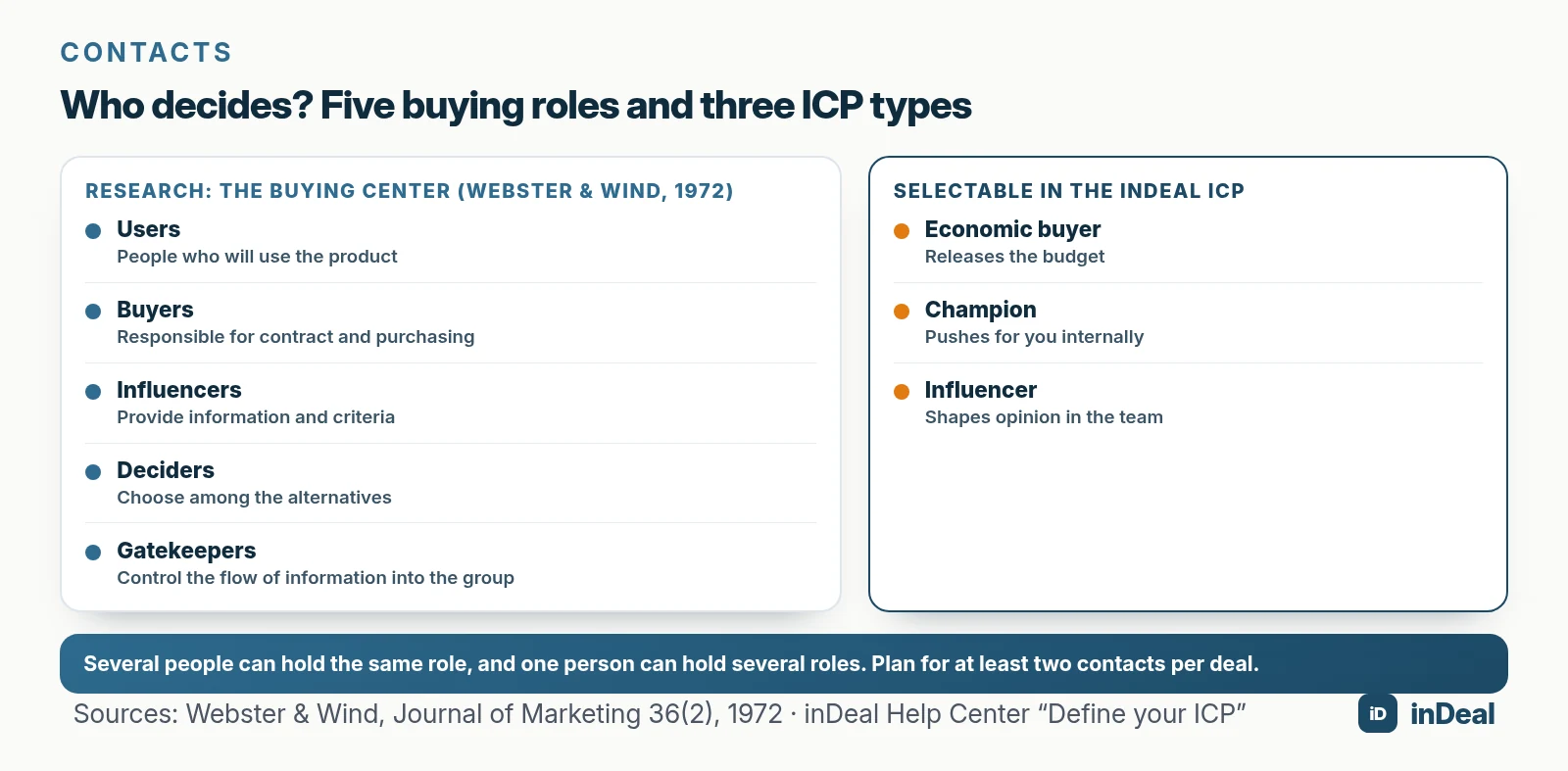
In inDeal you add one to five contacts. Each has a role (for example “Technical lead”), a type and up to four challenges. The types are economic buyer, champion and influencer. If there is no economic buyer or no champion, the form points this out; you can still save (Help Center).
The types are not a one-to-one translation of the research roles; they are a practical grid: who signs off, who pushes, who shapes opinion?
How do you set up your ICP in inDeal?
Open ICP in the sidebar, enter your website and click Analyze website. inDeal reads your home page and a few matching subpages and creates a suggestion that describes your target customers, not your own company. This usually takes less than a minute (Help Center).
Then:
- Review the suggestion. It appears in the edit form with a note that nothing is saved yet.
- Adjust and save. Only Save makes the ICP apply. If the analysis found little content, a note appears.
- Or create it manually. Choose Create manually and fill in the empty form.
- Include or exclude industries. A click on the check in the chip excludes an industry. At least one industry stays included.
- Use versions. Every save creates a new version; under Versions you see earlier states and can restore them.
Ten analyses per day are possible. If too little text is found, try another page such as your services page, or create the ICP manually.
With the Admin role you analyze and edit; with the Sales role you can see the ICP and all versions but not change anything.
A free CRM for your whole team. Start inDeal in 2 minutes. Just an email address, no credit card to sign up, unlimited users.
Start freeHow do you use the ICP in daily sales work?
An ICP that sits in a folder does nothing. It has to show up in three decisions: whom you look for, whom you contact and when you give up on a lead.
When searching: inDeal does not search excluded industries for new leads. Contacts from companies in these industries count as “Does not match” in the check, also for existing contacts, signals and website visitors (Help Center). If an included and an excluded industry point to the same search industry, the exclusion wins, and the form tells you.
When qualifying: the ICP filters before the conversation, BANT checks during it. How the two work together is in Lead qualification with BANT.
When giving up: if a lead does not fit, mark it lost with a reason instead of dragging it along for months. That way your ICP learns from practice. More on the flow in The perfect CRM sales process.
When enriching: add missing contact details only for leads that fit the ICP. That saves credits and time; more in Lead enrichment.
If you use LinkedIn, copy the search filters that match your ICP as text from the collapsed section Sales Navigator filters. Filters set in LinkedIn can differ, so check the search briefly (Help Center).
How do you keep your ICP up to date?
An ICP is a working hypothesis. Schedule a fixed review, for example once a quarter or after every major change to your offer and pricing.
If you run campaigns, inDeal makes a suggestion every 14 days. It looks at positive replies from the last 60 days, and a suggestion is created from 10 positive replies. Nothing is changed automatically: your ICP stays as it is until you accept, edit or dismiss the suggestion. Admins and owners get an email, and admins control the “Automatic ICP updates” toggle (Help Center).
According to the Help Center, the Lead suggestions tab is not switched on for everyone yet. Do not rely on it when you build your ICP.
What mistakes do small businesses make with their ICP?
Most mistakes come from wishful thinking. An ICP should describe who buys, not who would buy in a perfect world.
| Mistake | Consequence | Better |
|---|---|---|
| Too broad (“all small businesses”) | No filtering effect, pipeline full of coincidences | Two to five industries, a clear size range |
| Firmographics only | Trigger and problem are missing | Note problem and trigger in the profile |
| One contact only | Deal hangs on one person | Plan for an economic buyer and a champion |
| No exclusions | Time flows into poor leads | Define excluded industries |
| Created once, never reviewed | Profile goes stale | Review quarterly, use versions |
| Wishes instead of data | Profile does not match real customers | Start from your best customers |
What does an example ICP look like?
An example makes the profile tangible. The following ICP is fictional and only illustrates the structure.
| Building block | Example: IT services firm with 12 employees |
|---|---|
| Industries | Machinery, control engineering; excluded: public administration |
| Size | 50 to 249 employees |
| Regions | U.S., Germany, UK |
| Contacts | Technical lead (champion), managing director (economic buyer) |
| Offer | Managed services and machine data integration |
| Problem | Data sits in silos, decisions take too long |
| Solution | One platform, one contact person, fixed response times |
Which ICP fits you?
Start small. If you already have customers, build the ICP from your best five to ten. If you are at the beginning, let the website analysis give you a draft and check every line critically.
If you are looking for a free CRM for small businesses, make sure you can store your ICP there instead of maintaining it in a spreadsheet. An AI CRM for small businesses can make suggestions, but the decision whom you want to win stays with you. How the ICP matters for AI agents is covered in AI CRM vs. AI SDR.
Keep reading
- Lead management for small businesses
- Lead qualification with BANT
- The perfect CRM sales process
- Lead enrichment
- AI CRM vs. AI SDR
Frequently asked questions
What is an ideal customer profile (ICP)?
How do I create an ICP in 5 steps?
What is the difference between an ICP and a buyer persona?
How many industries and regions can an ICP have?
Can inDeal derive my ICP from my website?
How often should I update my ICP?
Does an ICP need a GDPR legal basis?
Is inDeal the same as indeal.io?
Sources
- Segmenting Customers in Mature Industrial Markets (Journal of Marketing 56(4), 72–82)
- A General Model for Understanding Organizational Buying Behavior (Journal of Marketing 36(2), 12–19)
- The Buying Center: Structure and Interaction Patterns (Journal of Marketing 45(3), 143–156)
- SME definition
- Size standards
- North American Industry Classification System (NAICS)
- E-business integration
- Define your ICP
- ICP updates
- inDeal – free AI CRM for small businesses
inDeal is the AI CRM for small and mid-sized B2B companies.
Keep reading
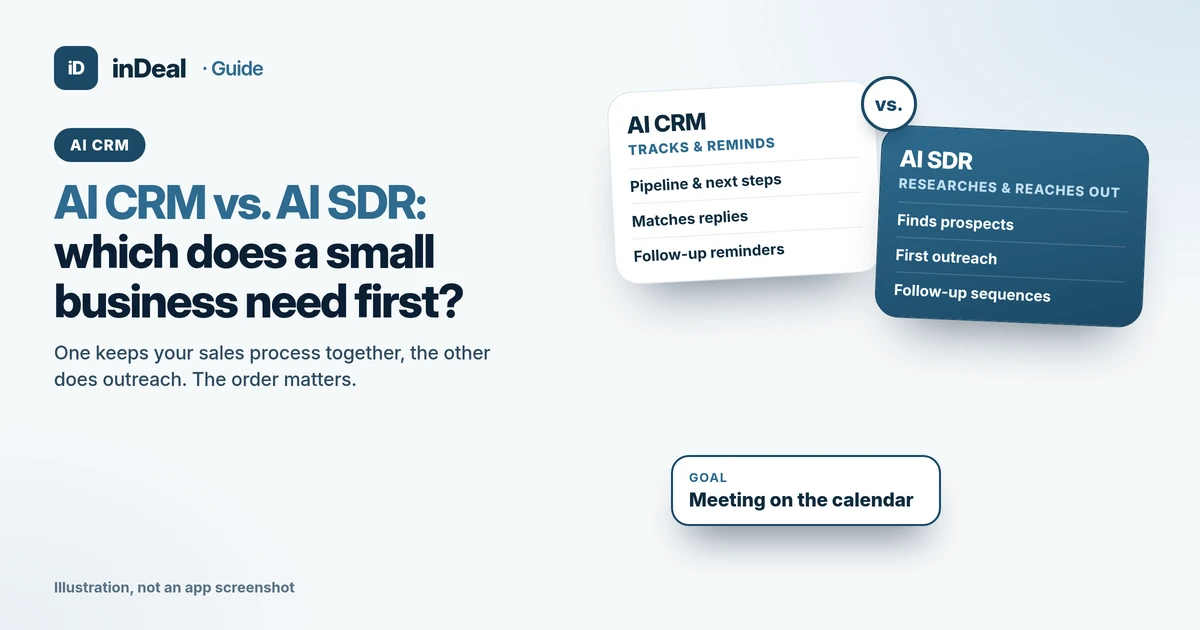 AI CRM
 vs. AI SDR: Which Does a Small Business Need First?
AI CRM vs. AI SDR for small business: what each does, what research shows, which rules apply, and why a free AI CRM is usually the right first step.
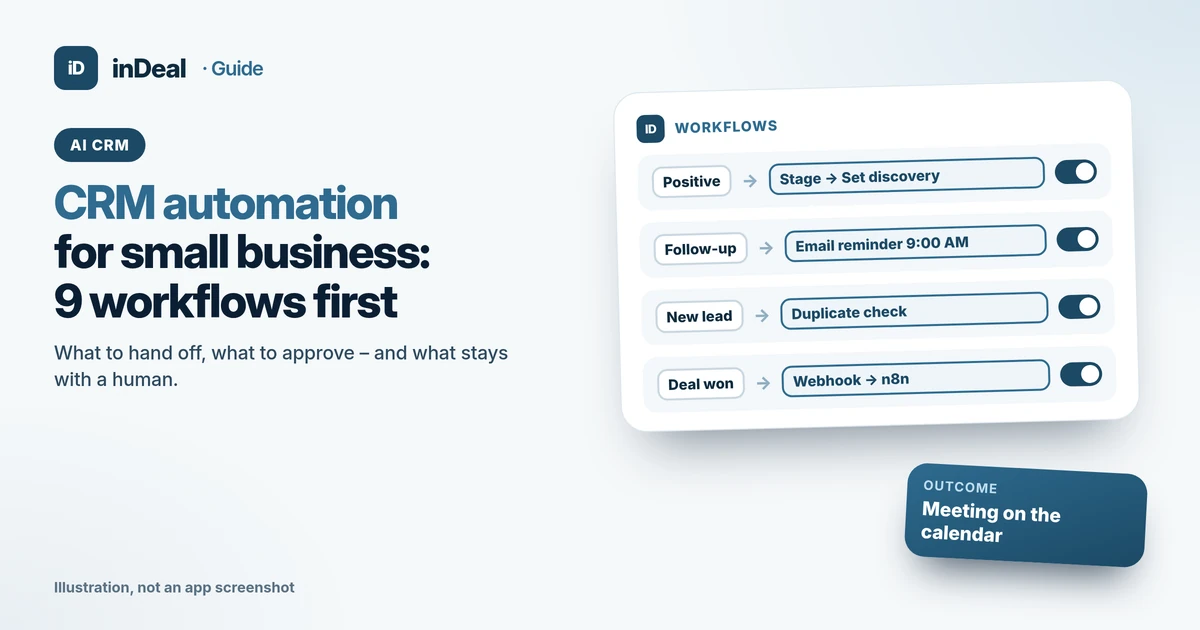 AI CRM
CRM Automation for Small Business: 9 Workflows to Set Up First
CRM automation for small business, step by step: 9 workflows from lead capture to forecasting, AI via MCP, and what to keep human. Start with a free AI CRM.
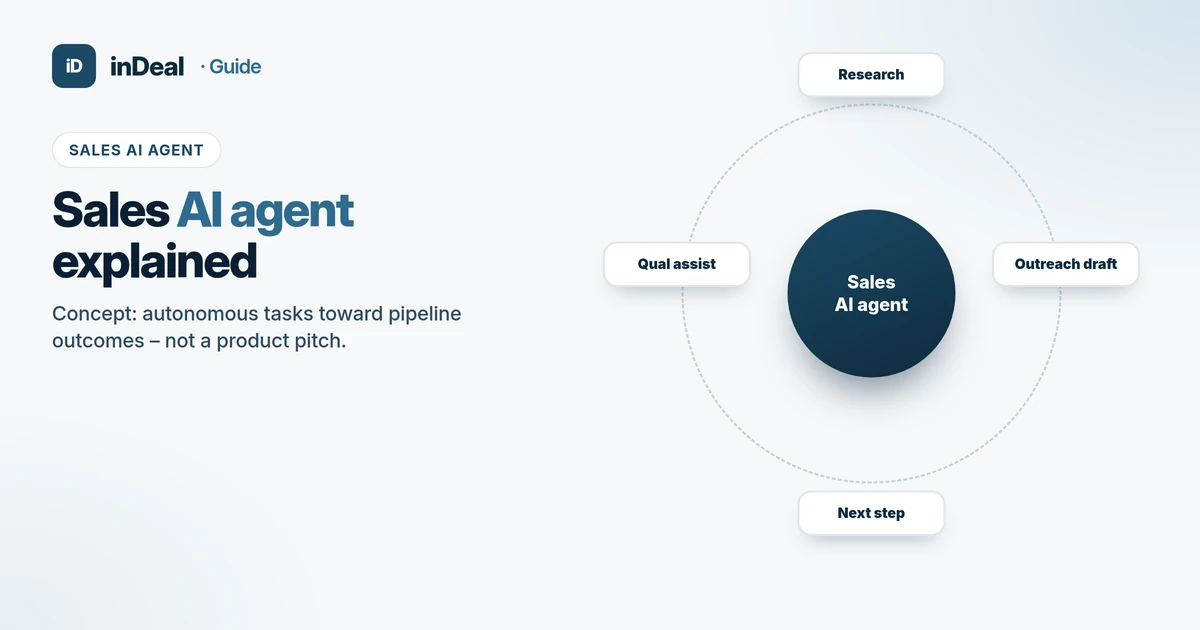 AI CRM
Sales AI Agent 2026: Definition, Contrast, Checklist
Sales AI agent explained: what it is, how it differs from chatbots, appointment agents and AI CRM, 2026 adoption, risks and a buyer checklist – concept, not a product pitch.