Contents
- What is a sales AI agent?
- How does it differ from a chatbot, appointment agent and AI CRM?
- Where does a sales AI agent sit in the SMB sales process?
- How common are sales AI and agents in 2026?
- What risks come with sales AI agents?
- What do you need BEFORE a sales AI agent?
- What does inDeal provide today – without a sales-agent feature?
- How do you evaluate any sales AI agent (checklist)?
- How do you run a 30-day pilot without feature hype?
- How do you tell assistance, automation and an agent apart?
- What data should a sales AI agent see – and what should you leave out?
- How do you measure whether the sales AI agent helps?
- What changes for teams with few SDRs?
- Which mistakes show up most in the first 90 days?
- When is a sales AI agent worth it – and when not?
- Frequently asked questions
- Sources
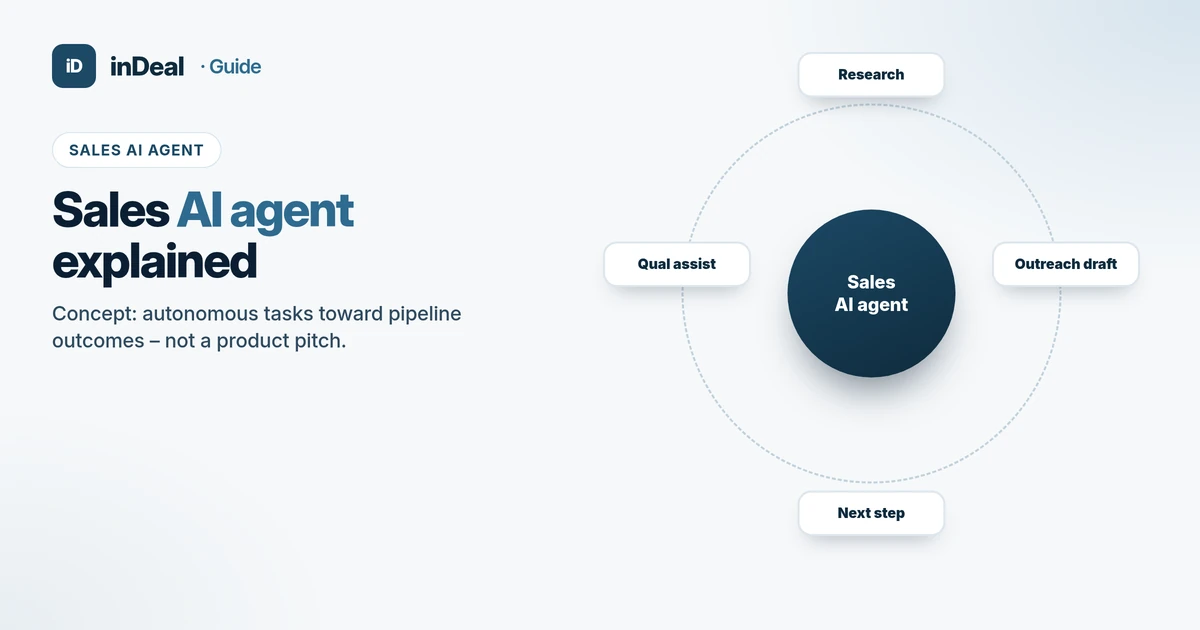
A sales AI agent is software that independently works toward pipeline outcomes – research, outreach drafts, next-step suggestions, qualification assist – not a FAQ chatbot. Before you deploy one, you need clarity on the definition, how it differs from related tools, the risks, and CRM basics. inDeal (indeal.ai) is a free AI CRM for small businesses from Lars Krüger GmbH, Berlin. Not to be confused with indeal.io, a different company.
As of October 14, 2026. Market: Bitkom 14 September 2026, Eurostat AI 2025, KfW Fokus 554 (29 July 2026); law: EUR-Lex AI Act Art. 50 (applies from 2 August 2026), GDPR; product facts: indeal.ai and success.indeal.ai. Not legal advice.
What is a sales AI agent?
A sales AI agent is an AI system whose job is not a single FAQ answer but a sales result: a warmer lead, a structured qualification note, a set follow-up, a prepared discovery. Bitkom describes agentic AI this way: unlike a chatbot that answers questions, an agent completes tasks on its own – for example by researching and collecting offers (Bitkom press, 14 Sep 2026).
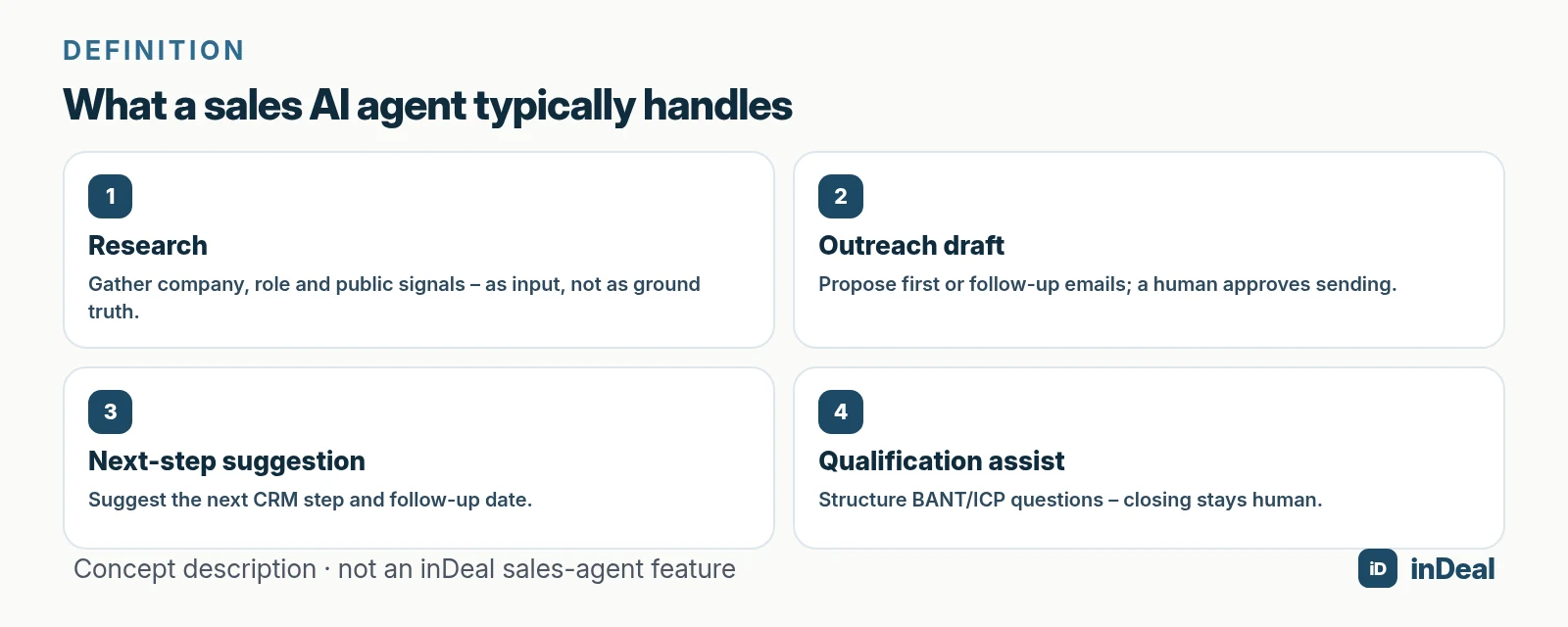
In sales that usually means four building blocks:
- Research on company, role and public signals (as input, not as ground truth).
- Outreach draft – first or follow-up emails; a human approves sending.
- Next-step suggestion – stage, follow-up date, next action in the CRM.
- Qualification assist – structured questions (need, budget range, decision maker) without replacing the close.
How does it differ from a chatbot, appointment agent and AI CRM?
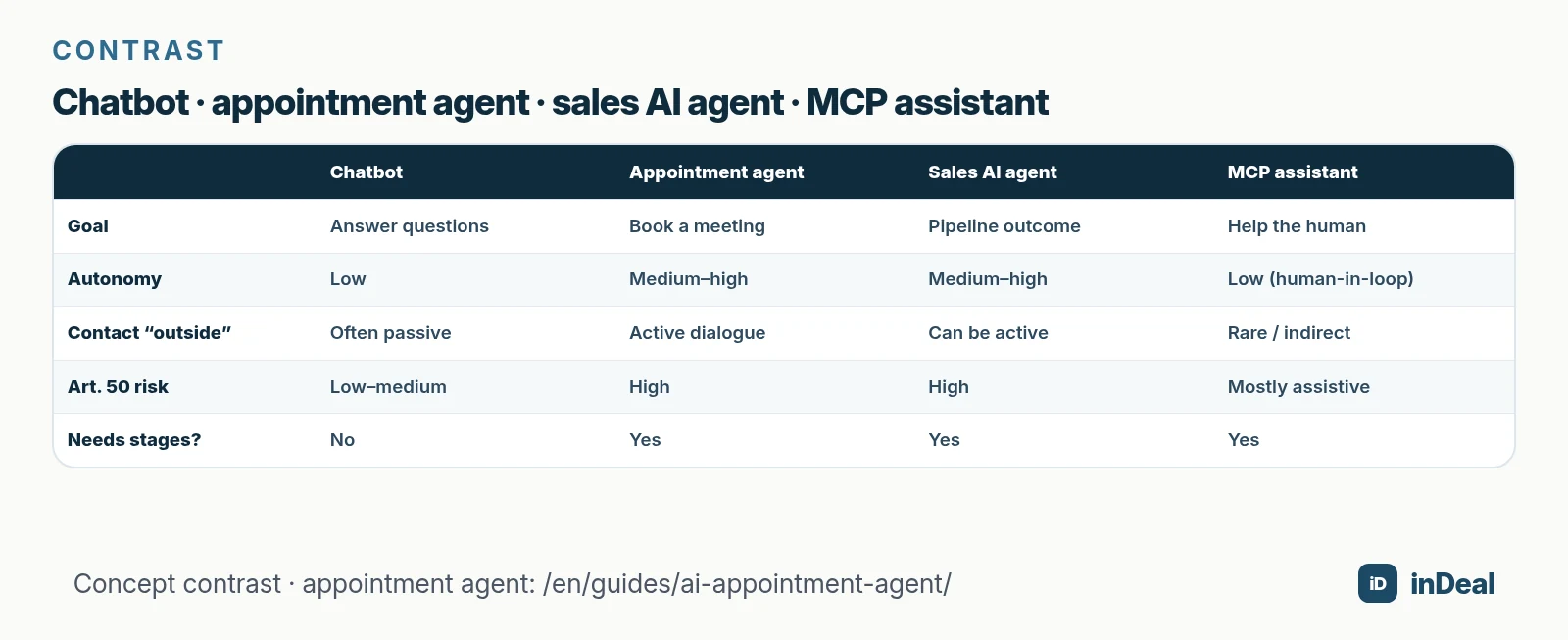
Four labels get mixed up. Use this contrast:
| Chatbot | Appointment agent | Sales AI agent | MCP assistant | |
|---|---|---|---|---|
| Goal | Answer questions | Book a meeting | Pipeline outcome | Help the human |
| Autonomy | Low | Medium–high | Medium–high | Low (human-in-loop) |
| Contact “outside” | Often passive | Active dialogue | Can be active | Rare / indirect |
| Art. 50 risk | Low–medium | High | High | Mostly assistive |
| Needs stages? | No | Yes | Yes | Yes |
An AI appointment agent is a specialized form with a clear exit of “meeting booked.” Deep dive: AI appointment agent. An AI CRM with MCP keeps the human in the loop: you ask Claude or ChatGPT; the assistant reads and updates CRM context – accountability stays with you (Connect AI assistants). That is assistance, not an outbound agent.
Paschen, Wilson and Ferreira (2020) describe in the abstract how human and artificial intelligence can create value together along the B2B sales funnel (doi:10.1016/j.bushor.2020.01.003) – as collaboration, not as a full replacement of the sales team.
Where does a sales AI agent sit in the SMB sales process?
The useful zone is between list building and deeper discovery:
- Before: ICP, enrichment, first outreach idea.
- Agent (concept): researches, drafts, suggests next steps, helps with qualification.
- After: a human runs discovery, offer and negotiation.
Without stages and exit criteria the agent inherits your chaos. inDeal models the lead path in stages – from Qualify through discovery to Lead lost (Setting stages correctly). More on the full process: Perfect CRM sales process and Sales pipeline stages.
For U.S. readers, the SBA size standards define small business by industry; in the EU the SME definition (under 250 employees plus turnover/balance-sheet limits) covers most teams searching for an “AI sales agent for small business.” Process maturity matters more than feature hype.
How common are sales AI and agents in 2026?
Three neutral yardsticks:
| Source | Metric | Base / note |
|---|---|---|
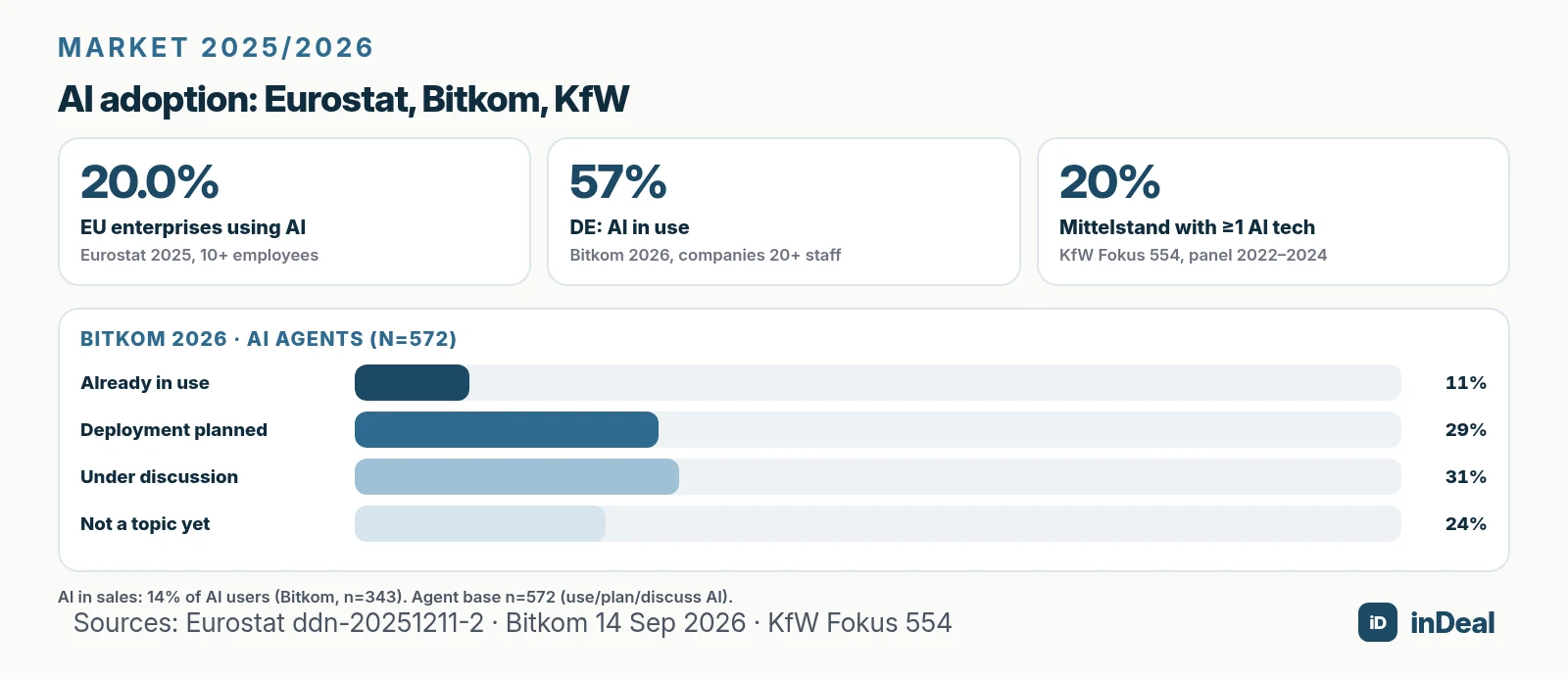
| Eurostat 2025 | 20.0% of EU enterprises use AI | 10+ employees (Eurostat News) |
| Bitkom 2026 | 57% use AI; 14% of AI users apply AI in sales | Companies 20+ staff; sales n=343 (Bitkom) |
| Bitkom 2026 | AI agents: 11% already / 29% planned / 31% discussing / 24% not a topic | Base n=572 (use or plan/discuss AI) |
| KfW Fokus 554 | 20% of Mittelstand firms use at least one AI technology | Panel 2022–2024 (PDF) |
KfW also notes that relatively easy-to-use applications dominate in the Mittelstand – natural language generation (14%) and text recognition (10%) – while more demanding technologies are rarer (Fokus 554). That matches practice: many small businesses start with assistance and drafts, not fully autonomous outbound agents.
What risks come with sales AI agents?
Name four risk types before any pilot:
- Hallucination. Invented facts in outreach or qualification notes destroy trust. Countermeasure: require sources; human review before send.
- Outreach rules. Unsolicited calls and email stay restricted under national marketing law – AI does not make them automatically lawful. (In Germany, see UWG § 7 on the DE twin; elsewhere check local rules.)
- GDPR. Lawful basis, purpose limitation, minimisation, objection to marketing (Art. 21); often a DPA with the vendor (EUR-Lex).
- AI Act Art. 50. Transparency when interacting with natural persons – disclose AI clearly, at first interaction at latest, where applicable (EUR-Lex 2024/1689; Service Desk; guidelines C(2026) 5054, applies from 2 August 2026).
What do you need BEFORE a sales AI agent?
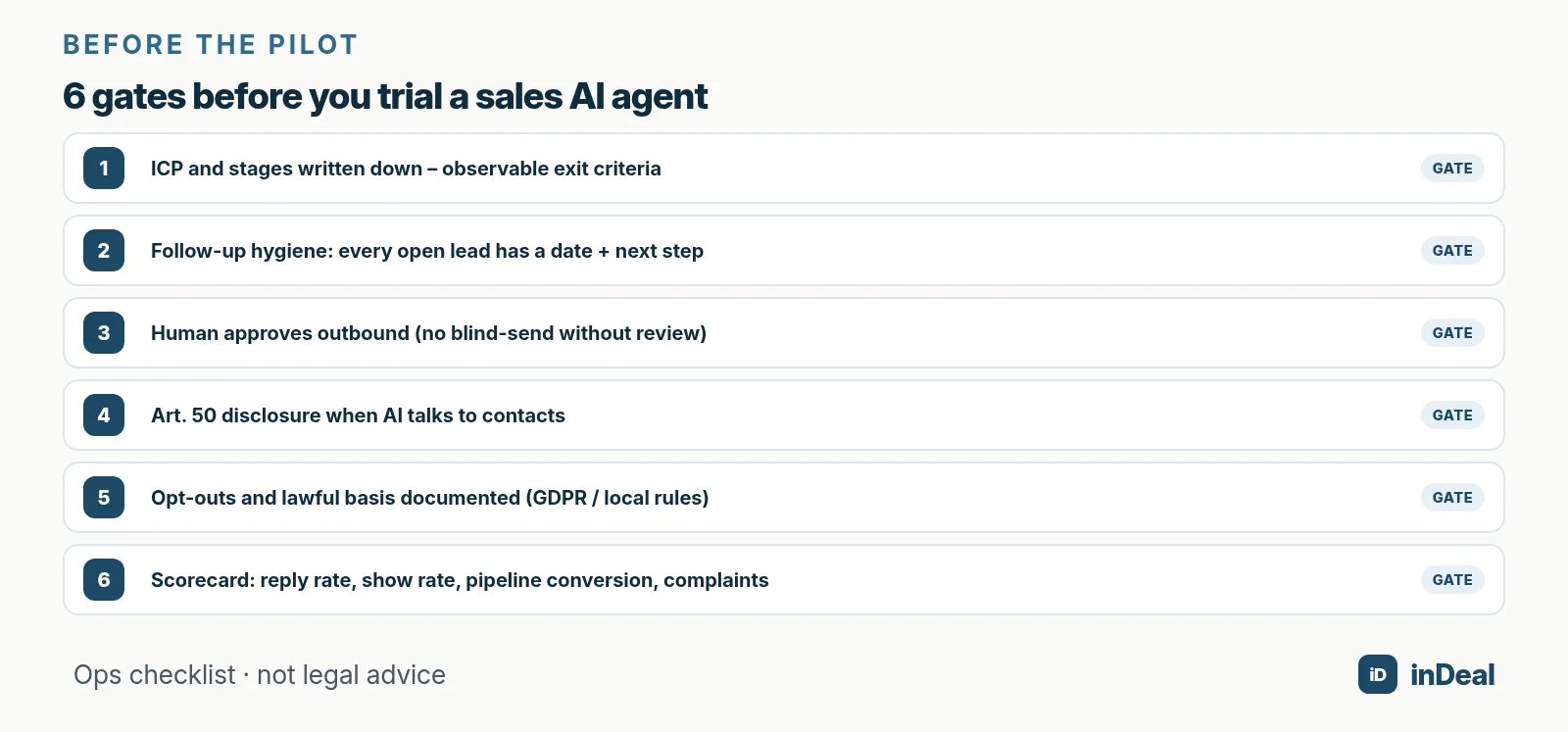
Agents scale the process you already have – good or bad. Minimum standard:
- ICP in writing – who is a fit, who is not.
- Stages with exit criteria – observable, not gut feel (Setting stages).
- Follow-up hygiene – every open lead has a date and next step (Follow-up).
- Approval rule – no blind-send without review.
- Disclosure and opt-out – Art. 50 where needed; objections effective.
- Scorecard – reply rate, show rate, pipeline conversion, complaints.
More on follow-up: Sales follow-up. Qualification logic: Lead qualification BANT.
What does inDeal provide today – without a sales-agent feature?
Instead of promising a “sales AI agent live,” three building blocks are verifiable:
- Stages with a clear meeting and deal path (Setting stages correctly).
- Follow-up with reminder and a daily list of due contacts (Follow-up).
- MCP to Claude, ChatGPT and Cursor – assistants query the CRM, create leads, set stages and next steps; you stay accountable (Connect AI assistants).
inDeal (indeal.ai) is a free AI CRM for small businesses: account and pipeline €0 per user, credits for enrichment and certain capture, EU/Frankfurt – details on indeal.ai/en. Deep dives: AI CRM for small business and Connect CRM to ChatGPT/Claude.
How do you evaluate any sales AI agent (checklist)?
When you assess any vendor or workflow, ask these operating questions – no vendor links, just diligence:
| Question | Why it matters |
|---|---|
| Which pipeline outcome is the goal (not “more AI”)? | Otherwise you optimize activity, not results |
| Who approves outbound before the first send? | Hallucination and outreach-law risk |
| How is Art. 50 met when contacts talk to the AI? | Transparency from 2 Aug 2026 |
| Which fields can the agent see – and which not? | Data minimisation (GDPR) |
| Is there a DPA with the provider? | Processor obligations |
| Which metrics stop the pilot (go/no-go)? | Reply, show rate, conversion, complaints |
| Does the agent fit your stages – or build a parallel world? | Hygiene before hype |
This is an evaluation checklist, not a certification and not a legal review.
How do you run a 30-day pilot without feature hype?
Week 1: ICP, stages, disclosure text, opt-out process. CRM hygiene: every active lead has a follow-up.
Week 2: Only warm inbound or reply contacts; a human reviews the first 20 drafts or dialogues. No cold list.
Week 3: Review metrics; tag hallucinations and complaints.
Week 4: Go/no-go. No-go is a win if you avoid expensive mistakes.
In parallel you can use stages, reminders and MCP in inDeal without waiting for an agent. Assistance already covers a large share of the “AI in sales” use Bitkom sees at 14% of AI users.
How do you tell assistance, automation and an agent apart?
Three levels help in team conversations:
- Assistance: You type; the AI suggests wording or next steps (for example a follow-up draft via MCP).
- Automation: Fixed rules without dialogue (reminder on a set date, stage change after a trigger).
- Agent: The AI decides across a dialogue or multiple steps and acts toward a pipeline outcome.
Only the third level typically triggers transparency duties for interactive systems under Article 50(1) – nuances and exceptions belong in legal review. For small businesses the practical rule still helps: once the AI talks to the person “outside,” disclose.
MCP in inDeal sits on the assistance track on purpose: you connect Claude or ChatGPT, query the CRM and let stages update – accountability stays with you (Connect AI assistants). That is a different maturity level than an outbound sales AI agent.
What data should a sales AI agent see – and what should you leave out?
Less is safer. A slim context is often enough:
- Name, company, role (where known)
- Short note on interest / campaign / last activity
- Stage and follow-up date
- Public company signals you have verified yourself
Leave out or tightly restrict:
- Unnecessary special-category personal data
- Internal side notes (“difficult customer”)
- Full email histories without a purpose
- Contacts without a lawful basis for outreach
GDPR requires purpose limitation and data minimisation (EUR-Lex). An agent that reads “everything” in the CRM because it is convenient raises risk and cost. Scope access so only fields needed for the task are visible – the same idea as CRM roles.
How do you measure whether the sales AI agent helps?
Without metrics the agent is a belief system. Five measures are enough to start:
- Reply or meeting rate per 100 warm contacts reached.
- Show rate of meetings that came from agent work.
- Pipeline conversion after discovery (offer / won).
- Opt-out and complaint rate.
- Review effort in minutes per 10 drafts – if it stays high forever, the agent does not scale.
If activity rises while show rate and conversion fall, you have volume without quality. Tighten exit criteria and qualification before the agent – do not just lengthen the prompt.
Eurostat puts AI use in EU enterprises at 20.0% in 2025 (Eurostat). Bitkom shows in parallel that AI agents are still the exception (11% already in use, base n=572). Both argue for a measured pilot instead of a big-bang rollout. More context on meeting stages and show rate: AI appointment agent and Sales pipeline stages.
What changes for teams with few SDRs?
Many small businesses have no classic SDR – the founder or account manager does outreach on the side. That is exactly where the sales AI agent hype hits hardest: “AI will be our SDR.” More realistic:
- AI handles preparation (research, draft, structure).
- Humans handle judgment and relationships.
- The CRM handles memory (stages, follow-up, timeline).
If preparation and memory are missing, no agent helps. If both work, assistance (MCP) often goes a long way – without the compliance load of an outbound dialogue agent. That lines up with KfW Fokus 554: in the Mittelstand, easier language and text applications spread first, not the most complex agent stacks (PDF).
For U.S. small businesses using the SBA size standards, the same order of operations applies: process first, agent second.
Which mistakes show up most in the first 90 days?
- Agent before stages. Parallel lists appear outside the CRM.
- Cold outreach as the first use case. Highest legal and brand risk.
- No review. Hallucinated company facts land in the first email.
- No go/no-go threshold. The pilot runs forever and eats attention.
- Feature promises to customers. You sell “our sales agent” while only assistance is live.
Countermeasures: write the gates from the checklist above as team rules and limit the pilot to warm contacts. In parallel tighten CRM hygiene from Sales follow-up and Perfect CRM sales process.
When is a sales AI agent worth it – and when not?
More likely worth it when:
- Stages, ICP and follow-ups already work.
- Volume breaks manual research and drafting.
- Transparency, opt-outs and data flows are documented.
- You have a scorecard and accept a no-go.
Better to wait when:
- Stages and next steps are still gut feel.
- You need the agent to hide a broken process.
- Cold outreach is legally unclear.
- Nobody has time to review drafts.
Keep reading without feature hype: free CRM for small business, AI appointment agent.
A free CRM for your whole team. Start inDeal in 2 minutes. Just an email address, no credit card to sign up, unlimited users.
Start freeFrequently asked questions
What is a sales AI agent?
Is a sales AI agent the same as an AI appointment agent?
Does a sales AI agent replace an SDR?
Must a sales AI agent disclose that it is AI?
Does inDeal include a sales AI agent?
What should I have before an agent pilot?
How common is AI in sales in 2026?
Is inDeal the same as indeal.io?
Sources
- Majority of companies use AI for the first time (press release)
- AI in the German economy – status quo and outlook 2026
- 20% of EU enterprises use AI technologies
- Use of artificial intelligence in enterprises
- Artificial intelligence in the Mittelstand (Fokus No. 554)
- Regulation (EU) 2024/1689 (AI Act) – Article 50
- Article 50: Transparency obligations (AI Act Service Desk)
- Guidelines on transparency obligations for providers and deployers of AI systems
- Regulation (EU) 2016/679 (GDPR)
- Collaborative intelligence: How human and artificial intelligence create value along the B2B sales funnel
- SME definition
- Table of size standards
- inDeal: homepage, pricing and FAQ
- Setting stages correctly
- Set a follow-up with a reminder
- Connect AI assistants to inDeal
Keep reading
 AI CRM
AI Appointment Agent 2026: What It Is and What Law Requires
AI appointment agent explained: how it works, where it fits in sales, AI Act Art. 50 transparency from Aug 2, 2026, GDPR limits – concept, not a product pitch.
 AI CRM
Connect CRM to ChatGPT & Claude (MCP)
Connect your CRM to ChatGPT, Claude, and Cursor: what MCP is, setup steps, what the assistant can and cannot delete, security, and GDPR orientation.
 AI CRM
AI CRM for Small Business: What It Can Do in 2026
AI CRM for small business in 2026: which AI features matter, what's free, how privacy and the EU AI Act apply, and where inDeal fits with ICP and MCP.