Contents
- What is BANT, and what do the four letters mean?
- Why does lead qualification matter for small businesses?
- Which BANT questions should you ask on a first call?
- How do you decide what happens after the call?
- How do you qualify before the first conversation?
- When should you requalify a lead?
- What are MEDDIC and CHAMP, and when do they fit better?
- How do ICP and BANT fit together?
- How do you map lead qualification to CRM stages?
- Should you score leads with points?
- What can you ask and store when qualifying leads?
- What mistakes happen in lead qualification?
- Which qualification framework fits you?
- Keep reading
- Frequently asked questions
- Sources
Lead qualification with BANT checks four questions: is there a budget, who decides (authority), which problem needs solving (need), and by when (timing)? That tells you on a first call whether more time is worth it. inDeal (indeal.ai) is a free AI CRM for small businesses from Lars Krüger GmbH in Berlin, where you record the result directly in stages. Not to be confused with indeal.io, a different company.
As of October 5, 2026. Research from Journal of Marketing / Industrial Marketing Management; law from EUR-Lex and Gesetze im Internet; product facts from indeal.ai and success.indeal.ai.
What is BANT, and what do the four letters mean?
BANT is a lead qualification framework with four criteria. It answers one question: is this contact a realistic customer now — or later, or never?
| Letter | Meaning | Core question | Good signal | Red flag |
|---|---|---|---|---|
| B | Budget | Can the buyer set aside money for a solution? | Range named, budget process known | "Just looking" with no frame |
| A | Authority | Who decides, who influences? | Decision-maker known or on the call | Only a user with no access to leadership |
| N | Need | Which problem costs time or money today? | Concrete pain with an example | General curiosity |
| T | Timing | By when should the problem be solved? | Deadline, trigger, project start | "Sometime next year" |
The key point: BANT is a conversation guide, not a form. Fire the four questions like an interrogation and you get polite answers. Weave them into a real conversation about the problem and you get reliable signals.
Why does lead qualification matter for small businesses?
Because selling time is your scarcest resource. Every hour with a contact who has no need is an hour missing for a contact who does.
Research shows how much gets lost. The Journal of Marketing study "The Sales Lead Black Hole" (2013) describes that about 70% of marketing-generated leads are not pursued by sales reps. Based on data from 461 reps at four firms, whether reps work leads depends, among other things, on how well leads are prequalified.
As early as 1988, Marvin Jolson distinguished in Industrial Marketing Management between "tight" and "loose" leads — strongly and weakly prequalified contacts. The question is still the same today: how much screening does a lead need before sales touches it?
For small teams, the answer is practical: enough that nobody spends time on obviously poor-fit contacts — and little enough that good leads do not get stuck in forms. Small businesses rarely have a sales ops team to set this up. In the U.S., the SBA Office of Advocacy counts 36,207,130 small businesses (under 500 employees); in the EU, Eurostat found that only 24.69% of small enterprises used CRM software in 2025. Many teams qualify in their heads — and forget half of it.
Which BANT questions should you ask on a first call?
Open questions that lead through the problem. Here is a question set that fits into 20 to 30 minutes.
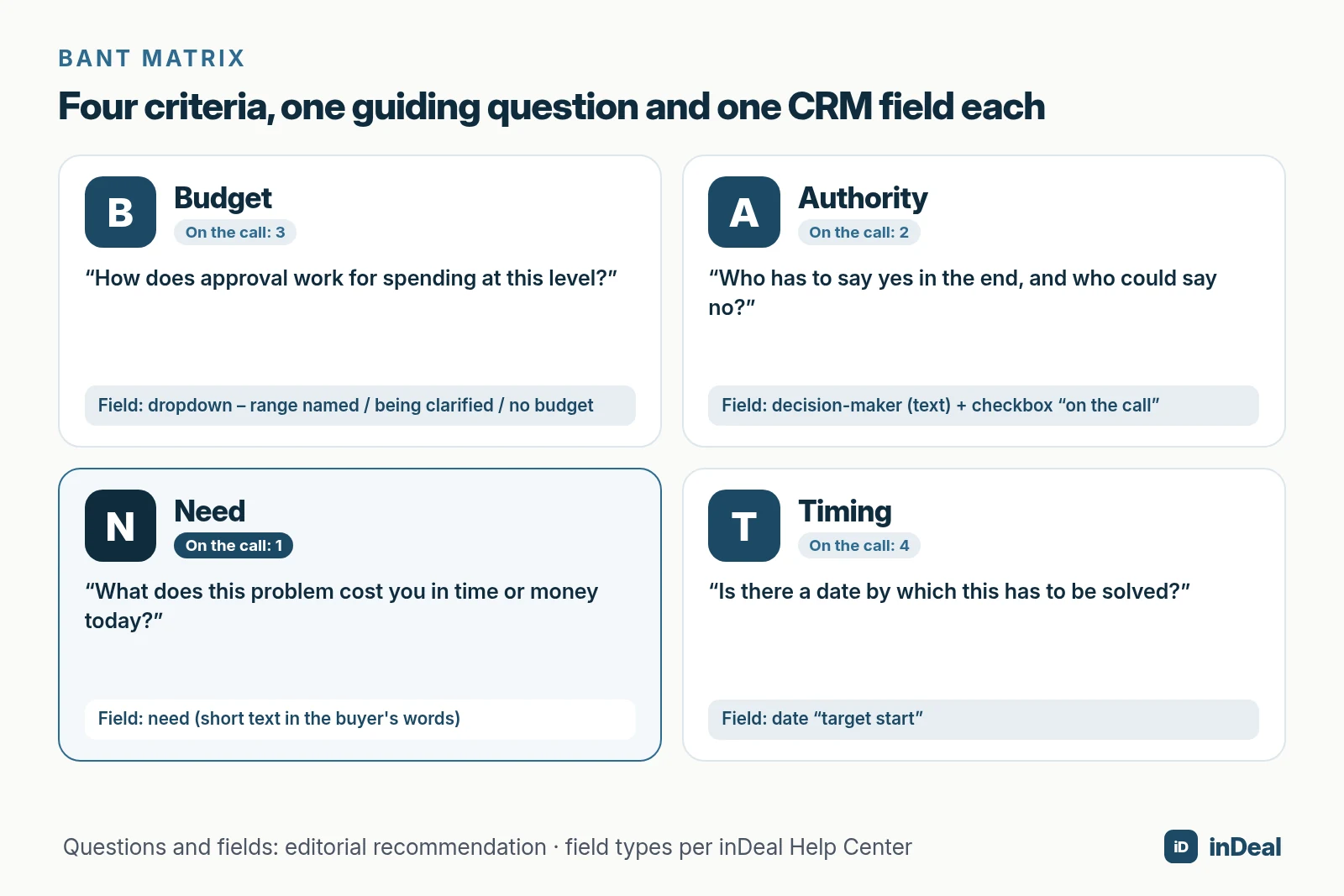
Need — understand the problem
- "What made you look into this now?"
- "How do you handle it today, and how much time does that cost you?"
- "What happens if you still work the same way six months from now?"
Authority — map the decision
- "Who else is involved in the decision besides you?"
- "How did you go about the last comparable purchase?"
- "Who has to say yes in the end — and who could say no?"
Budget — explore the frame
- "Have you already set aside a budget for this?"
- "Roughly what do you spend on this problem today?"
- "How does approval work for spending at this level?"
Timing — find the trigger
- "Is there a date by which this has to be solved?"
- "What is standing in the way of getting started?"
- "What would need to happen for you to start in four weeks?"
How do you decide what happens after the call?
With a clear rule that is the same for everyone on the team. A simple decision tree is enough for most small businesses.
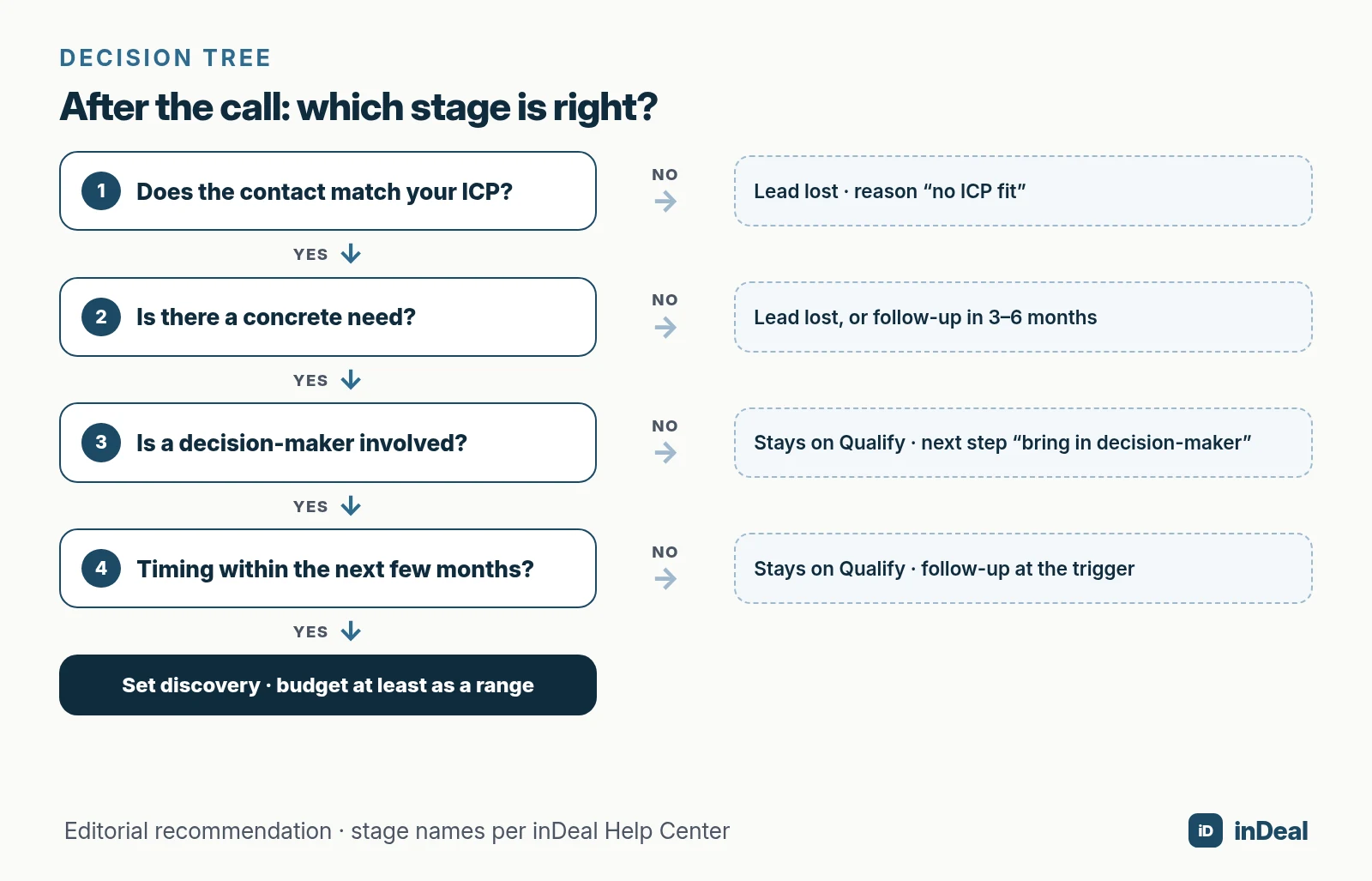
- Does the contact match your ICP? No → Lead lost with reason "no ICP fit."
- Is there a concrete need? No → Lead lost, or a follow-up in three to six months with a note.
- Is a decision-maker involved or reachable? No → next step "bring the decision-maker in."
- Is there timing within the next few months? No → follow-up date at the trigger they named.
- All yes (budget at least as a range)? → Set discovery and plan the meeting.
Budget comes last on purpose. In small companies, budget is often only released once need and solution are clear. A missing budget is rarely a reason to drop a lead — a missing need is.
How do you qualify before the first conversation?
With ten minutes of research before you call or write. Much of BANT cannot be asked before a conversation — but ICP fit and a possible trigger can be checked.
- Company: Check industry, size, and region against your ICP. If it does not fit, you save the touch.
- Role: Is the person a decision-maker, champion, or influencer? That shapes how you run the call.
- Trigger: New locations, sales job postings, a change in leadership — signals like these point to need and timing.
Record the result right on the lead: ICP fit as a note, the role in the job title field, the trigger in your need field. The call does not start from zero, and teammates can see why the lead is on the list.
When should you requalify a lead?
Qualification is not a one-time stamp. Check again at two points at the latest: after the discovery meeting, and when you move a deal to Win the deal, where inDeal asks for confidence and deal value.
If the decision-maker changed, the budget was cut, or the start date slipped, update the fields and confidence. A deal with stale qualification skews the forecast — and costs follow-up time in the wrong place.
What are MEDDIC and CHAMP, and when do they fit better?
Both are alternatives to BANT with a different focus. For small businesses, it pays to know them and borrow specific elements.
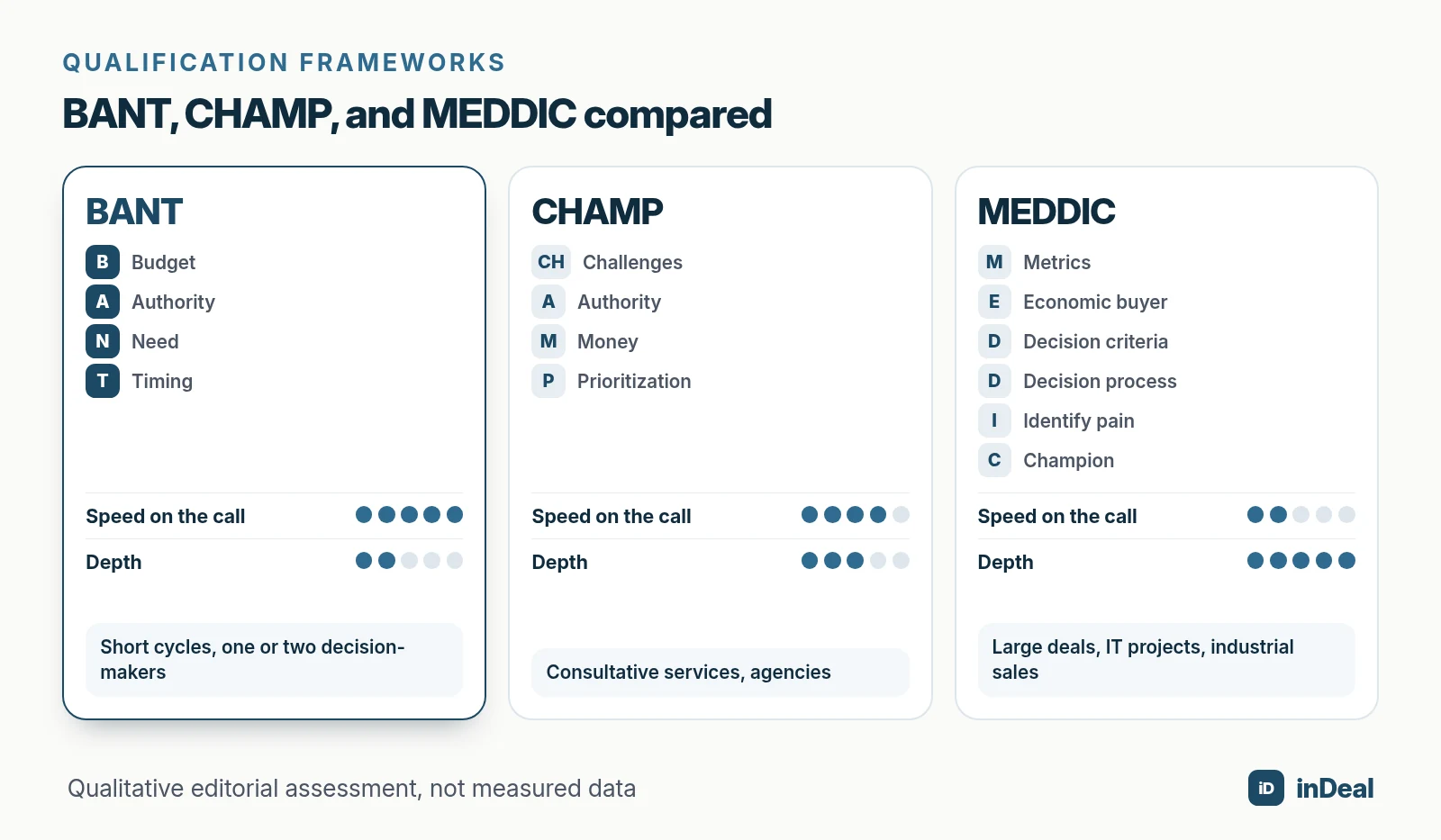
MEDDIC stands for metrics (measurable value), economic buyer, decision criteria, decision process, identify pain, and champion (an internal advocate). It is more thorough and fits large deals with several stakeholders.
CHAMP stands for challenges, authority, money, and prioritization. It deliberately starts with the buyer's challenges and asks at the end how important the topic is compared with other projects.
| Framework | Focus | Fits | Effort on the call |
|---|---|---|---|
| BANT | Quick buying readiness | Short cycles, one or two decision-makers | Low |
| CHAMP | Problem and priority | Consultative services, agencies | Medium |
| MEDDIC | Decision path and value | Large deals, IT projects, industrial sales | High |
Our recommendation for small businesses: BANT or CHAMP for the first call, and selected MEDDIC elements — especially economic buyer and champion — as soon as a deal gets bigger. We know of no neutral study proving that one framework converts better in general; what matters is that your team uses one framework consistently.
How do ICP and BANT fit together?
The ideal customer profile (ICP) filters before the conversation; BANT checks during it. The ICP describes which companies and roles fit in general; BANT checks whether this one contact is ready to buy now.
In inDeal, you set up the ICP in the ICP section, per the Help Center: target industries, company size, regions, and one to five contacts. Each contact has a type: economic buyer, champion, or influencer.
That is the bridge to BANT and MEDDIC: authority asks about the economic buyer, and MEDDIC also asks about the champion. If the ICP has no economic buyer or champion, the form points it out. If you want, inDeal suggests an ICP from an analysis of your website; it is only saved after you review it.
More on ICP and AI in sales in the pillar AI CRM for small business.
How do you map lead qualification to CRM stages?
Through the Qualify stage, four custom fields, and consistent lost reasons. That turns a good conversation into a record the whole team understands.
The stage as the result
Per Setting stages correctly, Qualify means you check whether business with this contact is possible. The result of a BANT check is therefore always a stage change:
| BANT result | Stage in inDeal | Upkeep |
|---|---|---|
| Fits, need and timing clear | Set discovery | Follow-up date + next step |
| Fits, timing later | Qualify (stays) | Follow-up date at the trigger, note |
| Decision-maker missing | Qualify (stays) | Next step "bring in decision-maker" |
| No need or no ICP fit | Lead lost | Pick a lost reason |
Watch out with "stays on Qualify": the Help Center lists staying there too long as one of the most common mistakes, because the lead then counts as untouched. Always set a date on which you decide again.
Four custom fields for BANT
Per Custom fields for leads, you create fields in Setup under Layout; there are nine field types, including text, dropdown, checkbox, and date. A proven set:
- Budget: dropdown with "range named," "being clarified," "no budget"
- Decision-maker: text with name and role, plus a checkbox "decision-maker on the call"
- Need: short text in the buyer's own words
- Timing: date "target start"
Custom fields show up automatically in the filter panel under Custom fields. That lets you find, for example, every lead with a target start next quarter but no decision-maker.
Notes and activities
What holds permanently — such as "budget approval goes through the advisory board" — belongs in a pinned note. What happened belongs in the timeline as an activity. Per Activities, notes and history, a high touchpoint count without stage progress is a warning sign.
Automation for replies
inDeal helps with prequalification on incoming replies: per the workflows article, a lead on Qualify that replies positively moves to Set discovery and gets a follow-up for today if none is set. A negative reply on Qualify marks it as Lead lost with a reason. The actual BANT judgment stays with a person.
What comes after qualification — meeting, offer, close — is covered in the guide CRM sales process.
Should you score leads with points?
A simple points system helps when several people qualify leads. It has to match your own data, though, not averages from the web.
A starting point: give each BANT criterion 0, 1, or 2 points — 0 for "unknown or no," 1 for "partly," 2 for "clear." Above a threshold you agree on as a team, the lead moves to Set discovery.
After eight to twelve weeks, check: what scores did won deals have, and what did lost ones have? If the threshold does not fit, change it. That is exactly why you need clean lost reasons — they are the most honest calibration a small team has.
What can you ask and store when qualifying leads?
Business details about need, responsibility, and budget are standard in B2B sales. Rules still apply to data and outreach.
- Data minimization: Article 5 of the GDPR requires that you only store what is needed for the purpose. It applies to anyone processing personal data of people in the EU. BANT does not need private details.
- Retention: Decide when leads without a need get deleted.
- Objection: Under Article 21 GDPR, people can object to direct marketing at any time; after that, marketing to that person stops.
- Outreach rules vary by country. In Germany, for example, Section 7 UWG allows promotional calls to businesses only with at least presumed consent, and promotional email generally requires prior express consent.
What mistakes happen in lead qualification?
Most mistakes do not happen on the call but afterward — when the result lands nowhere.
| Mistake | Effect | Better practice |
|---|---|---|
| BANT as an interrogation | Polite answers | Need first, open questions |
| Budget as a knockout criterion | Good leads get lost | Budget as a range, ask last |
| Result only in your head | Team does not know the status | Keep stage and custom fields current |
| Lead stays on Qualify forever | Counts as untouched | Set a decision date |
| No lost reason | No learning curve | A reason for every Lead lost |
| Everyone uses a different framework | Numbers not comparable | One framework, written down |
| Threshold never reviewed | Scoring does not match reality | Check against won/lost after 8–12 weeks |
Which qualification framework fits you?
- Solo or small team, short cycles: BANT in the order need, authority, budget, timing. Four custom fields, one threshold.
- Agency or consultancy: CHAMP — challenges and priority first, because the need often only becomes clear during the conversation.
- IT services or industrial sales with large deals: BANT to start, then economic buyer, champion, and decision process from MEDDIC.
- You want to put this into your CRM right away: In inDeal, use the Qualify stage, custom fields, and lost reasons in a free AI CRM for small businesses. For an overview of free options, see free CRM for small business.
A free CRM for your whole team. Start inDeal in 2 minutes. Just an email address, no credit card, unlimited users.
Start freeKeep reading
- CRM sales process 2026: 7 steps for small businesses
- Sales funnel for small business 2026
- Manage leads in spreadsheets: when the sheet is enough
- AI CRM for small business: what CRM with AI can really do in 2026
- Sales follow-up: next step instead of forgotten leads
Frequently asked questions
What does BANT stand for?
Is BANT still relevant in 2026?
What is the difference between BANT and MEDDIC?
When is a lead qualified?
What is the difference between an ICP and BANT?
How do I track BANT in a CRM?
Is it OK to store budget and decision-maker info in a CRM?
Is inDeal the same as indeal.io?
Sources
- The Sales Lead Black Hole: On Sales Reps' Follow-Up of Marketing Leads (Journal of Marketing 77(1))
- Qualifying sales leads: The tight and loose approaches (Industrial Marketing Management 17(3))
- E-business integration (Statistics Explained)
- Frequently Asked Questions About Small Business 2026
- Regulation (EU) 2016/679 (General Data Protection Regulation)
- Act Against Unfair Competition (UWG), Section 7 (German original)
- inDeal: homepage, pricing, and FAQ
- Define your ICP
- Custom fields for leads
- Setting stages correctly
- The four workflows in detail
- Activities, notes and history
Keep reading
 Leads and enrichment
Manage Leads in Spreadsheets: When Excel Is Enough
Manage leads in a spreadsheet: when Excel works, five limits (history, follow-up, multi-user, enrichment, GDPR), a column template, and CSV import into inDeal.
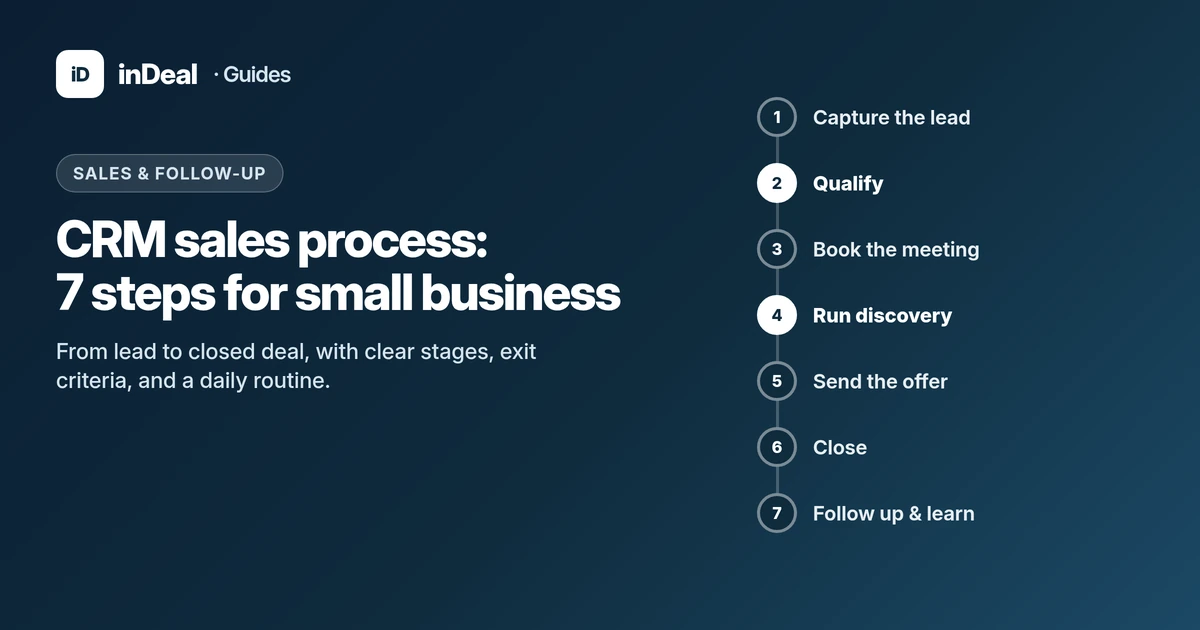 Sales and follow-up
CRM Sales Process 2026: 7 Steps for Small Businesses
A CRM sales process for small business in 7 steps: lead to close, pipeline stages with exit criteria, a daily rhythm, and CRM hygiene rules your team will keep.
 AI CRM
Connect CRM to ChatGPT & Claude (MCP)
Connect your CRM to ChatGPT, Claude, and Cursor: what MCP is, setup steps, what the assistant can and cannot delete, security, and GDPR orientation.