Contents
- What's the difference between an AI CRM and an AI SDR?
- What does an AI SDR actually do – and what can't it do?
- What does research say about AI in first contact?
- How common are AI agents in sales in 2026?
- Why does an AI SDR need a working CRM first?
- What rules apply to AI SDRs in the US and the EU?
- When is an AI SDR worth it for a small business?
- How do you run a 30-day AI SDR pilot?
- What does inDeal offer today as an AI CRM and appointment agent?
- Which fits your team: AI CRM, AI SDR or both?
- Keep reading
- Frequently asked questions
- Sources
AI CRM vs. AI SDR isn't an either-or choice for most small businesses. It's a question of order: first you need an AI CRM that keeps every contact on a dated next step, then an AI SDR can take over the outreach in front of it. Start the other way around and you create replies nobody handles. inDeal (indeal.ai) is a free AI CRM for small businesses by Lars Krüger GmbH, Berlin. Not to be confused with indeal.io, a different company.
As of October 26, 2026. Research: Li et al. 2026, Luo et al. 2019, Habel et al. 2025, Paschen et al. 2020; market data: Bitkom 2026, Eurostat 2025, European Commission 2026; law: EU AI Act Art. 50 (AI Act Service Desk), CAN-SPAM (FTC), GDPR (EUR-Lex), German UWG; product: success.indeal.ai and indeal.ai. Not legal advice.
What's the difference between an AI CRM and an AI SDR?
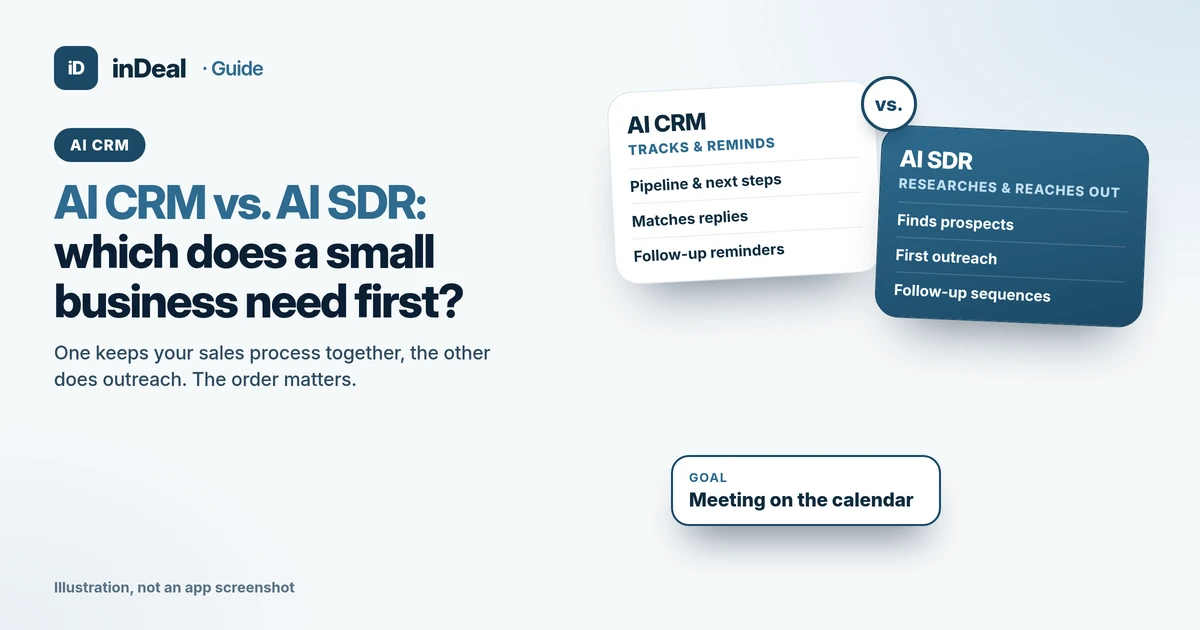
An AI CRM holds your sales process together; an AI SDR starts new conversations. One is your team's memory, the other is an extra pair of hands at the top of the funnel.
An AI CRM is a CRM that stores leads, deals, emails, notes and next steps, plus AI features: classifying replies, reminding you to follow up, enriching data and answering questions in plain language. An AI SDR is software that does the work of a sales development representative. An SDR is the person on a sales team who owns everything from first contact to a booked meeting.
| AI CRM | AI SDR | |
|---|---|---|
| Main job | Track contacts, deals and next steps | Find prospects, reach out, follow up |
| Works for | the whole team, every day | the top of the funnel |
| Typical AI features | reply classification, reminders, enrichment, chat-based reporting | research, copywriting, sequences, reply drafts |
| Outcome | no lead slips through the cracks | more conversations get started |
| Biggest risk | AI on messy data | volume without a process, legal mistakes |
| Without the other | works on its own | creates replies with nowhere to go |
An AI CRM works without an AI SDR. An AI SDR without a CRM produces meetings that get lost between inbox and calendar.
What does an AI SDR actually do – and what can't it do?
An AI SDR takes over the repeatable steps before the first conversation. It doesn't run the conversation, write the proposal or negotiate.
Typical AI SDR tasks:
- Find prospects: pull matching companies and people based on criteria you set.
- Research: scan a website, a profile or recent posts for a reason to reach out.
- Write first outreach: draft personalized messages and, depending on settings, send them.
- Follow up: write again at set intervals as long as nobody replies.
- Prepare replies: classify incoming replies and draft an answer up to a meeting proposal.
What it can't do: build trust in a real conversation, negotiate or look after a client for years. That's where deals happen, so an AI SDR belongs in front of your CRM, not in place of it.
What does research say about AI in first contact?
Research points to a division of labor, not replacement. Three studies are especially useful for small B2B teams.
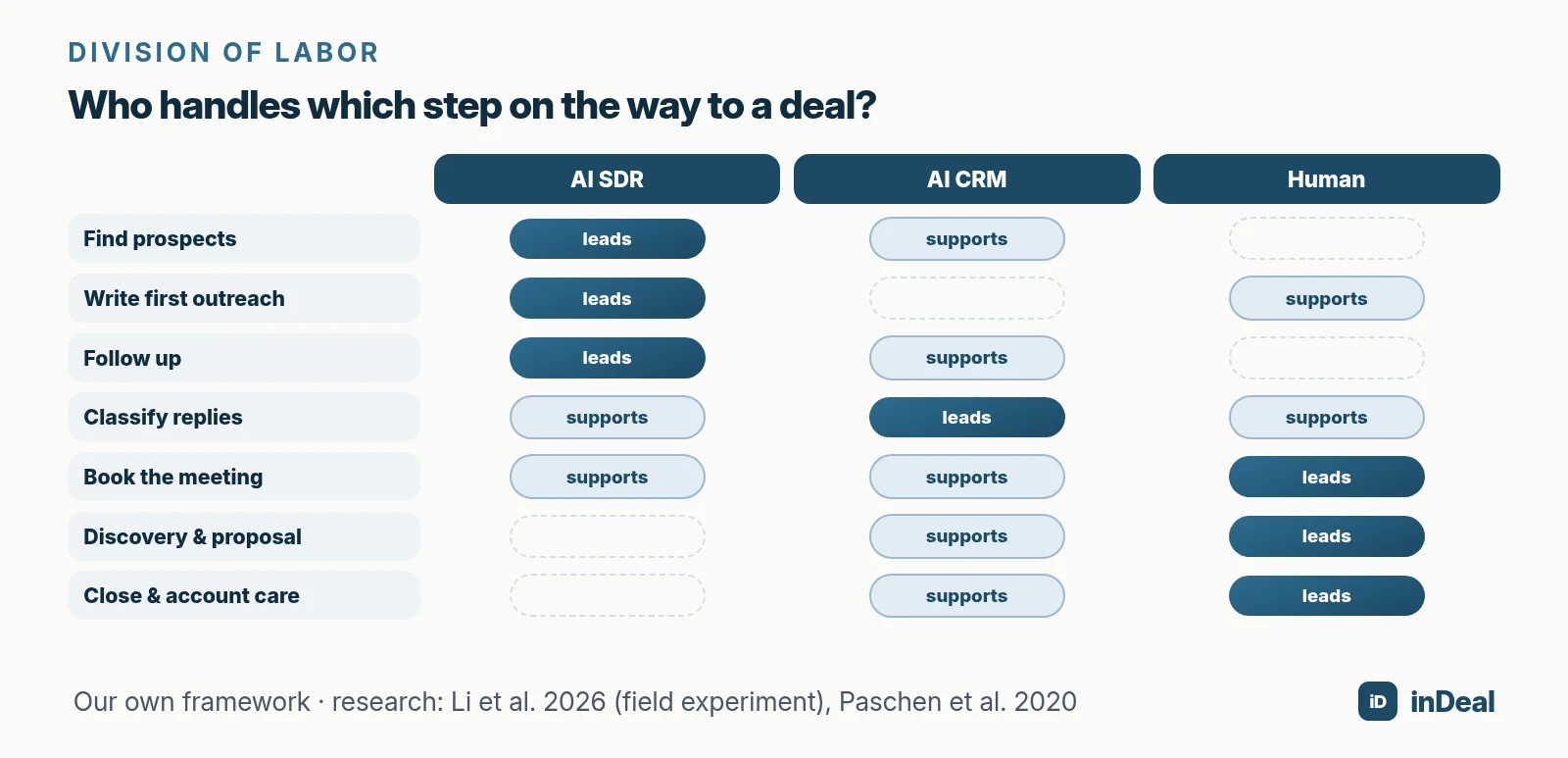
AI for first contact, humans for the conversation. In a randomized field experiment with 78,169 prospects in small-business lending at a large bank, an AI system made the first outbound call and tagged each prospect's intent as high, medium or low for human follow-up (Li et al., 2026). The AI-first workflow raised the odds of an application, but the gains only appeared after human follow-up. The AI also misclassified prospects less often than humans, who tended toward the middle and missed high-intent prospects.
Disclosure changes the conversation. In a field experiment with more than 6,200 customers, undisclosed chatbots on sales calls were as effective as proficient human agents. When customers were told up front that a machine was calling, purchase rates dropped by more than 79.7% (Luo et al., 2019). Hiding the bot isn't an option in the EU since 2026 (see below). The lesson for you: an AI SDR has to work with disclosure and bring a human in quickly.
Automation doesn't work the same everywhere. A study of automated lead nurturing found effects on lead conversion ranging from 0 to 23 percentage points across studies (Habel et al., 2025). What mattered was the length of the sales cycle, the expected deal volume and an existing relationship with the seller. The authors advise testing vendor claims in your own context.
Back in 2020, Paschen, Wilson and Ferreira described the B2B sales funnel as a collaboration between human and artificial intelligence.
How common are AI agents in sales in 2026?
Still uncommon, but growing fast. Most companies are only planning or discussing them.
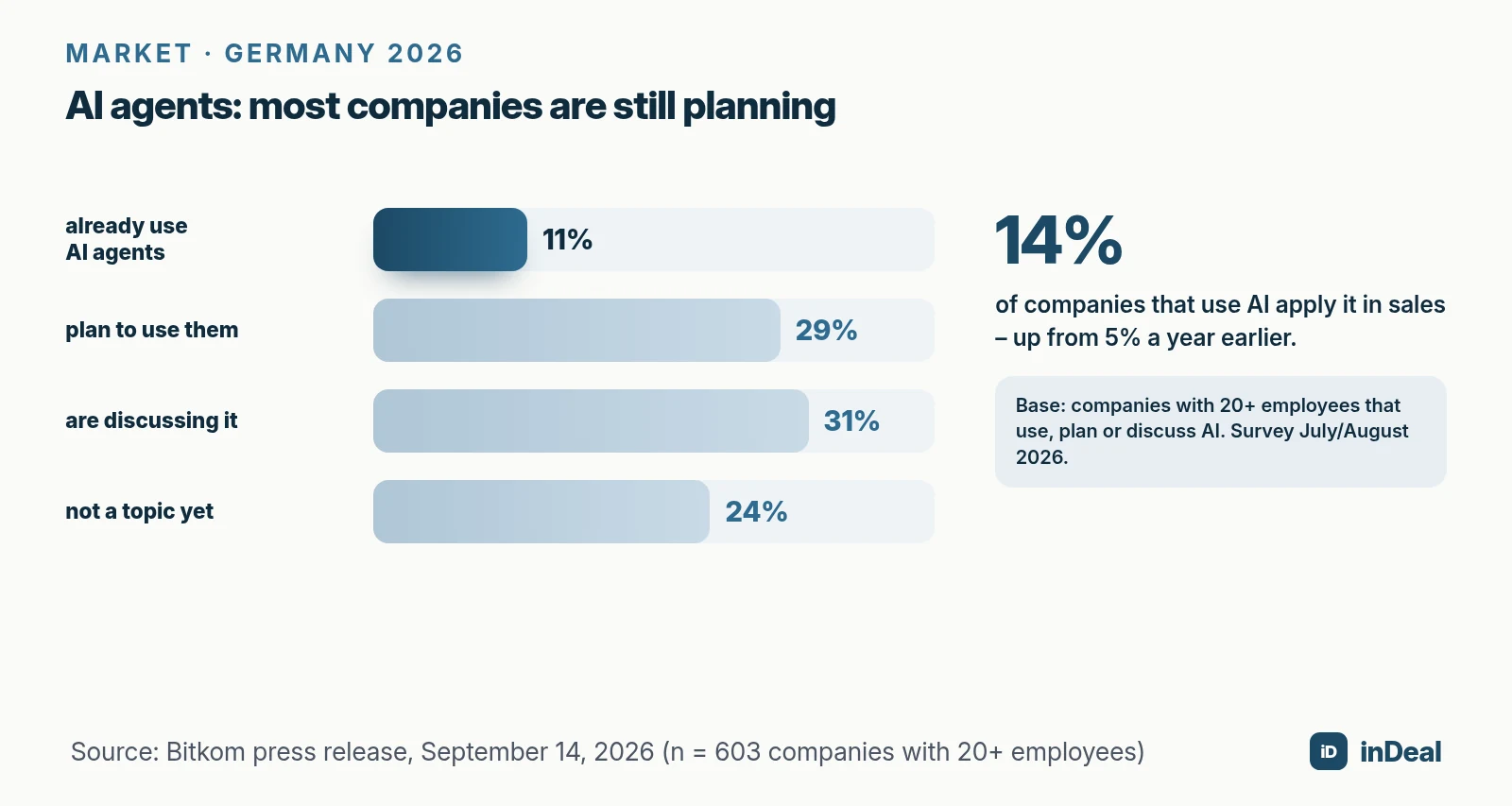
According to German digital association Bitkom, 57% of German companies with 20 or more employees used AI in 2026, a majority for the first time. Among AI users, 14% apply it in sales, up from 5% a year earlier. Among companies that use, plan or discuss AI, 11% already use AI agents, 29% plan to and 31% are discussing it.
Small firms lag behind. According to Eurostat, 17% of small EU enterprises (10–49 employees) used AI in 2025, versus 55.03% of large ones. Of all enterprises using AI, 34.70% used it for marketing or sales. Only 24.69% of small enterprises used CRM software at all (Eurostat).
The division of labor shows up in the data, too. In a European Commission survey of SMEs and mid-caps, 90% said people make the decisions, and only 2% of decisions were fully automated. A Commission brief from October 23, 2026 notes that smaller companies still use AI less often (European Commission).
Why does an AI SDR need a working CRM first?
Because every meeting an AI SDR starts has to continue in your CRM. Without one, there's no next step, no history and no owner.
Picture a three-person agency. The AI SDR brings in 12 positive replies in a week. Two end up in the founder's inbox, three go unanswered because a colleague is on vacation, and after two weeks nobody remembers what was agreed with four of them.
An AI CRM prevents exactly that. In inDeal, four built-in workflows classify every reply as positive, neutral or negative; when a lead in "Qualify" replies positively, it moves to "Set discovery", gets a follow-up date for today and you get an email (What workflows do). On the follow-up date, a reminder arrives at the time you picked, with the phone number and next step (Follow-up with reminder).
For staying on top of leads without being pushy, see Sales Follow-Up. For what to automate first, see CRM Automation for Small Business.
What rules apply to AI SDRs in the US and the EU?
Several sets of rules can apply at once: email law, AI transparency and data protection. On top of that come the terms of the platform the AI SDR uses.
- Commercial email in the US (CAN-SPAM): The law covers all commercial email and makes no exception for business-to-business messages. You need accurate headers, a postal address and a working opt-out, and you must honor opt-outs within 10 business days. You can't contract away responsibility: both the company promoted and the one sending can be held liable (FTC).
- AI transparency in the EU (AI Act Art. 50): Since August 2, 2026, people must be clearly informed when they're dealing with an AI system rather than a real person, for example a chatbot or AI agent (European Commission). The information must come at the latest at the first interaction, unless it's obvious (AI Act Service Desk, Art. 50).
- Data protection (GDPR): GDPR applies to anyone processing personal data of people in the EU. Under Article 21, people can object at any time to processing for direct marketing (GDPR). In Germany, email advertising also generally requires prior express consent under Section 7 of the UWG, including B2B.
What the transparency rule means for appointment agents is covered in AI Appointment Agent.
When is an AI SDR worth it for a small business?
When your process works and the real bottleneck is time for outreach. Before that, it creates more work than meetings.
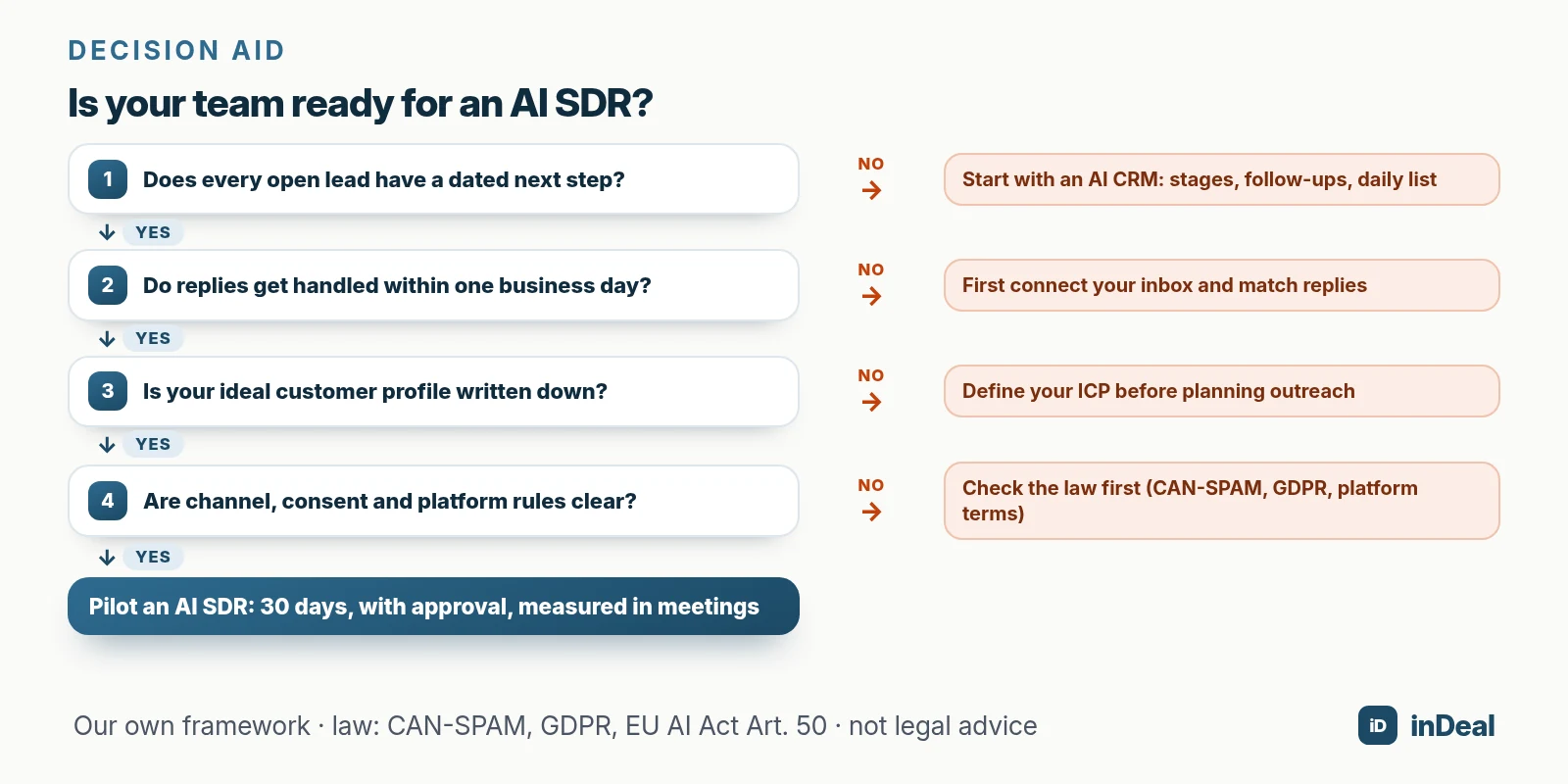
Good signs for a pilot:
- Every open lead has a dated next step.
- Replies get handled within one business day.
- Your ideal customer profile is written down: industry, size, role, typical problem.
- Channel, consent and platform rules are clear.
- Your target market is big enough for repeatable outreach.
Bad signs: leads live in spreadsheets and inboxes, nobody owns replies, or you sell a few large projects to a handful of known accounts. In that last case, a personal note from the founder often beats any sequence.
How do you run a 30-day AI SDR pilot?
Keep it small, use approval and measure meetings. After four weeks you'll know whether it sets up deals or just generates messages.
- Week 1 – foundation: clean up the CRM, assign owners, measure reply time. Write down your target audience and exclusions (existing customers, open conversations, blocklist).
- Week 2 – start with approval: one audience, one channel, low volume. A human reads every reply before it goes out.
- Week 3 – tune: rewrite messages that get no replies. Check that replies land in the CRM fast and get a next step.
- Week 4 – measure: compare booked and held meetings, reply rate, share of negative reactions and time per meeting. Only then decide whether more volume makes sense.
| Metric | What it tells you | Red flag |
|---|---|---|
| Meetings held per week | whether outreach turns into conversations | lots of replies, few meetings |
| Time to handle a reply | whether your CRM keeps up | positive replies sit for more than a day |
| Share of negative reactions | whether audience and tone fit | complaints, unsubscribes, reports |
| Show rate | whether meetings are real | many cancellations and no-shows |
| Meeting → proposal | whether the right people show up | meetings without a need |
Why held meetings and show rate matter more than booked ones is explained in Meeting Show Rate.
What does inDeal offer today as an AI CRM and appointment agent?
inDeal is a free AI CRM first; the appointment agent is an add-on you can book. According to indeal.ai, the CRM, all users and capturing leads by hand or by CSV are free, and the CRM stays free with or without the agent.
As an AI CRM, inDeal comes with ready-made stages, dated next steps, reply workflows, email reminders and MCP access. MCP (Model Context Protocol) is a standard that lets AI assistants such as Claude or ChatGPT work with apps; the assistant sees only what you're allowed to see and can't delete anything (Connect AI assistants to inDeal).
The appointment agent does the job of an AI SDR on LinkedIn: it reaches out to matching people from your LinkedIn profile, follows up and prepares replies. You decide who it contacts and what it writes, and whether replies go out with approval or on autopilot (Appointment agent overview). It only works during your working hours and stays within fixed daily and weekly limits per profile (Start, working hours and limits).
People who are already in a running agent, had a conversation in the last 90 days, are on the blacklist or work at a customer are excluded (Appointment agent FAQ). You see the first messages as a preview before anything goes out (indeal.ai).
Which fits your team: AI CRM, AI SDR or both?
For most small B2B teams: the AI CRM first, then an AI SDR with approval if you need it. Use this overview to decide.
| Situation | Recommendation |
|---|---|
| Leads live in spreadsheets, inboxes and business cards | Set up an AI CRM with dated follow-ups |
| Replies sit for days | AI CRM with connected inbox and reply workflows |
| Process works, but no time for outreach | Pilot an AI SDR or appointment agent with approval |
| Few large target accounts, long cycles | AI CRM plus personal outreach; AI SDR for research only |
| Big network, little follow-up | Appointment agent on your own network, with preview and approval |
| Unclear rules for channel or consent | Get advice first, then automate |
Your team doesn't need another tool; it needs meetings that turn into deals. An AI SDR gets more conversations started; an AI CRM makes sure none of them gets lost. To pick a free CRM, see Free CRM for Small Business; for what a CRM costs beyond the subscription, see CRM Cost for Small Business.
A free CRM for your whole team. Start inDeal in 2 minutes. Just an email address, no credit card to sign up, unlimited users.
Start freeKeep reading
- AI CRM for Small Business: What It Can Do in 2026
- Free CRM for Small Business (2026): Which One Fits Your Team?
- Sales AI Agent 2026: Definition, Contrast, Checklist
- AI Appointment Agent 2026: What It Is and What Law Requires
- CRM Automation for Small Business: 9 Workflows to Set Up First
Frequently asked questions
What is the difference between an AI CRM and an AI SDR?
Will AI SDRs replace human SDRs?
Do I need a CRM if I use an AI SDR?
Is an AI SDR worth it for a small business?
Does an AI SDR have to disclose that it is AI?
Is AI SDR cold email legal?
Does inDeal have an AI SDR?
Is inDeal the same as indeal.io?
Sources
- AI-Human Collaboration in Sequential Sales Funnels: Evidence from A Large-Scale Field Experiment (ISMS Marketing Science Conference 2026)
- Machines vs. Humans: The Impact of Artificial Intelligence Chatbot Disclosure on Customer Purchases (Marketing Science 38(6))
- Sales Pipeline Technology: Automated Lead Nurturing (Journal of Marketing)
- Collaborative intelligence: How human and artificial intelligence create value along the B2B sales funnel (Business Horizons 63(3))
- Erstmals nutzt die Mehrheit der Unternehmen KI (press release, German)
- Use of artificial intelligence in enterprises
- E-business integration
- Growing use of AI in European companies
- AI and skills in Europe – Closing the adoption gap
- AI Act, Article 50: Transparency obligations
- Safer and more transparent AI
- CAN-SPAM Act: A Compliance Guide for Business
- Regulation (EU) 2016/679 (General Data Protection Regulation)
- Act against Unfair Competition (UWG), English translation
- Appointment agent overview
- Start, working hours and limits
- Appointment agent FAQ
- What workflows do
- Follow-up with reminder
- Connect AI assistants to inDeal
- inDeal: Home page and FAQ
inDeal is the AI CRM for small and mid-sized B2B companies.
Keep reading
 AI CRM
CRM Automation for Small Business: 9 Workflows to Set Up First
CRM automation for small business, step by step: 9 workflows from lead capture to forecasting, AI via MCP, and what to keep human. Start with a free AI CRM.
 AI CRM
Sales AI Agent 2026: Definition, Contrast, Checklist
Sales AI agent explained: what it is, how it differs from chatbots, appointment agents and AI CRM, 2026 adoption, risks and a buyer checklist – concept, not a product pitch.
 AI CRM
AI Appointment Agent 2026: What It Is and What Law Requires
AI appointment agent explained: how it works, where it fits in sales, AI Act Art. 50 transparency from Aug 2, 2026, GDPR limits – concept, not a product pitch.