Contents
- What is a meeting show rate?
- Why does a low show rate hurt small businesses so much?
- How do you calculate show rate correctly?
- What does research say about reminders and no-shows?
- How do you reduce no-shows for sales meetings?
- What should your confirmation sequence look like?
- What should you do after a no-show?
- How does inDeal measure show rate?
- How do you read show rate next to the other funnel rates?
- Who owns show rate when setters and closers are different people?
- Which mistakes distort your show rate?
- Which lever fits your situation?
- Keep reading
- Frequently asked questions
- Sources
Meeting show rate tells you how many booked sales meetings actually happen: meetings held divided by meetings held plus meetings missed, counting only meetings with a settled outcome. You raise it mostly before the meeting – with short lead times, a clear confirmation and an easy way to reschedule. inDeal (indeal.ai) is a free AI CRM for small businesses operated by Lars Krüger GmbH, Berlin. Not to be confused with indeal.io, a different company.
As of October 19, 2026. Research: Cochrane review 2013, Dantas et al. 2018, Gollwitzer & Sheeran 2006 (healthcare and behavioral research, not B2B); market: Eurostat CRM 2025; product: success.indeal.ai and indeal.ai. Not legal advice.
What is a meeting show rate?
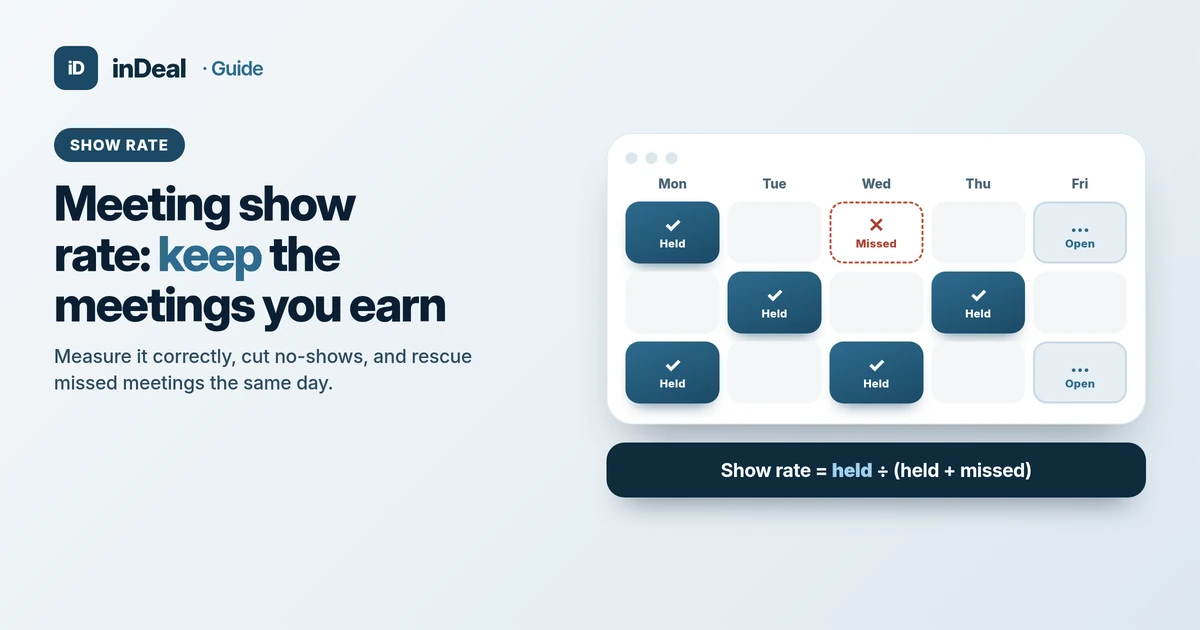
Meeting show rate is the share of booked meetings that took place. It measures the stretch between “it's on the calendar” and “we actually talked” – exactly where small B2B teams lose the most without noticing.
The formula:
Show rate = meetings held ÷ (meetings held + meetings missed) × 100
What you leave out matters just as much: future meetings and past meetings whose outcome you have not logged yet. Count those and your rate drops artificially, because tomorrow's calls look like no-shows.
Why does a low show rate hurt small businesses so much?
Every missed meeting costs you three times: the prep, the calendar slot and the outreach it took to book it. In a small team that slot does not belong to a big sales floor – it belongs to the founder or the only account executive.
A worked example (math, not a study): your team books 20 first meetings a month. At a 70% show rate, 14 happen; at 85%, 17 happen. If your meeting-to-proposal rate stays the same, proposals grow too – without a single extra lead.
That is the point: show rate is the cheapest lever in your funnel. You do not need more prospects, you need to keep the meetings you already earned. How the other stages fit together is covered in sales funnel for small business.
How do you calculate show rate correctly?
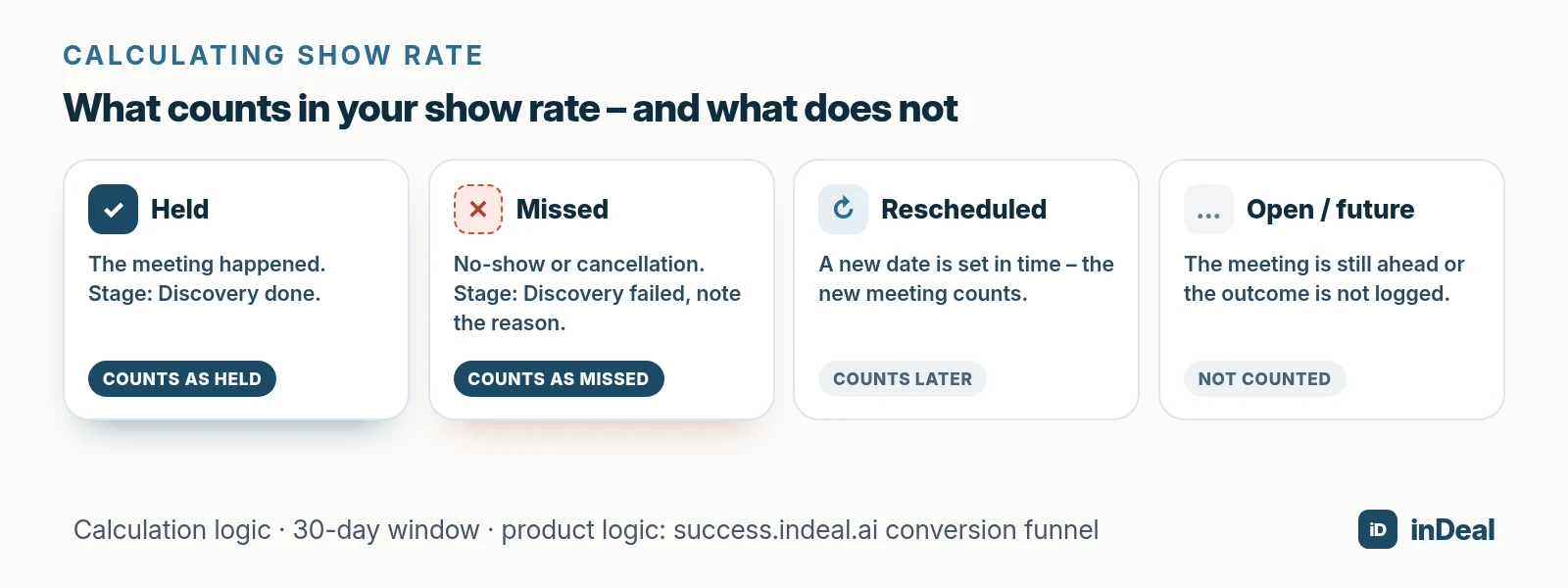
Use only meetings with a settled outcome, and keep no-shows, cancellations and reschedules apart. Without that split you cannot tell whether your problem is meeting quality or confirmation.
| Case | Counts in show rate? | How to log it |
|---|---|---|
| Meeting happened | Yes, as held | Discovery done |
| Did not show up, no notice (no-show) | Yes, as missed | Discovery failed + offer new slots |
| Cancelled in advance | Yes, as missed (noted “cancelled”) | Discovery failed, note the reason |
| Rescheduled in time, new date set | No – the new meeting counts | Update the meeting date |
| Meeting is in the future | No | Discovery scheduled |
| Meeting is past, outcome not logged | No – until you log it | Update the stage |
A 30-day window is a good compromise for small teams: long enough for a stable number, short enough to see change. Below roughly a dozen meetings any rate swings hard – read it as a direction, not a verdict.
What does research say about reminders and no-shows?
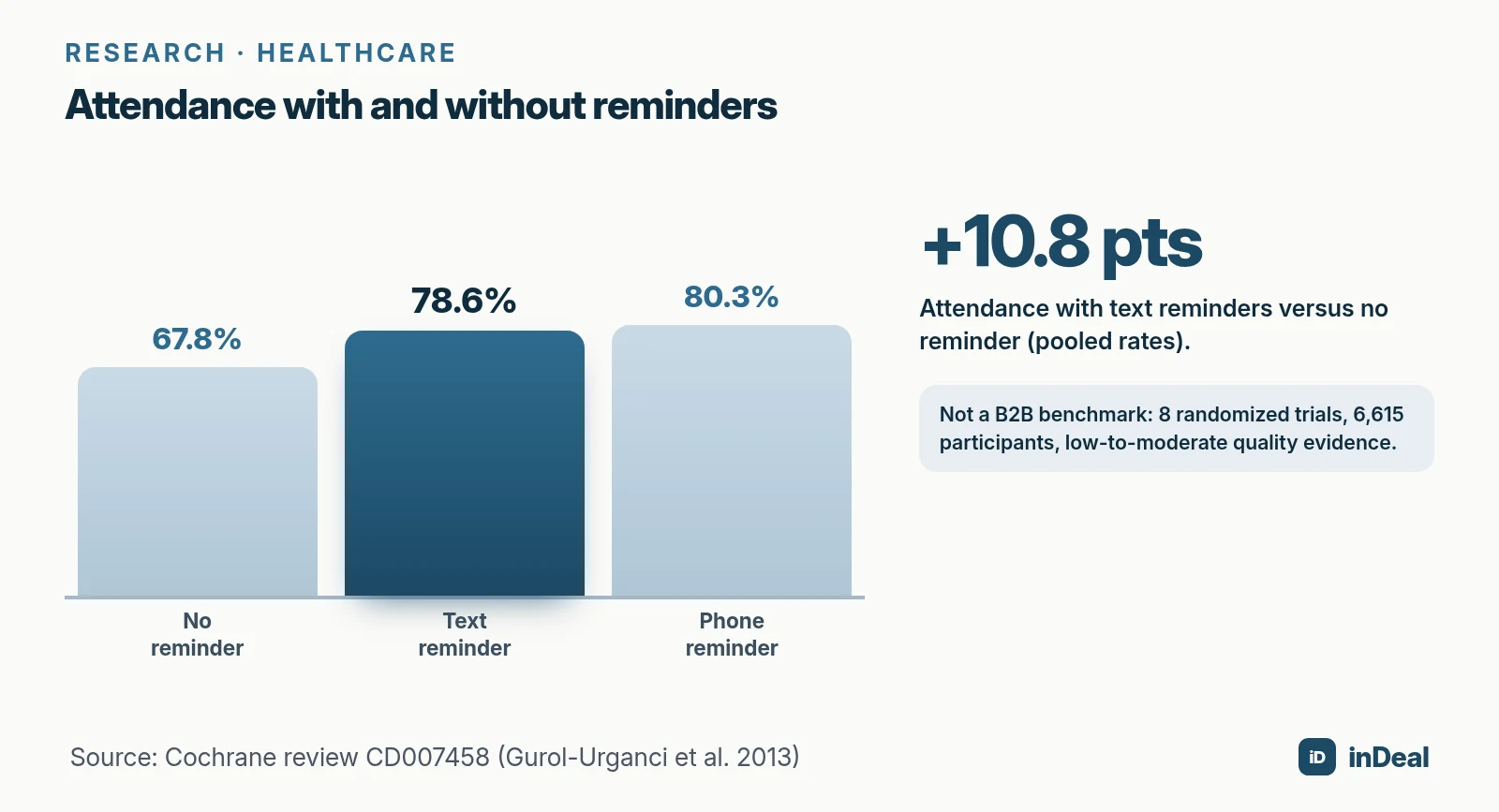
There is no large neutral study on B2B sales meetings. The best evidence on reminders and attendance comes from healthcare – transferable as a mechanism, not as a benchmark.
- Reminders work: A Cochrane review (2013, 8 randomized trials, 6,615 participants) found attendance of 67.8% with no reminder, 78.6% with text reminders and 80.3% with phone reminders. Text and phone worked about equally; text cost less per attended appointment.
- Lead time matters: A systematic review of 105 studies (Dantas et al. 2018) puts the average no-show rate at around 23%. The most consistently reported drivers: long lead time and prior no-shows.
- Concrete plans help: A meta-analysis of if-then plans (Gollwitzer & Sheeran 2006, 94 tests) found a medium-to-large effect (d = 0.65) on reaching goals. In sales terms: people who spell out when, where and why are more likely to follow through.
How do you reduce no-shows for sales meetings?
The biggest levers work before the meeting: who you book, how fast and how firmly. Reminders help, but they cannot rescue a meeting someone only accepted to be polite.
- Book qualified meetings only. Have the prospect name a concrete problem before they agree. Without their own reason, there is no reason to show – see lead qualification with BANT.
- Keep lead time short. Offer slots in the next few business days, not three weeks out. Long lead time is one of the most stable no-show drivers in the research.
- Send the invite while you are still talking. Ask them to accept it on the spot.
- Get the outcome in their words. Ask: “What do you want to have decided after this call?” Put the answer in the confirmation – that is your prospect's if-then plan.
- Three-line agenda. Goal, three points, duration. A vague “intro call” is the first thing to get dropped.
- Day-before check-in with an exit. “Still good for 10am tomorrow? If not, just send me another day.” An early cancellation beats an empty video room.
- Rescue routine. At 5 minutes late, a short email with the link; at 10 minutes, a call; then two specific new slots the same day.
What should your confirmation sequence look like?
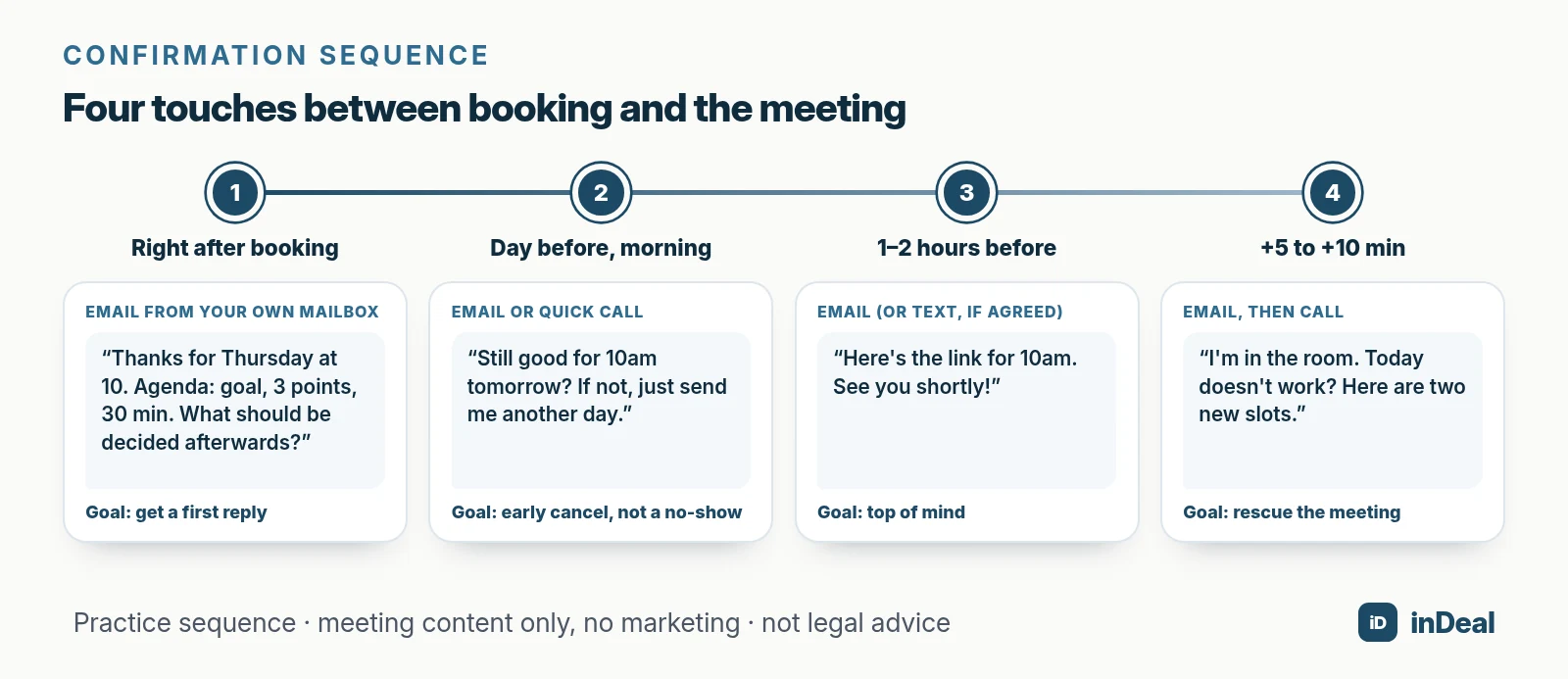
A good sequence has three or four short touches, and each one asks for a small, explicit confirmation. The goal is a reply, not one more message in the inbox.
| When | Channel | Content | Goal |
|---|---|---|---|
| Right after booking | Email from your own mailbox | Time, link, agenda, one prep question | Get a first reply |
| Day before, morning | Email or quick call | “Still good?” + reschedule option | Early cancel instead of no-show |
| Meeting day, 1–2 hrs before | Email (or text, if agreed) | One line with the link | Keep it top of mind |
| 5–10 min after start | Email, then call | Link, “I'm in the room” | Save the late arrival |
Keep every message strictly about the meeting: time, link, agenda, reschedule option. Do not slip marketing into it. Data protection under the GDPR applies whenever you process data of people in the EU, and unsolicited marketing email is regulated nationally – in Germany, for example, by § 7 UWG. This is not legal advice.
If an AI assistant drafts or sends your confirmations, read up on the transparency questions in the guide AI appointment agent.
What should you do after a no-show?
A missed meeting is the fastest lead to save in your pipeline: the interest was there a few days ago. What matters is keeping it visible and planning the next step right away.
- Log it honestly: “Discovery failed”, not back to “Set discovery”. Otherwise your rate looks better than it is.
- Follow up the same day: a short, friendly email with two specific new slots.
- Set a follow-up date: for example in 2 business days, with a reminder for yourself.
- Note the reason: sick, priorities shifted, no need – patterns show up later.
- Set a limit: after the second unexplained no-show, “Lead lost” with a reason is often more honest than a third invite.
How to set follow-up rhythms in general is covered in sales follow-up.
How does inDeal measure show rate?
In inDeal, show rate is its own card in the Conversion funnel · Last 30 days on Home, next to lead conversion, pipeline conversion and deal conversion (conversion funnel). It counts:
- Meetings from the past 30 days up to and including yesterday (German time); today's and future meetings do not count yet.
- Settled outcomes only: happened (Discovery done, or a deal was created) or Discovery failed.
- A past meeting still on Discovery scheduled counts once you update the stage.
- The comparison with the previous period appears from 3 meetings and is shown in percentage points.
For the three meeting stages the meeting date is required (setting stages correctly). If your lead cancels ahead of time, you can pick Discovery failed for a future meeting too; the history then records it as cancelled, not as a no-show.
In the Discovery pipeline on Home, Discovery failed carries a hot marker (weekly trends and pipeline overview). On the follow-up date you can set an email reminder for yourself in 15-minute steps (follow-up with reminder) – the email includes name, phone, email and the next step.
According to indeal.ai, account, pipeline and mail integration cost €0 for any number of users; you only need credits for enrichment and for capturing leads with the Chrome lead plugin.
How do you read show rate next to the other funnel rates?
Show rate is one of four conversion rates. On its own it says little – next to the others it shows where your process leaks money. The rule from the inDeal help center is simple: find the lowest of the four numbers, that is where you lose the most.
| Rate | Transition | If it is low … |
|---|---|---|
| Lead conversion | Lead → meeting booked | Check outreach and qualification |
| Show rate | Meeting → happened | Confirmation, lead time, reminder shortly before |
| Pipeline conversion | Discovery → offer | The next step after the meeting is missing |
| Deal conversion | Offer → won | Price, timing or follow-up |
A common pattern in small teams: meetings per week go up while show rate goes down. You are booking more, but more loosely – often further out. More meetings only pay off if the meetings held grow too.
Who owns show rate when setters and closers are different people?
As soon as one person books and another runs the meeting, show rate needs an owner. Otherwise the closer blames weak bookings and the setter blames missing confirmations.
- Setter owns qualification, lead time, the invite and the confirmation right after booking.
- Closer owns the day-before check-in, a punctual start and the rescue routine.
- Together you review the rate once a week, split by source.
In inDeal, the Meeting booked by field in the meeting dialog records who booked it – the basis for reviewing no-shows by setter later, as coaching input rather than blame. For sources, use the Channel filter (inbound/outbound). This matters most for agencies booking meetings for clients; more in CRM for agencies.
Which mistakes distort your show rate?
Most wrong show rates are data-hygiene problems, not sales problems. These six show up again and again in small teams:
| Mistake | Effect | Better |
|---|---|---|
| Moving a missed meeting back to “Set discovery” | Rate too high, miss invisible | Discovery failed + new slots |
| Not updating the stage after the call | Meeting not counted, pipeline looks empty | “Discovery done” right after the call |
| Treating cancellations like no-shows | No learning | Note the reason |
| Counting future meetings | Rate artificially low | Settled outcomes only |
| Mixing all sources into one rate | Outbound drags everything down | Filter by source/channel |
| Meeting without a follow-up date | Lead drops off your daily list | Always a next step with a date |
Which lever fits your situation?
Start where your numbers drop most clearly. If you do not have a number yet, start by measuring.
| Situation | First lever |
|---|---|
| You do not know your show rate | Keep stages clean for 30 days, then read it |
| Many meetings booked 2+ weeks out | Offer slots in the next few business days |
| Outbound meetings miss more than inbound | Tighten qualification before the yes |
| Cancellations only arrive on the day | Day-before check-in with reschedule option |
| No-shows never get rebooked | Same-day rescue routine |
| High show rate, few proposals | The leak is later – see sales pipeline stages |
Show rate is not a vanity metric. Your buyers do not want a calendar full of placeholders, and you want conversations that turn into proposals. Measuring it protects the time you already put into prospecting.
A free CRM for your whole team. Start inDeal in 2 minutes. Just an email address, no credit card to sign up, unlimited users.
Start freeKeep reading
- AI CRM for small business: what an AI CRM really does in 2026
- Free CRM for small business 2026: which free CRM fits you?
- Sales follow-up: next steps instead of gut feeling
- Sales pipeline stages
- CRM for agencies 2026: 9 criteria for small agency teams
Frequently asked questions
What is a meeting show rate?
What is a good show rate for sales meetings?
Is a cancellation the same as a no-show?
How many reminders should you send before a sales meeting?
Do reminder emails really reduce no-shows?
How does inDeal calculate show rate?
What should I do after a prospect no-shows?
Is inDeal the same as indeal.io?
Sources
- Mobile phone messaging reminders for attendance at healthcare appointments (Cochrane Review, Gurol-Urganci et al.)
- No-shows in appointment scheduling – a systematic literature review (Dantas et al.)
- Implementation intentions and goal achievement: a meta-analysis of effects and processes (Gollwitzer & Sheeran)
- E-business integration
- § 7 UWG – Unreasonable harassment (German Act against Unfair Competition)
- Conversion funnel and business results
- Setting stages correctly
- Follow-up with reminder
- Weekly trends and pipeline overview
- inDeal homepage, pricing and FAQ
inDeal is the AI CRM for small and mid-sized B2B companies.
Keep reading
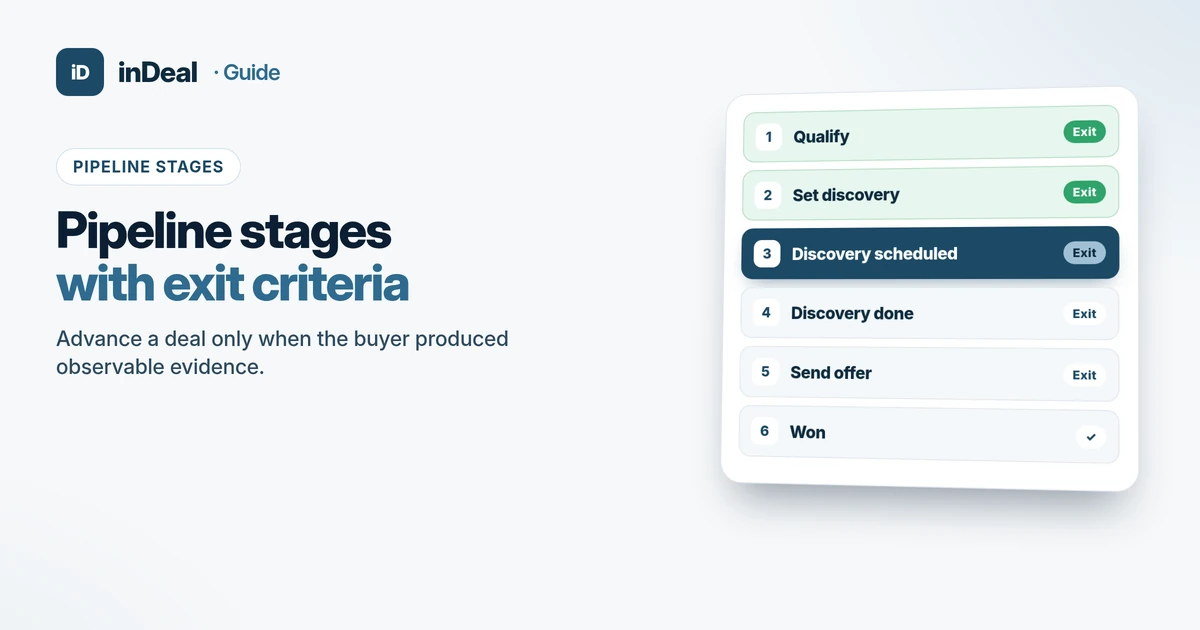 Sales and follow-up
Sales Pipeline Stages 2026: Exit Criteria for SMBs
Sales pipeline stages for small teams: lead and deal stages with exit criteria, a hygiene checklist, and current inDeal labels – evidence over optimism.
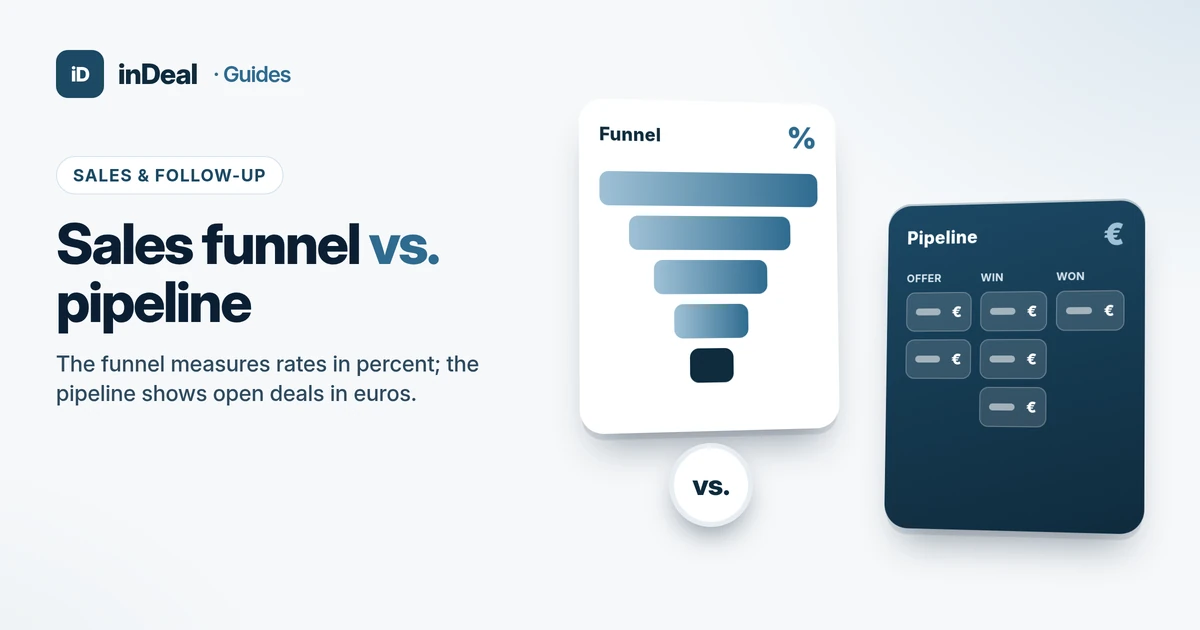 Sales and follow-up
Sales Funnel vs. Pipeline: The Difference, Explained (2026)
Sales funnel vs pipeline: what each one measures, which metrics to track, and a weekly review rhythm for small B2B teams, plus a worked example in euros.
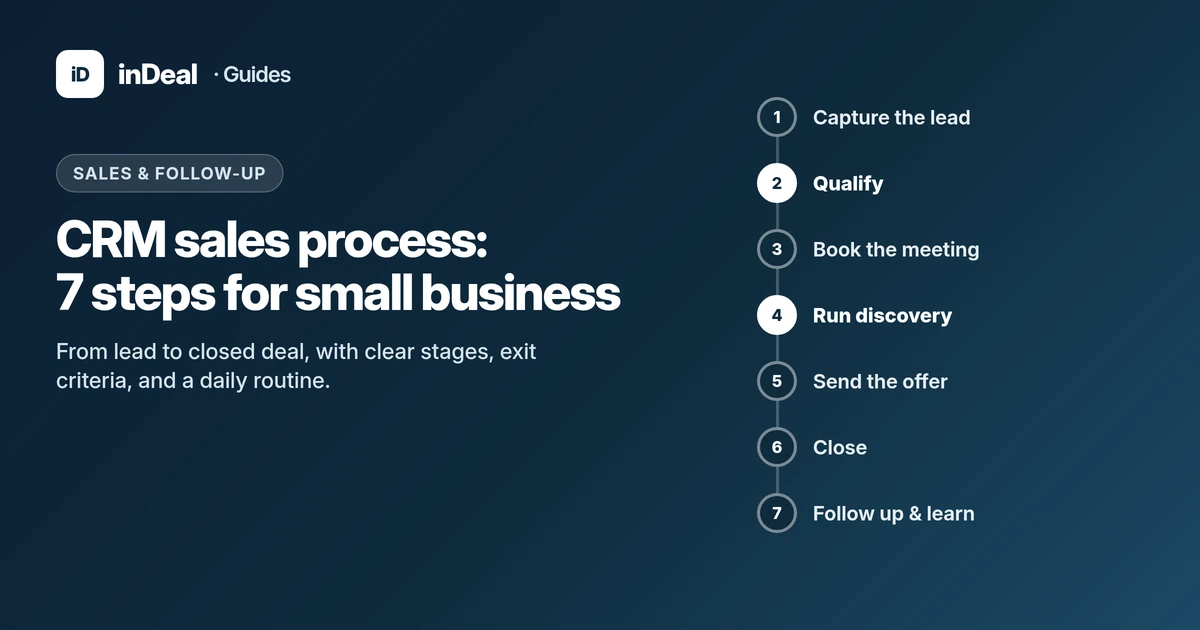 Sales and follow-up
CRM Sales Process 2026: 7 Steps for Small Businesses
A CRM sales process for small business in 7 steps: lead to close, pipeline stages with exit criteria, a daily rhythm, and CRM hygiene rules your team will keep.