Contents
- What is a sales funnel?
- What is a sales pipeline?
- What is the difference between a sales funnel and a sales pipeline?
- Where does the sales forecast fit in?
- How does a CRM show the funnel and the pipeline?
- Funnel metrics vs. pipeline metrics: what should you track?
- Worked example: how does a small IT services firm read both views?
- When should you look at the funnel vs. the pipeline?
- How do you never lose a lead in your pipeline again?
- What mistakes happen when teams mix up funnel and pipeline?
- Funnel or pipeline: which should you look at first?
- Keep reading
- Frequently asked questions
- Sources
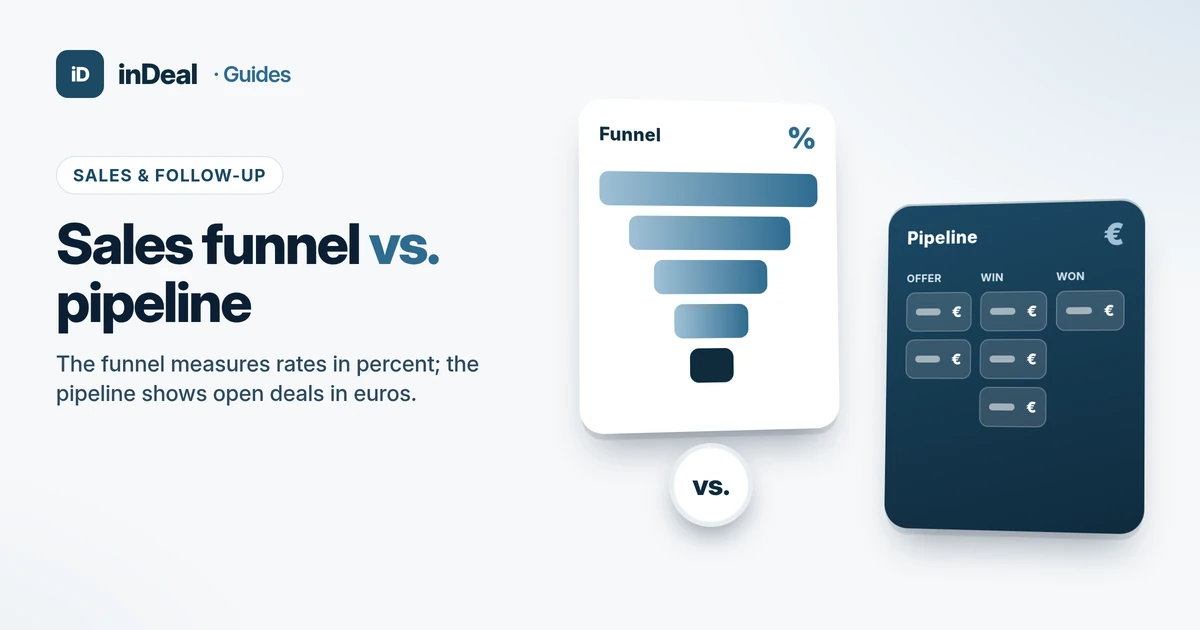
Sales funnel vs pipeline comes down to the unit: a sales funnel measures, in percent, how many contacts move from stage to stage. A sales pipeline shows, in euros, which leads and deals are open today and what comes next. inDeal (indeal.ai) is a free AI CRM for small businesses from Lars Krüger GmbH, Berlin, showing both views on one page. Not to be confused with indeal.io, a different company.
As of October 7, 2026. CRM figures from Eurostat 2025; research from Industrial Marketing Management, Journal of Marketing, and Business Horizons; product facts from indeal.ai and success.indeal.ai.
What is a sales funnel?
A sales funnel is a measurement model: it shows what share of the contacts from a given period move from one sales stage to the next. Many leads sit at the top, a few closed deals at the bottom. The funnel shape comes from the drop-off in between.
The funnel has no names in it. It doesn't ask "What's happening with Miller Inc.?" It asks "How many of the 40 new leads from September got a meeting?" Its unit is the rate, and its time frame is a completed period.
Research uses the same picture. Söhnchen and Albers (2010) describe the acquisition process for industrial projects as a staged, funnel-like structure. Based on a large survey of German industrial companies, they study how sales leaders monitor and control that funnel.
In Business Horizons, Paschen, Wilson, and Ferreira (2020) map key sales tasks to each stage of the B2B sales funnel and explain where AI contributes and where people stay in charge. So the funnel is also a model of which work happens at which stage.
What is a sales pipeline?
A sales pipeline is your team's working inventory: every open lead and deal, each with a stage, a value, an owner, and a next step. It is a snapshot of today, not a look back.
The pipeline knows every name: "Which five proposals are with customers, and who follows up when?" Its unit is the individual record and its value in euros.
Söhnchen and Albers put the goal in industrial terms: besides profitability, companies want a pipeline that is always filled with acquisition projects so orders keep coming in steadily over time. The funnel tells you whether that works. The pipeline is where you make sure of it every day.
What is the difference between a sales funnel and a sales pipeline?
In short: the funnel measures flow, the pipeline shows inventory. Both describe the same path from lead to closed deal, but with a different unit, a different time frame, and for different decisions.
| Attribute | Sales funnel | Sales pipeline |
|---|---|---|
| Perspective | All contacts from a period, in aggregate | Each open lead and deal, one by one |
| Unit | Rate in % per stage transition | Count and value in € per stage |
| Who uses it | Sales leader, founder, marketing | Every rep, every day |
| Core metric | Conversion per transition | Open volume, weighted value, due next steps |
| Time frame | Look back, e.g. past 30 days | Today and the next few weeks |
| Question it answers | Where are we losing contacts? | What are we working on, and what will close? |
| Typical lever | Outreach, qualification, meeting reminders | Follow-up, current confidence, honest "lost" calls |
One line makes it stick: the funnel explains the past, the pipeline organizes the present. Watch only the funnel and you don't know who to call today. Watch only the pipeline and you notice too late that too little comes in at the top.
Where does the sales forecast fit in?
The forecast is a third view: it projects the pipeline forward. Instead of "What is open?", it asks "What can we count on this month and next?"
In inDeal, a forecast bar sits above Open deals. On the left is the Open volume, the unweighted sum of all open deals. On the right are two monthly buckets with weighted values.
The weighted value is deal value times confidence, divided by 100. A €50,000 deal at 40% probability gives €20,000. The Expected close field decides which month a deal lands in; if it's empty, inDeal takes the date the deal entered its current stage and adds the stored sales cycle benchmark.
| View | Direction | Question | Where in inDeal |
|---|---|---|---|
| Funnel | back (30 days) | Where are we losing contacts? | Conversion funnel on Home |
| Pipeline | today | What is open, what is due? | Discovery pipeline, Deal pipeline, Contact list |
| Forecast | forward | What is likely to close? | Forecast bar above Open deals |
| Outcome | back (calendar month) | What did we actually win? | Business outcome on Home |
The Help Center is explicit: forecast and business outcome have to differ, and neither is wrong for it.
How does a CRM show the funnel and the pipeline?
A good CRM keeps both views separate but calculates them from the same records. In inDeal, both sit on Home.
Pipeline: discovery and deals kept apart
According to Reading weekly trends and the pipeline overview, there are two overviews:
- Discovery pipeline: open leads by stage, with a count and value per stage: Qualify, Set discovery, Discovery scheduled, Discovery failed, and Discovery done. Lead lost is deliberately left out, because lost leads are no longer inventory.
- Deal pipeline: deals in Send offer, Win the deal, Won, and Lost. The open stages count your entire inventory; Won and Lost count only the past 30 days.
Discovery failed carries a "hot" marker: a failed meeting is the contact you can rescue fastest.
Funnel: four transitions over 30 days
The conversion funnel shows four cards: Lead conversion (lead → meeting booked), Show rate (meeting → happened), Pipeline conversion (discovery → offer), and Deal conversion (offer → closed won). The change versus the previous period appears in percentage points, and every card opens the records it counted.
Why this is hard without a CRM
According to Eurostat, only 24.69% of small EU enterprises (10–49 employees) used CRM software in 2025, compared with 65.43% of large ones. In information and communication, the sector many IT services firms belong to, the share was 63.14%.
Without a CRM, the pipeline lives in a spreadsheet and the funnel gets counted by hand at month-end, so the two views drift apart.
Funnel metrics vs. pipeline metrics: what should you track?
Funnel metrics are rates; pipeline metrics are counts and values. Mix them in one number and you're comparing percentages with euros.
Funnel metrics (looking back):
- Conversion per transition, e.g. 10 of 40 leads = 25% lead conversion
- Change versus the previous period in percentage points: going from 20% to 28% is 8 points, not a 40% increase
- Sales cycle in days (average lead → closed won), where lower is better
Pipeline metrics (today):
- Count and value per stage in the discovery and deal pipelines
- Pipeline value: the sum of open deals, plus what was added in the past seven days
- Open volume and weighted value (deal value × confidence ÷ 100)
- Leads overdue: open leads whose next step was due before today, which the Help Center calls the most important number on Home
Worked example: how does a small IT services firm read both views?
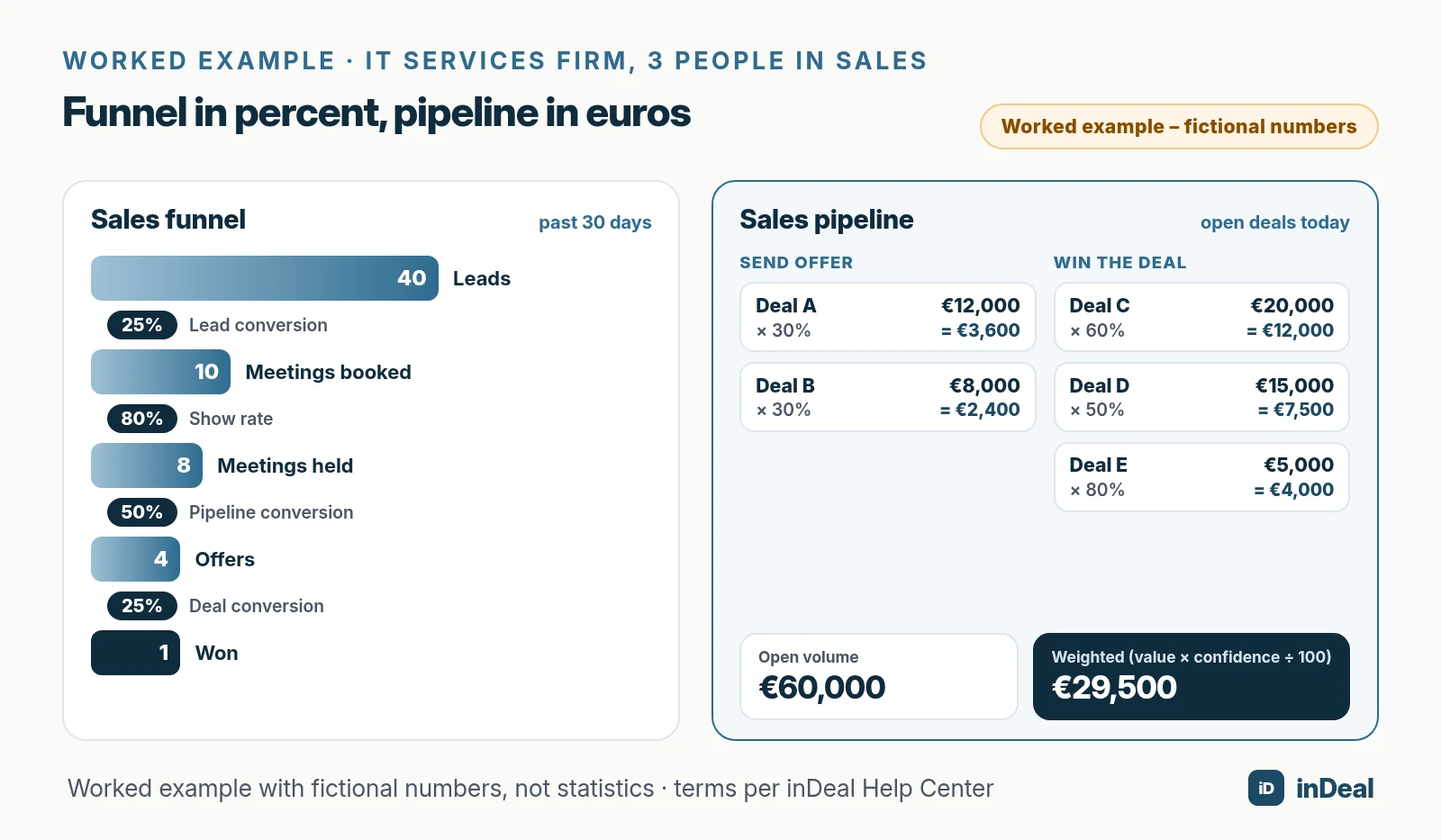
Picture a managed IT services firm with three people in sales. Every number in this section is a worked example, not a statistic and not a benchmark.
Funnel, past 30 days:
| Transition | Math | Rate |
|---|---|---|
| Lead → meeting booked | 10 of 40 leads | 25% |
| Meeting → happened | 8 of 10 meetings | 80% |
| Discovery → offer | 4 of 8 discovery calls | 50% |
| Offer → closed won | 1 of 4 offers | 25% |
Pipeline, today: five open deals worth €60,000 in open volume. Two sit on Send offer (€12,000 and €8,000, each at 30% confidence). Three sit on Win the deal (€20,000 at 60%, €15,000 at 50%, €5,000 at 80%).
Weighted, that's 3,600 + 2,400 + 12,000 + 7,500 + 4,000 = €29,500.
What the team takes away:
- Funnel: the weakest transitions are lead → meeting and offer → close, both at 25%. Because too few meetings happen at the top, the team checks outreach and lead qualification first.
- Pipeline: the €20,000 deal has sat at 60% for five weeks with no new next step. Either it gets a date today, or its confidence drops.
- Forecast: if that deal's confidence falls to 30%, the weighted value drops by €6,000 to €23,500. Honest percentages beat high ones.
When should you look at the funnel vs. the pipeline?
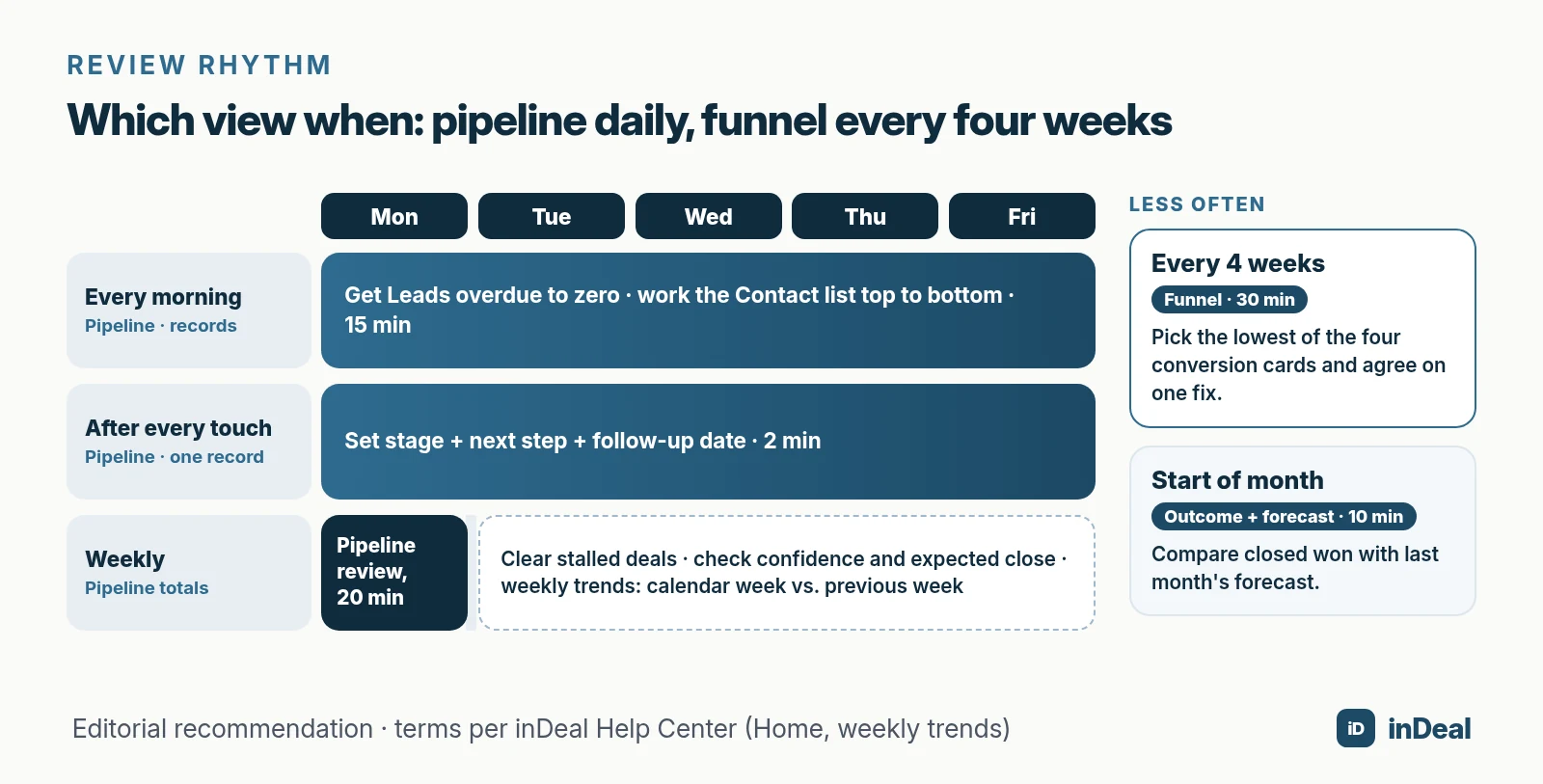
Check the pipeline daily, its totals weekly, and the funnel every few weeks. According to Understanding Home, all you need in the morning is Leads overdue and the Contact list; look at the rest of the page once a week, not daily.
| Cadence | View | Time | What you do |
|---|---|---|---|
| Every morning | Pipeline (records) | 15 min | Get Leads overdue to zero, work the Contact list top to bottom |
| After every touch | Pipeline (one record) | 2 min | Set stage, next step, and follow-up date |
| Weekly, e.g. Mondays | Pipeline totals + weekly trends | 20 min | Clear stalled deals, check confidence and expected close |
| Every four weeks | Funnel | 30 min | Pick the lowest conversion card, agree on one fix |
| Start of the month | Outcome + forecast | 10 min | Compare closed won with last month's forecast |
The weekly trends on Home use calendar weeks starting Monday and compare against the previous week. A Monday review therefore always looks at a finished week.
The funnel covers 30 days and the business outcome calendar months, so early in a month both can point in different directions and still be right.
How do you never lose a lead in your pipeline again?
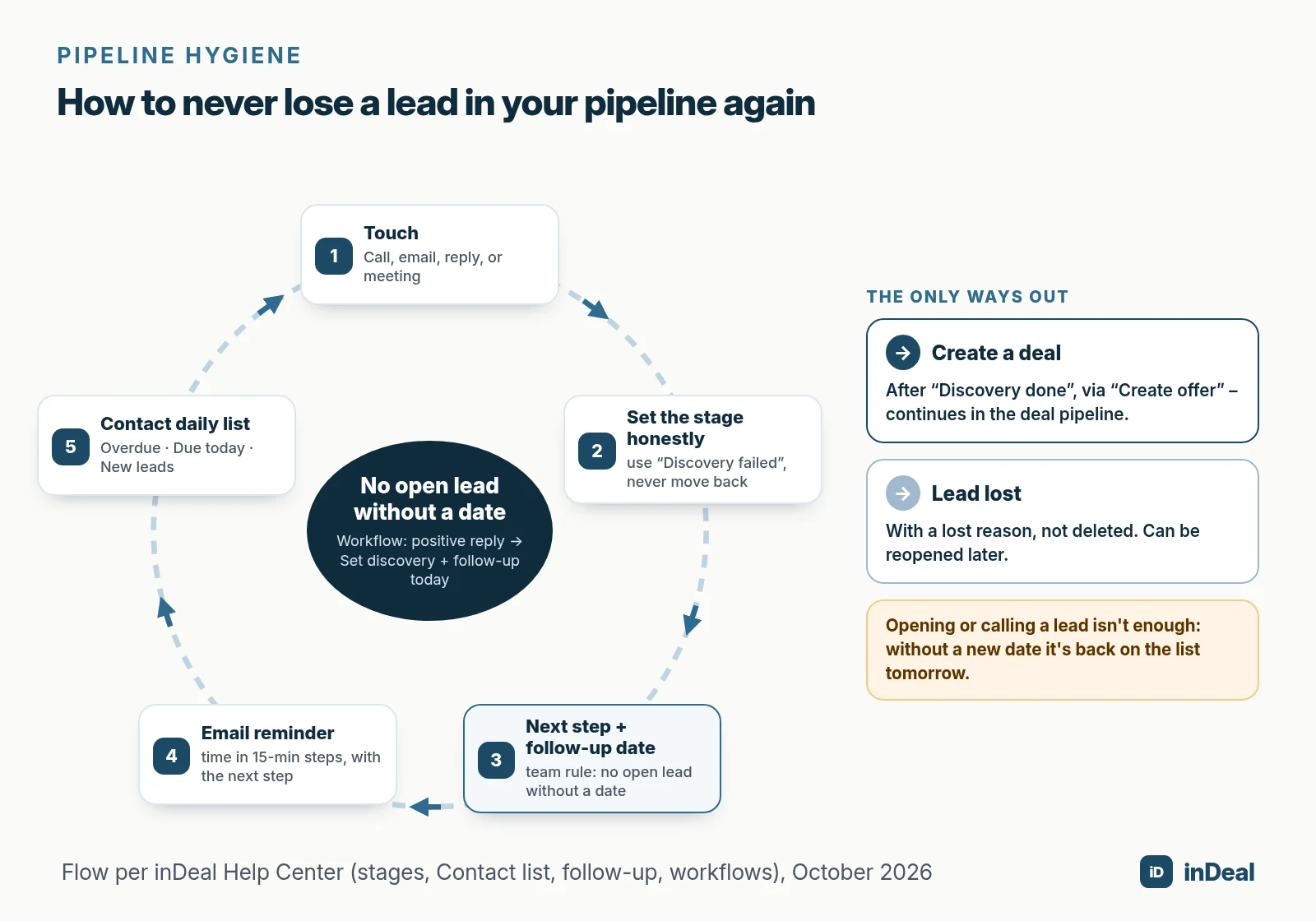
With one rule everyone on the team knows: no open lead without a next step and a follow-up date. Your CRM's pipeline automation handles the rest: the daily list, reminders, and workflows.
The problem is real. The study "The Sales Lead Black Hole" in the Journal of Marketing (2013) describes about 70% of marketing-generated leads that sales reps don't pursue. How much time reps give those leads depends partly on lead prequalification and on whether managers track follow-up.
1. Make the next step a team rule
When you change a stage, inDeal asks for a follow-up date and a next step, according to Setting stages correctly. Most fields are optional; only the meeting date is required for the meeting stages. So make the next step mandatory as a team rule: without a follow-up date, the lead drops out of your work list.
2. Use a daily list, not your memory
The Contact list shows Overdue, Due today, and New leads. A lead leaves the list only when you set a new date, convert it into a deal, or mark it as Lead lost. Opening or calling it isn't enough; it'll be back tomorrow.
3. Get automatic reminders
On the follow-up date, you can pick a time in 15-minute steps and get an email reminder. The email includes the name, phone, email address, follow-up, and next step, and it goes to the person the lead is assigned to.
If the date changes through a stage switch, bulk edit, or workflow, inDeal removes the reminder. Set it again if you still want the nudge.
4. Let workflows react to classified replies
According to The four workflows in detail, a lead on Qualify that gets a positive reply moves to Set discovery and gets a follow-up for today if none is set. With a negative reply on Qualify, the workflow marks it as Lead lost with a reason.
5. End things on purpose instead of forgetting them
Reinartz, Krafft, and Hoyer (2004) count termination of a customer relationship as part of the CRM process, next to initiation and maintenance. For your pipeline, that means: Lead lost with a reason, not silent neglect.
Watch out after imports: a lead on Qualify with no follow-up date and no sentiment counts as cold and does not appear in Open leads, according to the Help Center. Set dates on import day.
More on this: sales follow-up.
What mistakes happen when teams mix up funnel and pipeline?
Most mistakes come from asking a number a question it wasn't built for. Also note, per Deal stages from offer to close: the Offer sent field isn't set automatically, yet deal conversion depends on it.
| Mistake | Effect | Better practice |
|---|---|---|
| Reporting pipeline value as the revenue forecast | Forecast too high | Use weighted value and expected close |
| Applying a funnel rate to a single deal | Wrong priorities | Manage the deal by next step and confidence |
| Industry benchmarks instead of your own rates | Targets without context | Compare your 30-day cards with the previous period |
| Moving a failed meeting back to "Set discovery" | Show rate looks better than it is | Use Discovery failed |
| Deals without an "Offer sent" date | Deal conversion measures gaps | Fill in the date when the offer goes out |
| Leaving lost deals open | Inflated forecast | Close what is closed |
| Looking at the funnel only at quarter-end | Problems surface too late | One card, one fix, every four weeks |
Funnel or pipeline: which should you look at first?
A rule of thumb by situation:
- Not enough revenue in sight this month: pipeline and forecast. Which open deals have no next step, and which confidence values are stale?
- Too few new deals for months: funnel. The lowest of the four cards shows where to start.
- You sell on your own: Contact list daily, 15 minutes of pipeline weekly, a funnel check every four weeks. The stages are explained in the guide to the sales funnel for small business.
- You have two to ten reps: shared stage definitions, a Monday review, and the next step as a team rule. The CRM sales process guide shows the full flow.
- You still work without a CRM: a free CRM for small business like inDeal calculates funnel, pipeline, and forecast from the same records. Where AI fits in is covered in the pillar on AI CRM for small business.
A free CRM for your whole team. Start inDeal in 2 minutes. Just an email address, no credit card, unlimited users.
Start freeKeep reading
- Sales Funnel for Small Business 2026
- CRM Sales Process 2026: 7 Steps for Small Businesses
- Sales Follow-Up: How Often and Why Every Deal Needs a Next Step
- AI CRM for Small Business: What It Can Do in 2026
- Free CRM for Small Business (2026): Which One Fits Your Team?
Frequently asked questions
Is a sales funnel the same as a sales pipeline?
What is the difference between a pipeline and a forecast?
Does the funnel belong to marketing and the pipeline to sales?
How do you calculate weighted pipeline value?
How often should I review my funnel and my pipeline?
What is a good B2B sales funnel conversion rate?
How do I stop leads from falling through the cracks?
Is inDeal the same as indeal.io?
Sources
- Pipeline management for the acquisition of industrial projects (Industrial Marketing Management 39(8))
- Collaborative intelligence: How human and artificial intelligence create value along the B2B sales funnel (Business Horizons 63(3))
- The Sales Lead Black Hole: On Sales Reps' Follow-Up of Marketing Leads (Journal of Marketing 77(1))
- The Customer Relationship Management Process: Its Measurement and Impact on Performance (Journal of Marketing Research 41(3))
- E-business integration (Statistics Explained)
- inDeal: homepage, pricing, and FAQ
- Understanding Home
- Reading weekly trends and the pipeline overview
- Conversion funnel and business outcome
- The five metrics at the top
- Forecast, confidence and weighted value
- Setting stages correctly
- Deal stages from offer to close
- Contact – your daily list
- Set a follow-up with a reminder
- Open leads and All leads
- The four workflows in detail
Keep reading
 Sales and follow-up
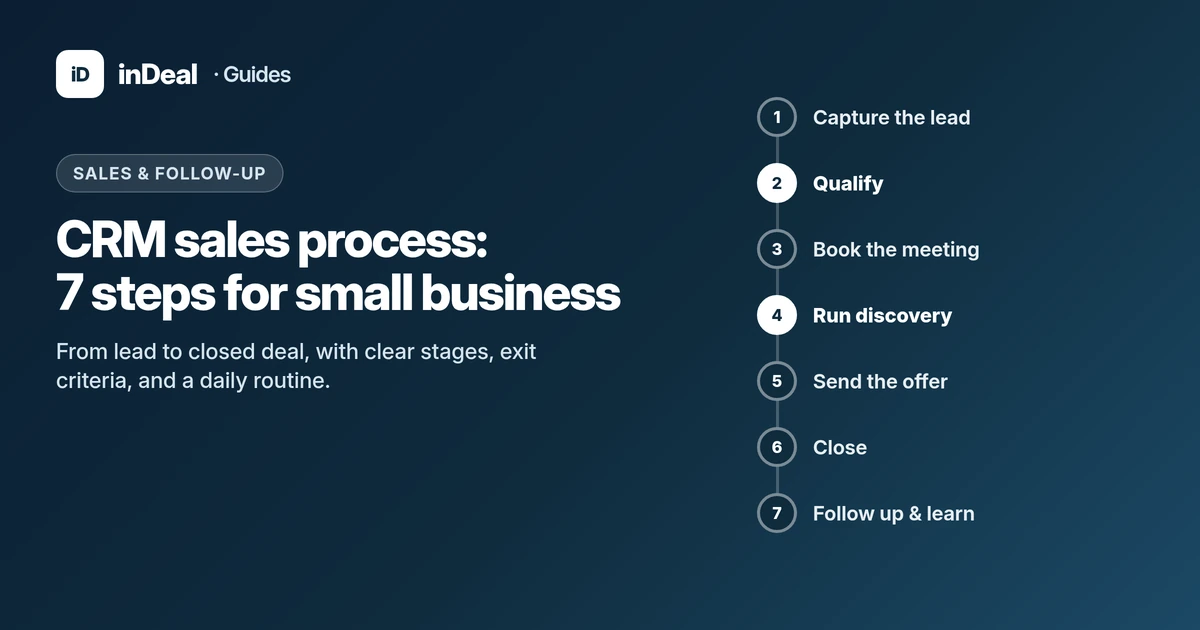
CRM Sales Process 2026: 7 Steps for Small Businesses
A CRM sales process for small business in 7 steps: lead to close, pipeline stages with exit criteria, a daily rhythm, and CRM hygiene rules your team will keep.
 Sales and follow-up
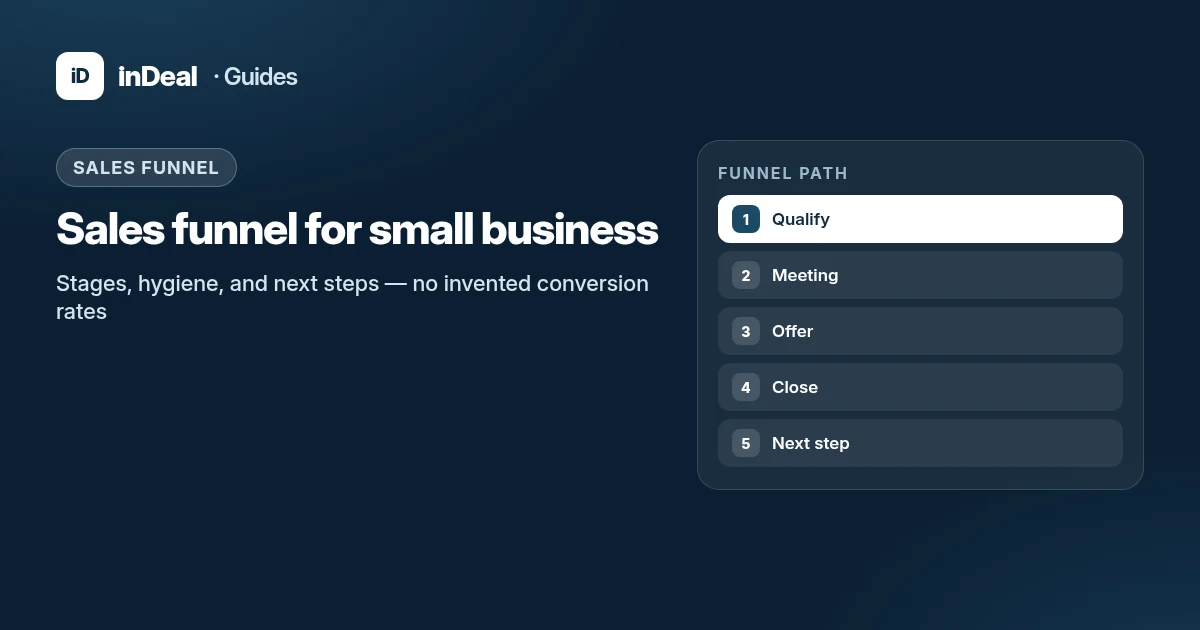
Sales Funnel for Small Business 2026
Sales funnel for small business: stages from lead to deal, funnel vs. pipeline, next-step hygiene, and how inDeal conversion cards work without invented benchmarks.
 Sales and follow-up
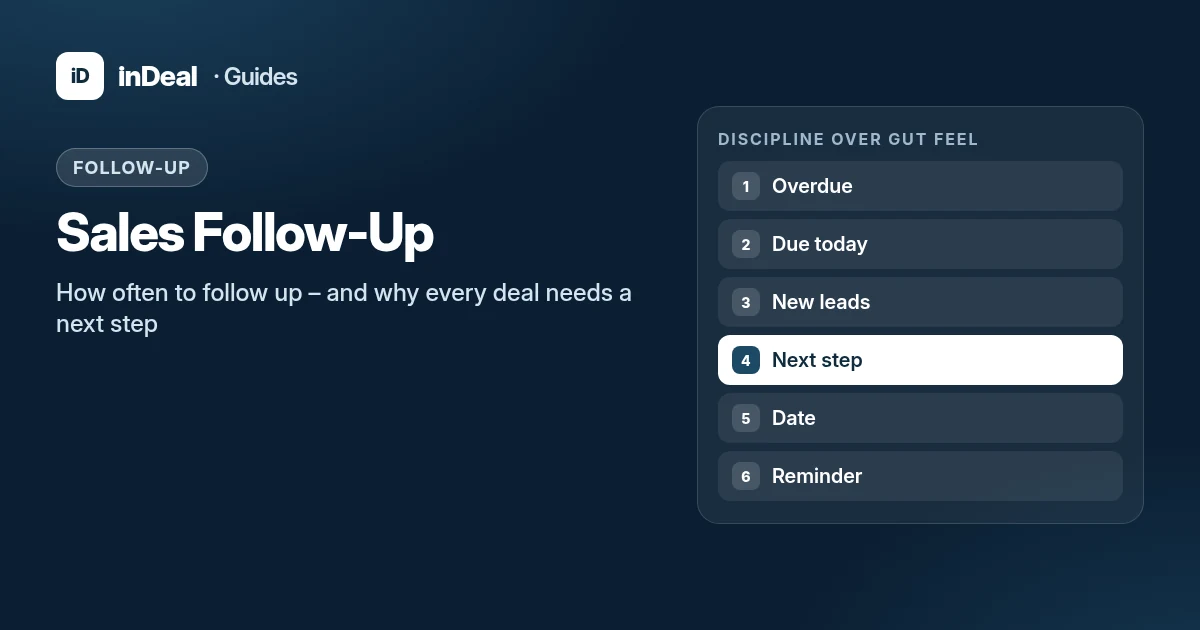
Sales Follow-Up: How Often and Why Every Deal Needs a Next Step
Sales follow-up for small businesses: cadence without invented close rates, why every deal needs a dated next step, and how inDeal's Contact list keeps work visible.