Contents
- How much does a CRM really cost a small business?
- What are the cost blocks of a CRM?
- What pricing models do CRMs use?
- How much do small businesses spend on digital tools?
- Is a free CRM really free?
- What does it cost to switch CRMs?
- Why is a CRM nobody uses the most expensive one?
- How do you calculate your 3-year CRM total cost?
- How much does inDeal cost?
- How do you keep CRM costs low for your small business?
- Keep reading
- Frequently asked questions
- Sources
CRM cost for small business is much more than the subscription: setup, data migration, training, usage, upkeep and switching later often make up the bigger share. If you only compare monthly prices, you can easily pick the CRM that costs the most over three years, or one nobody on your team uses. inDeal (indeal.ai) is a free AI CRM for small businesses by Lars Krüger GmbH, Berlin. Not to be confused with indeal.io, a different company.
As of October 26, 2026. Data: KfW SME digitalisation report 2025, Eurostat 2025/2026, Speier & Venkatesh 2002; law: EU Data Act (EUR-Lex, European Commission), GDPR; definitions: SBA, European Commission; product: success.indeal.ai and indeal.ai. No vendor prices, not legal advice.
How much does a CRM really cost a small business?
Subscription plus setup plus ongoing work plus exit, calculated over the whole time you use it. There's no honest one-size-fits-all number, because team size, pricing model and the state of your data vary too much. But you can calculate it reliably yourself.
What counts as "small" depends on where you are. In the US, the SBA sets size standards by industry: most manufacturers with 500 employees or fewer and most non-manufacturers with average annual receipts under $7.5 million qualify. In the EU, an SME has fewer than 250 employees and up to €50 million in revenue or €43 million in total assets (European Commission).
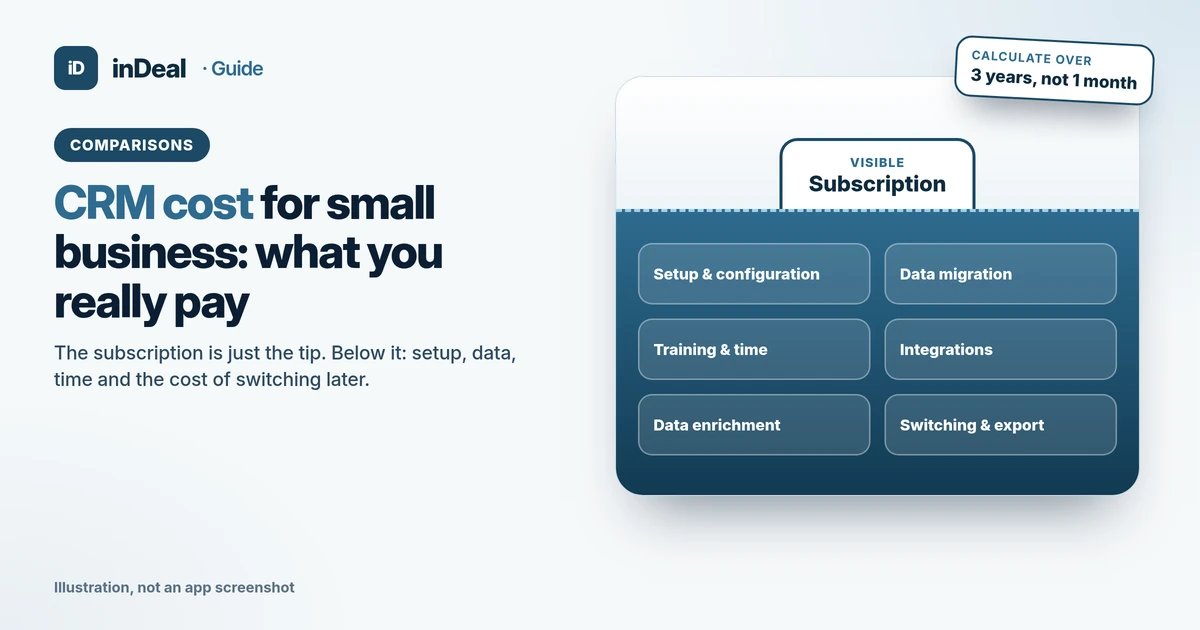
For most teams, the subscription price is visible and everything else only shows up after you sign. Like an iceberg: below the surface sit setup, data migration, training, integrations, data enrichment and switching. The good news: you can estimate most of these costs up front and keep them small with the right choice.
What are the cost blocks of a CRM?
Three groups: one-time costs at launch, ongoing costs every month and costs when you switch. Most people forget the third.
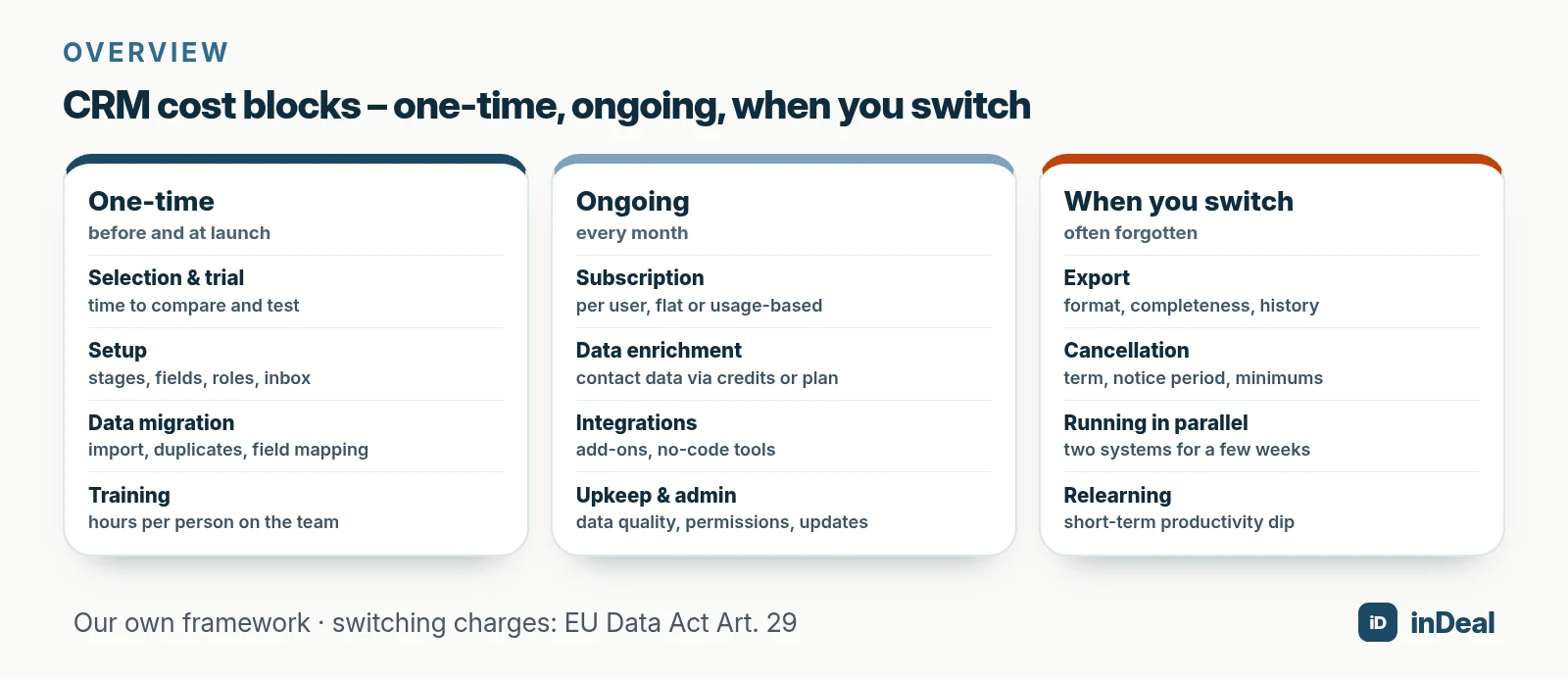
| Cost block | What it includes | How to estimate it |
|---|---|---|
| Selection and trial | comparing, demos, trial period | hours × internal hourly rate |
| Setup | stages, fields, roles, connecting your inbox | hours in-house or a consultant's quote |
| Data migration | export from spreadsheets or old system, duplicates, field mapping | hours for cleanup and import |
| Training | onboarding every person | users × hours × hourly rate |
| Subscription | per user, flat or usage-based | monthly price × users × 36 |
| Usage and add-ons | data enrichment, add-ons, integrations | expected monthly usage × 36 |
| Upkeep | data quality, permissions, updates | admin hours per month × 36 |
| Switching | export, parallel run, notice period | hours plus remaining contract term |
The biggest difference between two offers is rarely the subscription. It comes from setup, migration and time. A CRM that takes two weeks to configure costs a three-person team more working days than one that ships with a ready-made sales process.
What pricing models do CRMs use?
Four basic models, often mixed. Which is cheapest for you depends mostly on team size and usage.
| Pricing model | How you're billed | Good for | Watch out for |
|---|---|---|---|
| Per user | fixed amount per person per month | stable teams with few users | cost rises with every new person |
| Flat | one price for the team or a user tier | predictable budgets | jumps when you hit the next tier |
| Usage-based | credits for specific actions | fluctuating needs | what exactly uses credits, and only on success? |
| Freemium | basics free, extras paid | starting with no budget | limits on users, contacts and features |
Many vendors combine models, for example per-user fees plus paid add-ons. So don't just read the entry-tier price; check which feature sits in which tier. What a small sales team actually needs is often one tier up: email integration, automations or reports. Also count everyone who'll use it in three years, including part-timers, freelancers and the owner who only wants to read reports.
How much do small businesses spend on digital tools?
Less in absolute terms than you might think, but often more relative to revenue than large firms. That's what the KfW SME digitalisation report 2025 shows for Germany, based on 2024 data from KfW, the German state development bank.
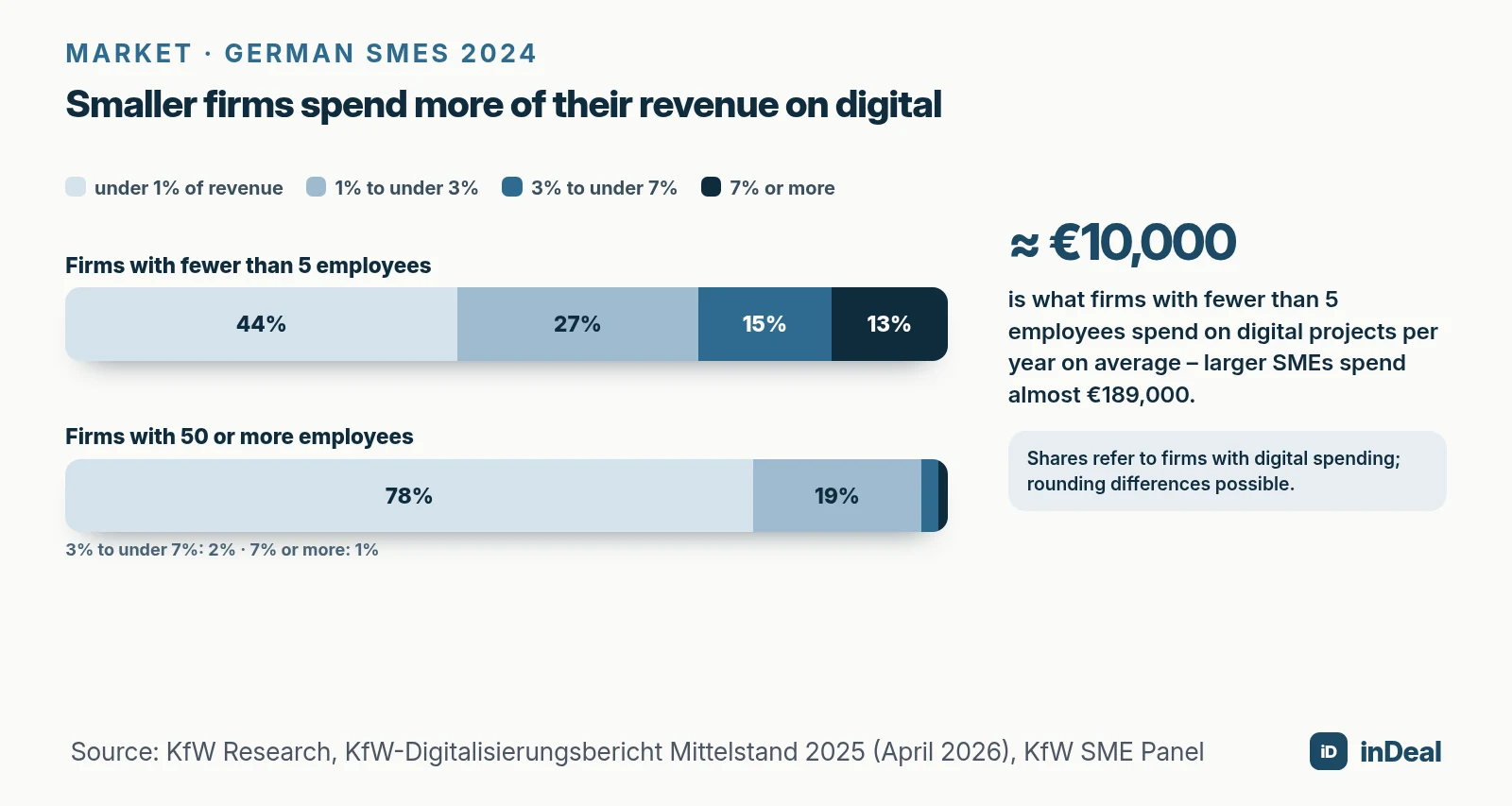
Key figures for 2024:
- Who's investing: 30% of German SMEs completed a digital project. In total, they spent €23.8 billion on it (KfW).
- How much: Firms with digital spending averaged about €25,000. Firms with fewer than 5 employees spent almost €10,000, firms with 50 or more almost €189,000, nearly 19 times as much.
- Relative to revenue: 13% of the smallest firms spent 7% of revenue or more, and another 15% spent between 3% and 7%. Among larger SMEs, those shares were just 1% and 2%.
- Few physical assets: Only 37% of project costs are material investments. The rest is mostly work, consulting and know-how.
What that means for your CRM: for small teams, costs weigh heavily, and most of them are time, not hardware. That's where to save. KfW also lists data protection and security, the effort of adapting IT and processes, and a lack of IT skills among the barriers.
Across Europe, a CRM still isn't a given in small firms: according to Eurostat, only 24.69% of small enterprises (10–49 employees) used CRM software in 2025, versus 28.51% of all enterprises and 65.43% of large ones. 52.7% of all enterprises used paid cloud services, and 27.9% of those used them for CRM (Eurostat).
Is a free CRM really free?
The software can be; your time never is. A free CRM saves you the subscription, not the setup, data upkeep or training. So what matters is where the free plan ends.
Check every free offer for:
- Users: Is the whole team free, or just one person?
- Data: Is there a contact cap? What happens when you hit it?
- Features: Are pipeline, email integration and reminders included?
- Usage: What does data enrichment cost, and are you only charged on success?
- Export: Can you get all your data, including history, out in a common format?
A free plan pays off when you can stay on it long term. It gets expensive when you hit a limit after three months and have to switch or upgrade under pressure. Typical limits are covered in Free CRM Limits; options for small teams are in Free CRM for Small Business.
What does it cost to switch CRMs?
Mostly time and double work. Export, cleanup, import, a few weeks of running two systems and getting your team used to the new one come with every switch. Add the notice period and minimum term of your old contract.
If you use a cloud CRM in the EU, the EU Data Act shifts things in your favor. The regulation has applied since September 12, 2025 (European Commission):
- Export: Software-as-a-service providers must offer open interfaces and, at a minimum, export data in a commonly used, machine-readable format.
- Switching charges: From January 12, 2027, switching charges go away entirely, including data egress fees. Until then, providers may only charge what switching actually costs them (Data Act, Art. 29).
The law doesn't cover your own team's time, though. If you're moving from spreadsheets or an old system, plan the migration carefully. When the move pays off is explained in Spreadsheet vs. CRM.
Why is a CRM nobody uses the most expensive one?
Because you pay for everything and get nothing: the subscription, setup and training are gone, and your leads still live in inboxes and spreadsheets.
Research has known this for a long time. In a study of 454 salespeople at two companies, teams rated a new sales force automation tool positively right after training. Six months after launch, it had been widely rejected, and absenteeism and voluntary turnover had risen significantly (Speier & Venkatesh, 2002).
The lesson for small businesses: count adoption as a cost. A CRM that starts with a ready-made sales process and takes work off your plate instead of adding it needs less setup time and is more likely to get used. Think dated next steps, reminders and automatically enriched contacts. What AI adds here is covered in AI CRM for Small Business.
How do you calculate your 3-year CRM total cost?
With a simple worksheet and your own numbers. Three years is a sensible horizon because one-time costs spread out and a later switch is included.
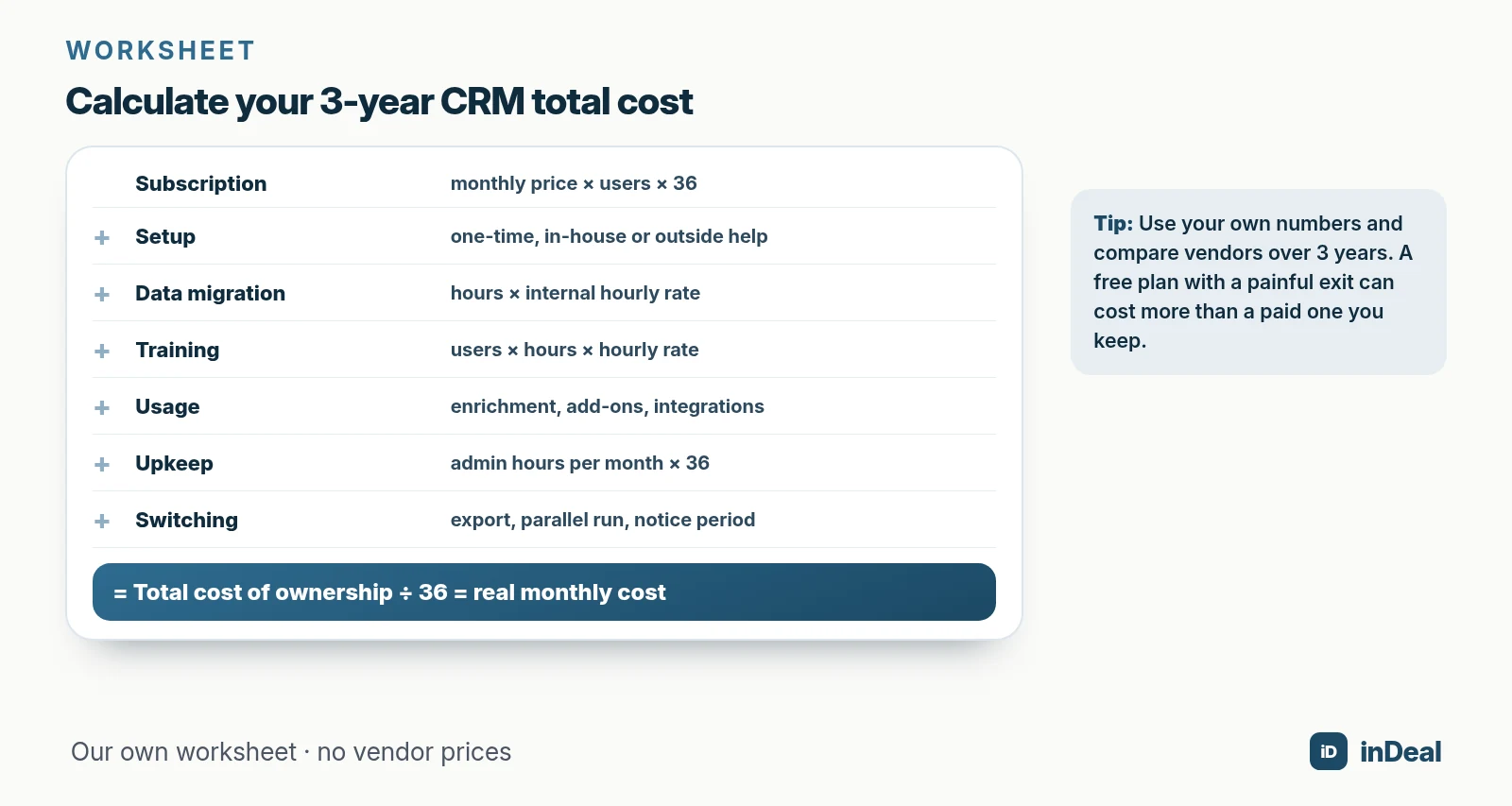
Here's how:
- Subscription: monthly price × users × 36. Use the team size you expect in three years, not today's.
- Setup: hours for stages, fields, roles and inbox × internal hourly rate, or a consultant's quote.
- Data migration: hours for export, cleanup and import × hourly rate.
- Training: users × hours × hourly rate.
- Usage: data enrichment, add-ons and integrations per month × 36.
- Upkeep: admin hours per month × hourly rate × 36.
- Switching: estimated hours for a later exit plus any remaining contract term.
The total is your TCO (total cost of ownership); divide by 36 for your real monthly cost. Only compare vendors on that basis.
| Question | Why it changes the cost |
|---|---|
| Do you pay per user? | Every new person permanently raises the subscription |
| Is the sales process preconfigured? | Saves days of setup |
| Is usage only charged on success? | You only pay for data that's found |
| Are there minimum terms? | Sets the cost of leaving |
| Can you get all your data out? | Lowers switching costs |
| Where is data stored, is there a DPA? | Avoids data protection work |
How pricing with and without per-user fees develops as your team grows is worked through in CRM Without Per-User Pricing. For agencies with changing freelancers, CRM for Agencies shows what matters.
How much does inDeal cost?
The CRM itself costs nothing. According to indeal.ai, the CRM, all users and adding leads by hand or by CSV are free; there's no per-user license. You need credits for data enrichment, and you're only charged for contact details that are found.
Here's what that means for the cost blocks:
- Subscription: no per-user fee. You invite your team and assign the Admin or Sales role (Managing the team).
- Data migration: CSV import with automatic column mapping; duplicate rows and conflicts go into an error report with the reason (Creating, importing and enriching leads).
- Usage: credits are only used when inDeal searches for contact details such as an email address or phone number for you, and every transaction shows up in the history (Credits and usage).
- Data protection: data is stored on servers in the EU (Frankfurt) (indeal.ai). The DPA under Art. 28 GDPR is in the Legal section (Trash and legal).
You can add the appointment agent, which sets up meetings from your LinkedIn profile; the CRM stays free with or without it. When an agent like that pays off is covered in AI CRM vs. AI SDR.
How do you keep CRM costs low for your small business?
By calculating over three years and tackling the hidden costs first. The subscription is the smallest lever; setup, migration, adoption and exit decide.
| Situation | What lowers the cost |
|---|---|
| Small team, tight budget | Free CRM without per-user fees, preconfigured process |
| Team growing fast | Pricing with no cost per head |
| Lots of data in spreadsheets | Plan a CSV import, clean duplicates first |
| Switch coming up | Check export and notice periods, use the Data Act |
| Team dislikes new tools | A CRM that removes work: reminders, enrichment, set next steps |
| Strict data protection needs | Check EU hosting and the DPA |
Every lead without a next step ends up costing you more than any license: lost meetings, forgotten proposals, revenue that goes to a competitor. The cheapest CRM is the one your team uses every day.
A free CRM for your whole team. Start inDeal in 2 minutes. Just an email address, no credit card to sign up, unlimited users.
Start freeKeep reading
- AI CRM for Small Business: What It Can Do in 2026
- Free CRM for Small Business (2026): Which One Fits Your Team?
- CRM Without Per-User Pricing: How It Works in 2026
- Free CRM Limits 2026: A Small-Business Checklist
- Spreadsheet vs. CRM: When Small Businesses Should Switch
Frequently asked questions
How much does a CRM cost for a small business?
What are the hidden costs of a CRM?
Is a free CRM really free?
How do I calculate the total cost of ownership (TCO) of a CRM?
How much does it cost to switch CRMs?
Which CRM pricing model is cheapest for a small team?
How much does inDeal cost?
Is inDeal the same as indeal.io?
Sources
- KfW-Digitalisierungsbericht Mittelstand 2025 (KfW SME digitalisation report, German)
- KfW-Digitalisierungsbericht Mittelstand 2025 (news release, German)
- E-business integration
- Over half of EU enterprises used paid cloud services in 2025
- The Hidden Minefields in the Adoption of Sales Force Automation Technologies (Journal of Marketing 66(3))
- Regulation (EU) 2023/2854 (Data Act)
- Data Act explained
- Regulation (EU) 2016/679 (General Data Protection Regulation)
- SME definition
- Size standards
- Managing the team
- Creating, importing and enriching leads
- Credits and usage
- Trash and legal
- inDeal: Home page and FAQ
inDeal is the AI CRM for small and mid-sized B2B companies.
Keep reading
 Comparisons
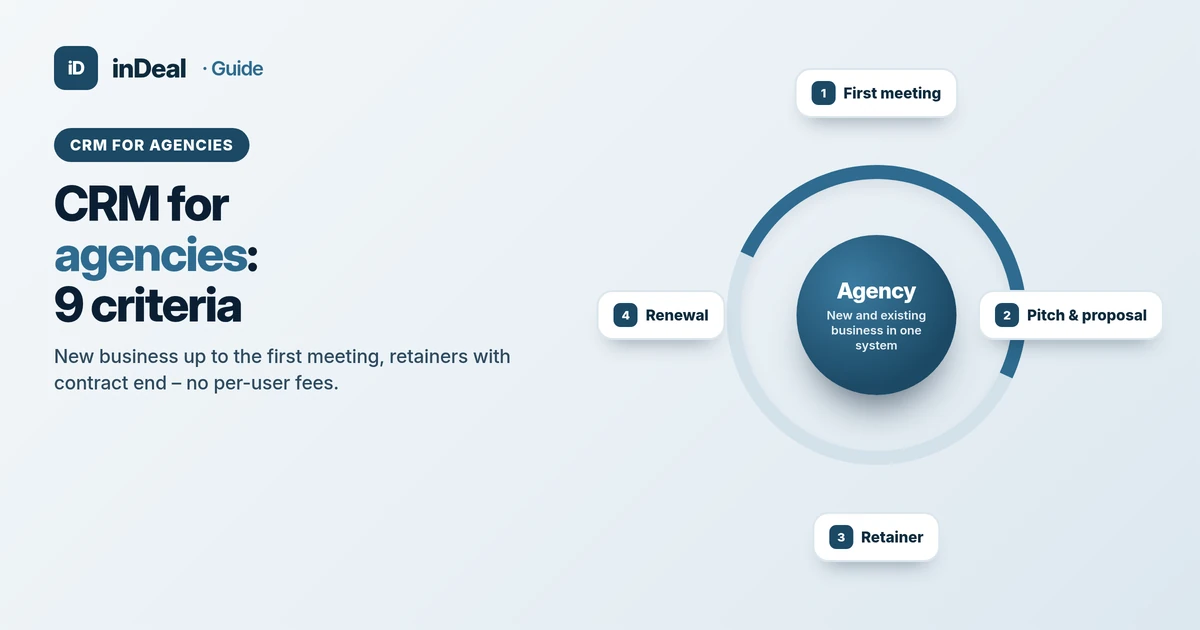
CRM for Agencies 2026: 9 Criteria for Small Agency Teams
CRM for agencies: 9 criteria for new business, retainers and team roles – a neutral guide for small marketing agencies, with a free start and no per-user fees.
 Comparisons
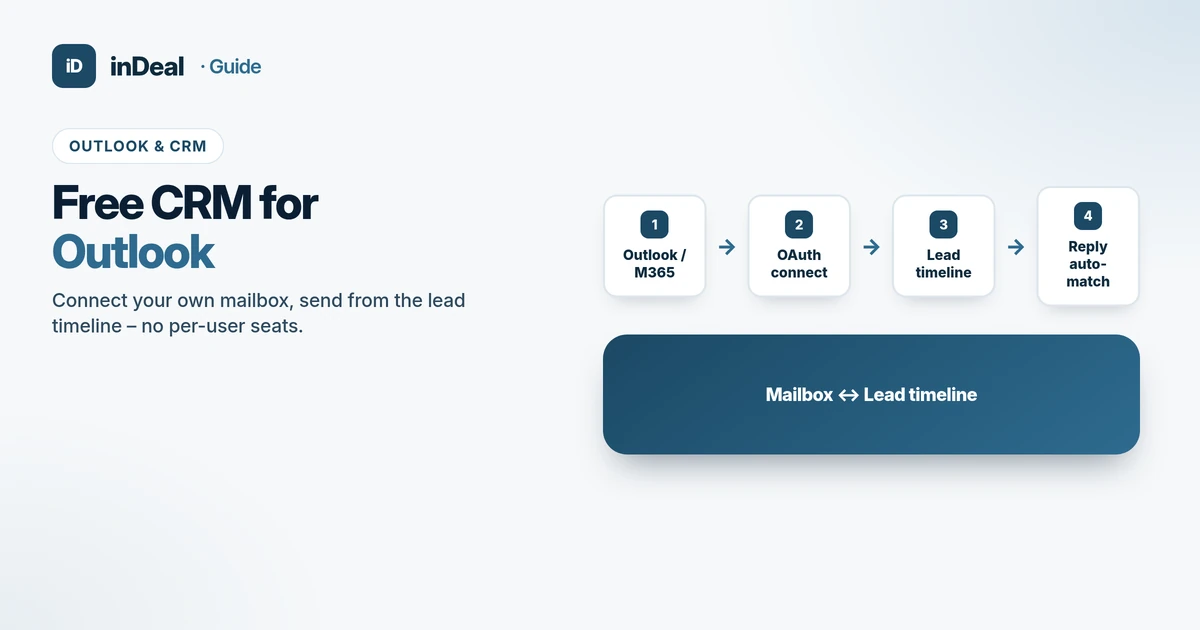
Free CRM for Outlook 2026: Mailbox & Timeline
Free CRM for Outlook: connect your own mailbox, send from the lead timeline, match replies automatically – a criteria checklist without per-user seats.
 Comparisons
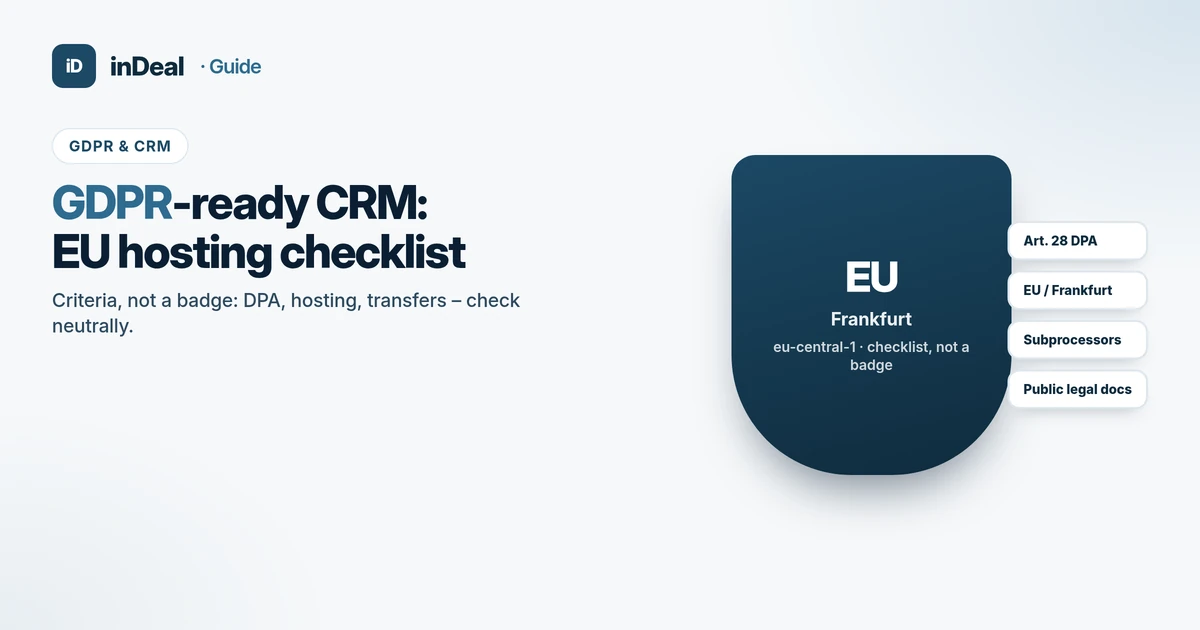
GDPR-Compliant CRM 2026: EU Hosting Checklist
GDPR-compliant CRM checklist: Art. 28 DPA, EU/Frankfurt hosting, subprocessors and transfers – criteria for small businesses, no compliance superlatives.