Contents
- What does "CRM without per-user pricing" mean?
- What CRM pricing models are there?
- Why is per-user pricing a problem for small businesses?
- How does a usage-based CRM like inDeal work?
- Is a CRM without per-user pricing really free?
- What does a CRM without per-user pricing cost in practice?
- What costs come on top of the license?
- What should you check before choosing a CRM without per-user pricing?
- How do you switch to a CRM without per-user pricing?
- Who benefits most from a CRM without per-user pricing?
- Which CRM pricing model fits your team?
- Keep reading
- Frequently asked questions
- Sources
A CRM without per-user pricing does not bill each person on your team; it charges for tiers, usage or add-on services instead. Cost grows with usage rather than headcount, so everyone with customer contact can join. inDeal (indeal.ai) is a free AI CRM for small businesses from Lars Krüger GmbH, Berlin: €0 per user, credits only for contact data found. Not to be confused with indeal.io, a different company.
As of October 9, 2026. Net prices from indeal.ai and success.indeal.ai; CRM figures from Eurostat 2025; law from EUR-Lex (GDPR).
What does "CRM without per-user pricing" mean?
It means you don't pay per person. With classic pricing, every login costs a fixed monthly amount. Without per-user pricing, the team is free; something else gets billed.
A user license, often called a "seat", is the right of one person to use the software. If you want five sellers, an owner and an assistant in the CRM, a seat model charges you seven times.
Without per-user pricing, that math disappears. It doesn't mean the CRM is always completely free. It means team size is not what drives the price.
For small teams, that is more than a pricing detail. It decides whether the CRM becomes the shared memory of every customer touch, or just the tool of one or two people while everyone else keeps working from inboxes and spreadsheets.
What CRM pricing models are there?
Four basic models are common. Many vendors combine them, for example a free plan plus paid per-user tiers.
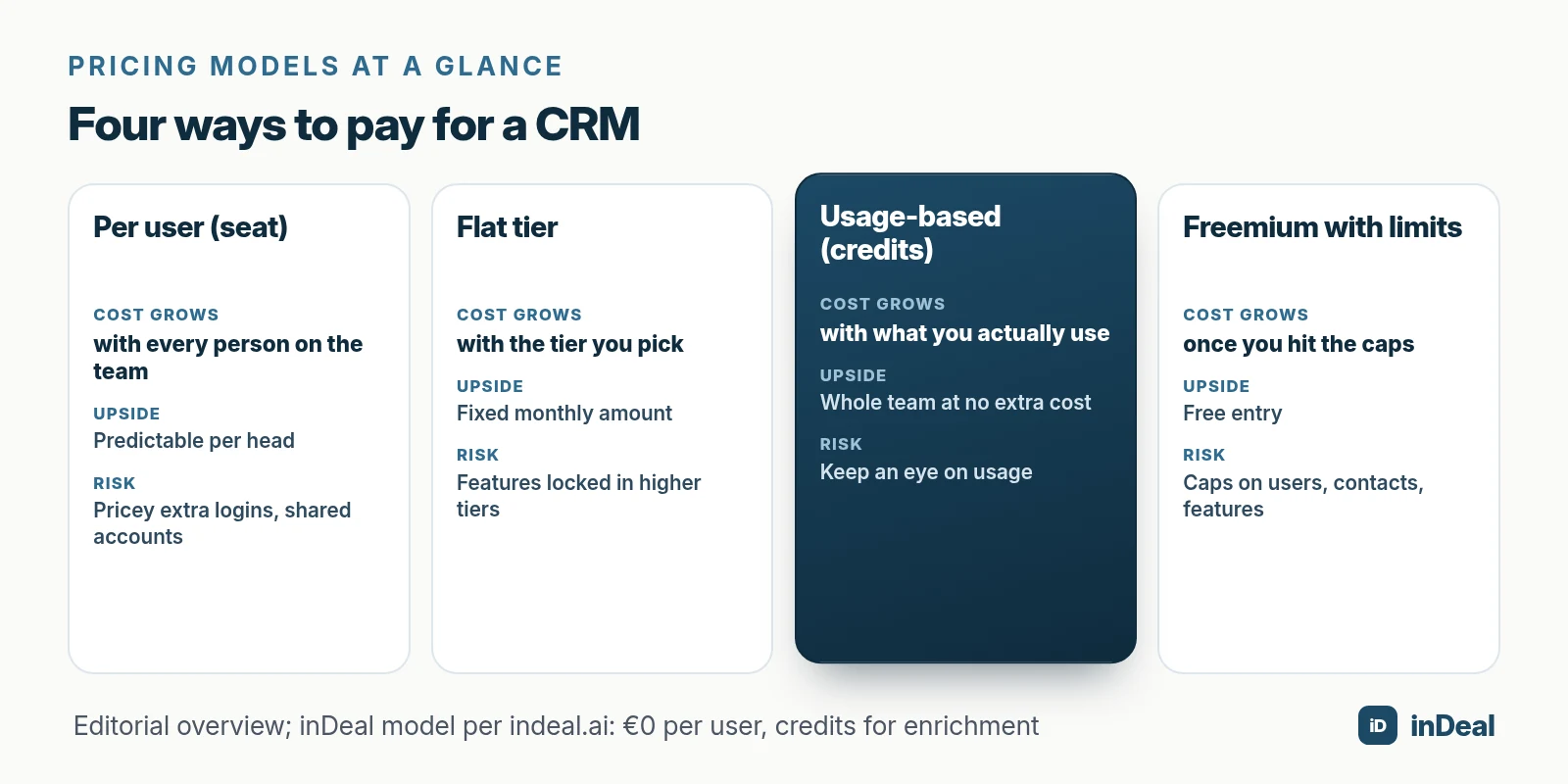
| Pricing model | Cost grows with | Upside | Risk |
|---|---|---|---|
| Per user (seat) | every person with a login | Predictable per head | Teams share logins or leave people out |
| Flat tier | the tier you pick | Fixed monthly amount | Key features only in higher tiers |
| Usage-based (e.g. credits) | what you actually use | Whole team at no extra cost | Usage needs watching |
| Freemium with limits | going over the caps | Free entry | Caps on users, contacts or features |
A CRM with unlimited users usually sits in the second or third row. The typical caps of free plans are covered in the free CRM limits checklist.
Why is per-user pricing a problem for small businesses?
Because it sets the wrong incentives. When every login costs money, only the "main users" get access, and the very people who talk to customers now and then stay outside.
In a small business, sales rarely sell alone. The owner handles key conversations, customer service hears about upsell needs, a student assistant researches leads. Without access, that knowledge ends up in emails, chats and spreadsheets.
The typical consequences:
- Shared logins: Several people use one account, so nobody can tell who changed what.
- Shadow spreadsheets: Whoever has no access keeps a private list.
- Gaps in history: Conversations without a CRM entry are missing at the next handover.
Eurostat fits that picture: in 2025 only 24.69% of small EU enterprises (10–49 employees) used CRM software, versus 65.43% of large ones. Cost isn't the only reason, but it is a hurdle that grows with every person.
How does a usage-based CRM like inDeal work?
In inDeal you pay not for people but for contact data that is found. Per indeal.ai, the account, pipeline, lead plugin and mail integration cost €0 for unlimited team members, with starter credits included.
Only enrichment uses credits. Per the Help Center, these prices apply:
| Detail | Credits |
|---|---|
| Email address | 1 |
| Mobile number | 5 |
| Landline number | 0.5 |
| Company data | free |
| Unsuccessful search | free |
If all three contact details are found, that is 6.5 credits. Since not every lead has a mobile number, a fully enriched lead costs 3.7 credits on average. Capturing and managing leads costs no credits.
What do the credit plans cost?
For regular enrichment there are plans with a monthly allowance. All prices net, plus VAT, per the Help Center:
| Plan | Monthly billing | Annual billing (per month) | Credits/month | Fully enriched leads (approx.) |
|---|---|---|---|---|
| Starter | €69 | €49 | 300 | 80 |
| Scale | €139 | €99 | 800 | 210 |
| Enterprise | €559 | €399 | from 4,000 | from 1,080 |
Extra credits cost €0.15 to €0.19 per credit depending on the pack. Per Credits and usage, the monthly allowance is topped up every month; leftovers carry over up to twice the allowance. Purchased credits never expire.
Is a CRM without per-user pricing really free?
Partly. "No per-user pricing" only describes what you don't pay for. Whether costs arise depends on which services are billed separately.
In inDeal the split is clear: working in the CRM is free, looking up data costs credits. If you add leads by hand or import them via CSV and don't enrich contact data, you need no credits per indeal.ai. If you regularly have phone numbers and email addresses looked up, you pay per hit.
That differs from freemium plans, which limit the product itself, for example through users, contacts or features. In a usage-based model the product is complete; only the add-on costs money.
Two rules from the Help Center are worth knowing: an unsuccessful search uses nothing. Enrichment credits are not refunded, though, even if a detail that was found turns out not to help you.
What does a CRM without per-user pricing cost in practice?
Take a team that wants to fully enrich about 80 new leads a month. With the Starter plan on annual billing, that costs €49 per month net, the same with one person as with twenty.
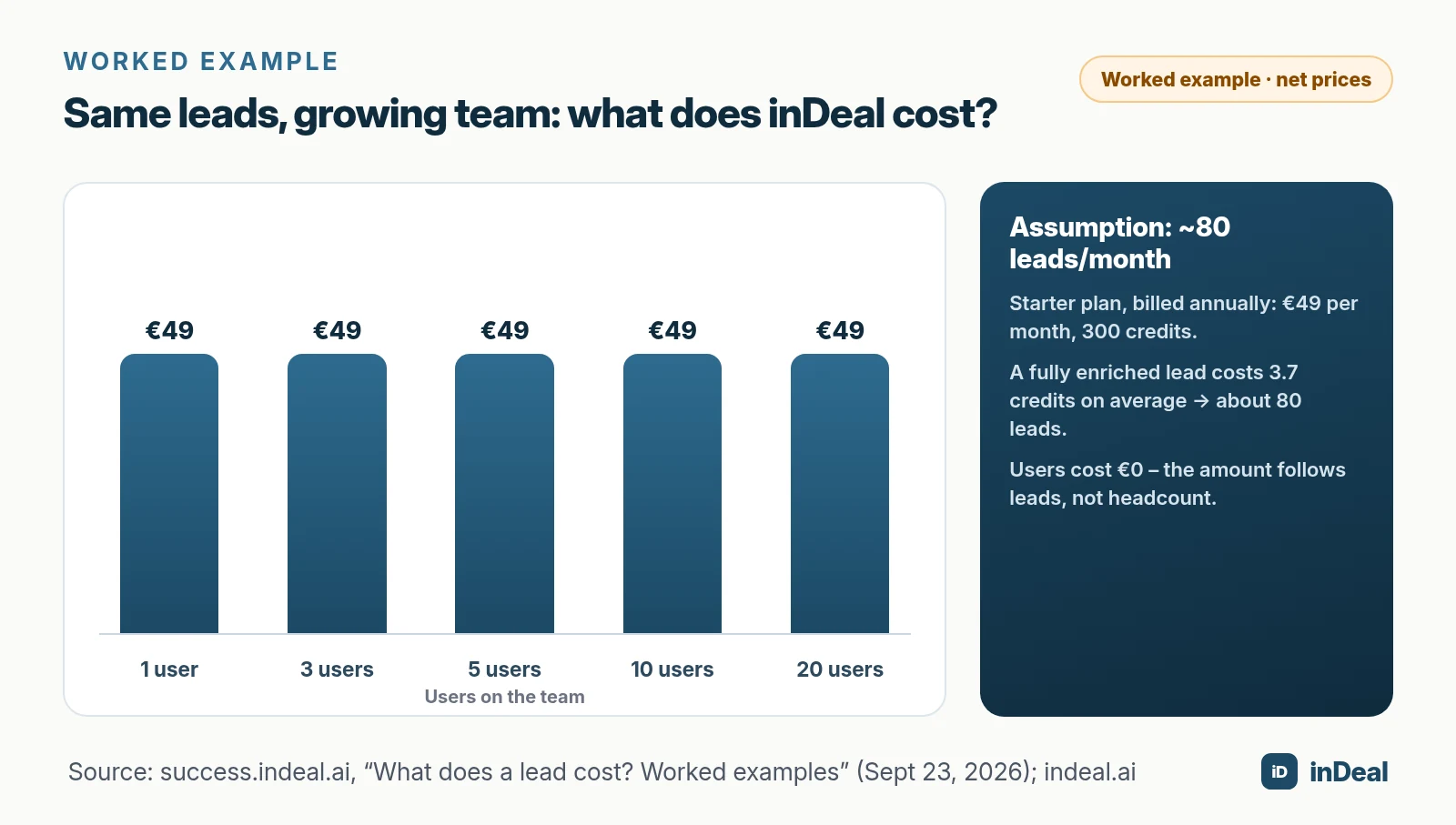
The math: 300 credits ÷ 3.7 credits per lead ≈ 81 leads, rounded down to about 80 in the Help Center. If you only need email addresses, 300 credits cover up to 300 leads.
With a seat model you would multiply the per-user price by team size for the same comparison. Plug in the current prices of the vendors you are comparing. We deliberately don't quote general figures.
What costs come on top of the license?
Even without seat pricing, a CRM isn't free in the sense of "zero effort". These cost blocks belong in every honest comparison, whatever the pricing model:
| Cost block | What it covers | How to keep it small |
|---|---|---|
| Rollout | Defining the process, onboarding the team | Use preconfigured stages, one page of rules |
| Data migration | Cleaning and importing old lists | CSV import, remove duplicates first |
| Data upkeep | Keeping stages, follow-ups and history current | Daily list, connect your mailbox |
| Contact data | Getting phone numbers and emails | Only enrich what you'll actually call |
| Integrations | Email, calendar, other tools | Built-in connections instead of custom work |
| Exit | Export, data deletion | Check the export path before you sign |
The biggest block is usually your team's time, not the software. A CRM nobody maintains is too expensive even for free. That's why it pays to define the workflow before you start.
What should you check before choosing a CRM without per-user pricing?
The fine print. A pricing model without seat fees is only cheap if everything else is right. Ask these six questions before any switch:
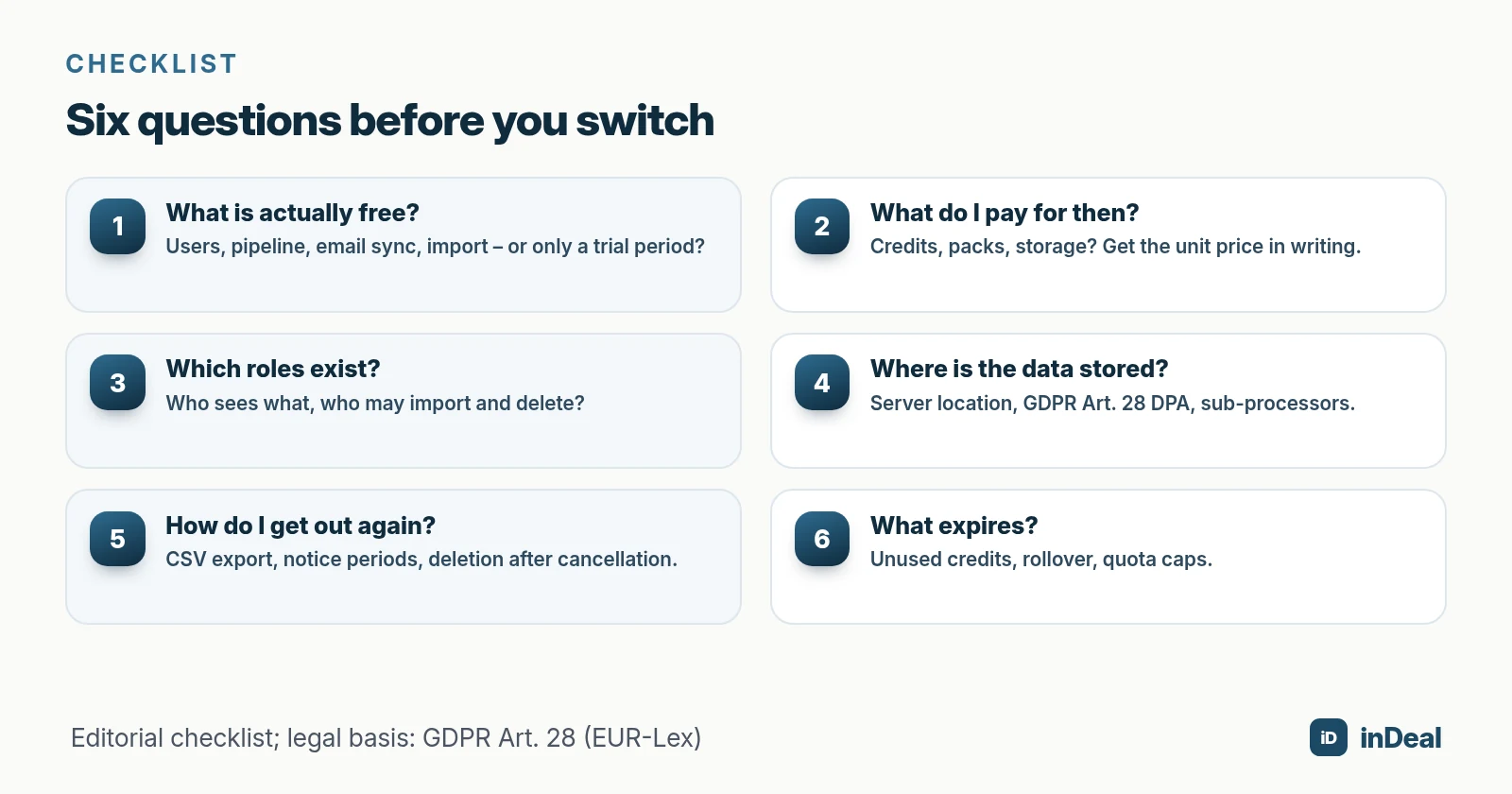
- What is actually free? Users, pipeline, email sync and import, or only a trial period?
- What do I pay for then? Credits, packs, storage? Get the unit price in writing.
- Which roles exist? Who sees what, who may import and delete?
- Where is the data stored? Server location, sub-processors and a data processing agreement.
- How do I get out again? Export, notice periods, deletion after the contract ends.
- What expires? Unused credits, rollover rules, caps.
Roles: unlimited doesn't mean uncontrolled
More users need clear permissions. Per Managing the team, inDeal has two roles: Admin with full access to records, import, setup and team, and Sales, which sees and edits only its own leads. When someone leaves, you deactivate them first; their leads stay assigned until you reassign them.
Data protection: check the DPA
If a CRM vendor processes personal data on your behalf, Art. 28 GDPR requires a data processing agreement. That applies whatever the pricing model, and the GDPR covers anyone processing data of people in the EU. Per indeal.ai, inDeal stores data on servers in the EU (Frankfurt), with tenant separation at database level and a DPA included.
How do you switch to a CRM without per-user pricing?
In five steps, without losing data. Changing pricing models usually means changing tools too, so plan it like a small move.
- Export what you have: Download contacts, open deals and, if possible, activities from the old system as CSV.
- Check the notice period: Many contracts renew annually. Time the switch so you don't pay twice.
- Plan roles: Who becomes Admin, who works with the Sales role? Only then invite the whole team.
- Import and schedule: In inDeal you map CSV columns to fields. Afterward every active lead needs a follow-up date or it won't show up in open leads. Details in Spreadsheet vs. CRM.
- Switch off the old system: Set a cut-off date after which only the new CRM counts, and have the old vendor delete your data when the contract ends.
A practical tip: at launch, invite the people who had no access before, such as the owner, customer service or an assistant. That is exactly what a no-per-head model is for. With the Sales role, they only see their own leads.
Who benefits most from a CRM without per-user pricing?
Mainly teams where many people have occasional customer contact, and small businesses that want to grow without renegotiating their software bill with every hire.
| Situation | Seat model | No per-user pricing |
|---|---|---|
| One or two full-time sellers, nobody else | Easy to plan | Equivalent; lead volume decides |
| Owner, service and sales all work in it | Cost rises with every person | Everyone on board at no extra cost |
| Seasonal staff or student assistants | Licenses change constantly | Invite, deactivate, done |
| Many leads that need enrichment | Seat price plus any data costs | Usage is the main cost block |
| Few leads, large team | Expensive | Very affordable |
The European Commission counts enterprises with fewer than 250 employees as SMEs (SME definition); in the U.S., the SBA sets size standards by industry. Either way, the pricing model makes the biggest difference at the small end, with five to fifty people: many of them talk to customers, but hardly anyone works in the CRM all day.
Which CRM pricing model fits your team?
It depends on what grows in your business: the number of people or the number of leads. A recommendation by situation:
- A small core team with steady lead volume: Both models work. Compare total cost over twelve months, not the monthly price.
- Many people should be in the CRM, few work in it daily: A CRM without per-user pricing is almost always cheaper and keeps the history complete.
- You enrich lots of leads: Run the numbers on usage. For inDeal, the worked examples page shows the cost per lead and plan.
- You're just getting started: Pick a free CRM for small business with no per-head cost and get the process right first, as shown in the CRM sales process.
- You still work from a spreadsheet: Read Spreadsheet vs. CRM first, then decide on the pricing model.
Where AI adds value in a CRM and what it costs is covered in the pillar AI CRM for small business.
A free CRM for your whole team. Start inDeal in 2 minutes. Just an email address, no credit card, unlimited users.
Start freeKeep reading
- Free CRM for Small Business (2026)
- Free CRM Limits 2026: A Small-Business Checklist
- Spreadsheet vs. CRM: When Small Businesses Should Switch
- CRM Sales Process 2026: 7 Steps for Small Businesses
- AI CRM for Small Business: What It Can Do in 2026
Frequently asked questions
Is there a CRM with unlimited users for free?
What does per-user pricing mean for a CRM?
Why does a CRM without per-user pricing matter for small businesses?
How much does inDeal cost?
What is a credit in inDeal?
Do unused credits expire?
Is a CRM without per-user pricing worse?
Is inDeal the same as indeal.io?
Sources
Keep reading
 Comparisons
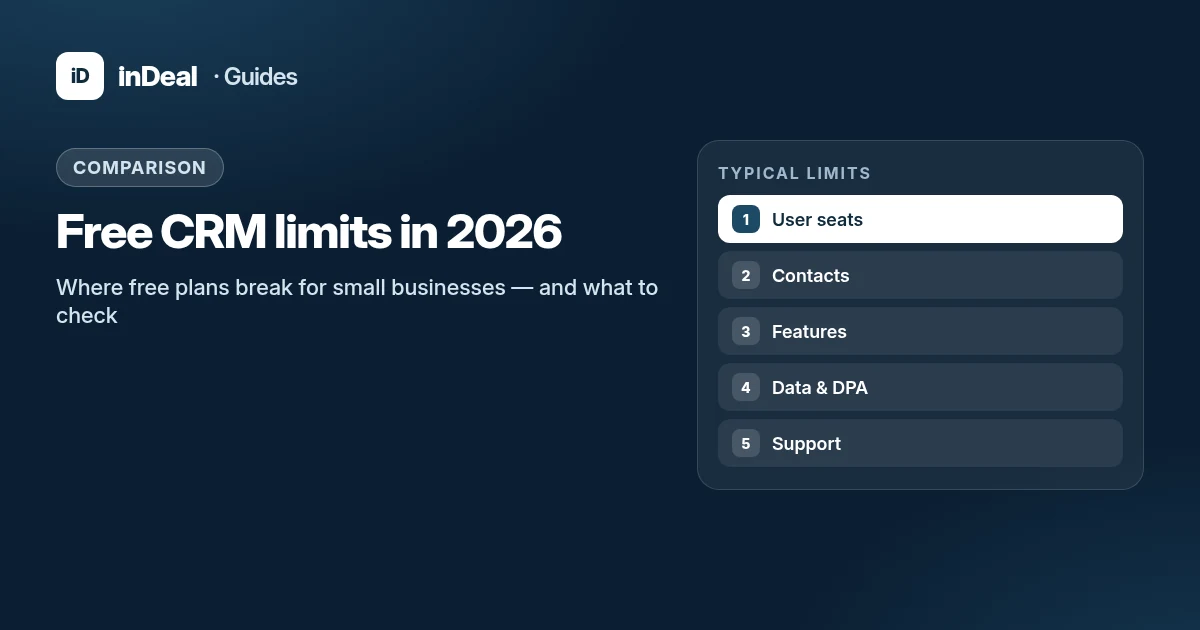
Free CRM Limits 2026: A Small-Business Checklist
Free CRM limits: seats, contacts, AI gates, storage, support, and DPAs — a buyer checklist for small businesses, plus how inDeal differs.
 Leads and enrichment
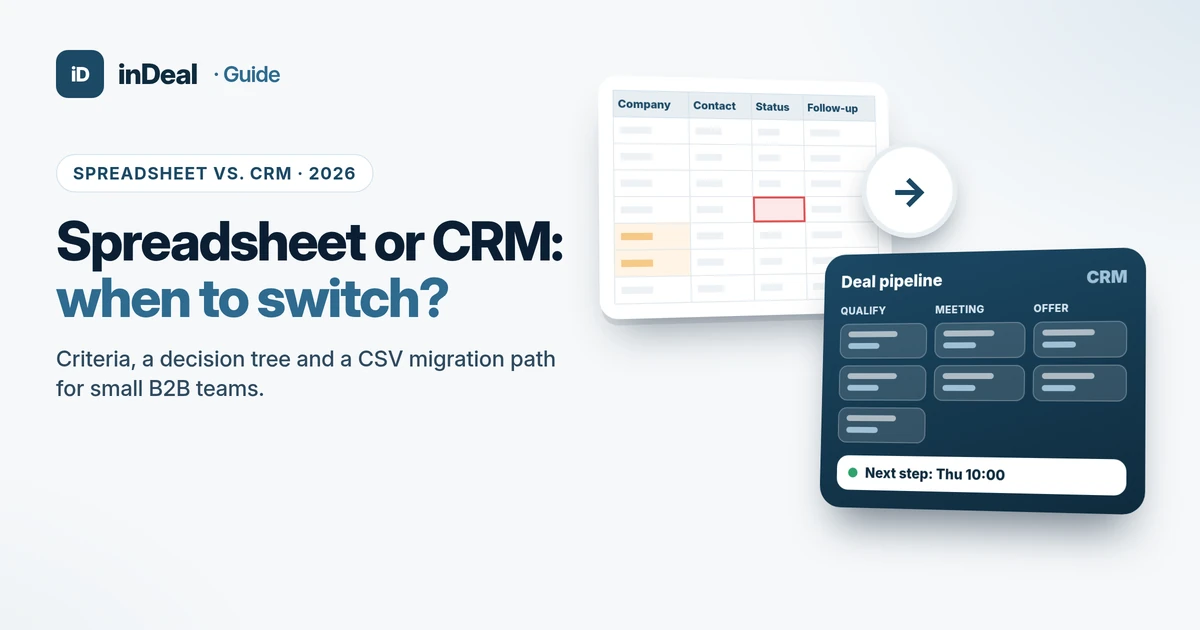
Spreadsheet vs. CRM: When Small Businesses Should Switch
Spreadsheet vs. CRM for small business: 7 criteria, a four-question decision tree and a CSV migration path so your sales team stops losing leads.
 Sales and follow-up
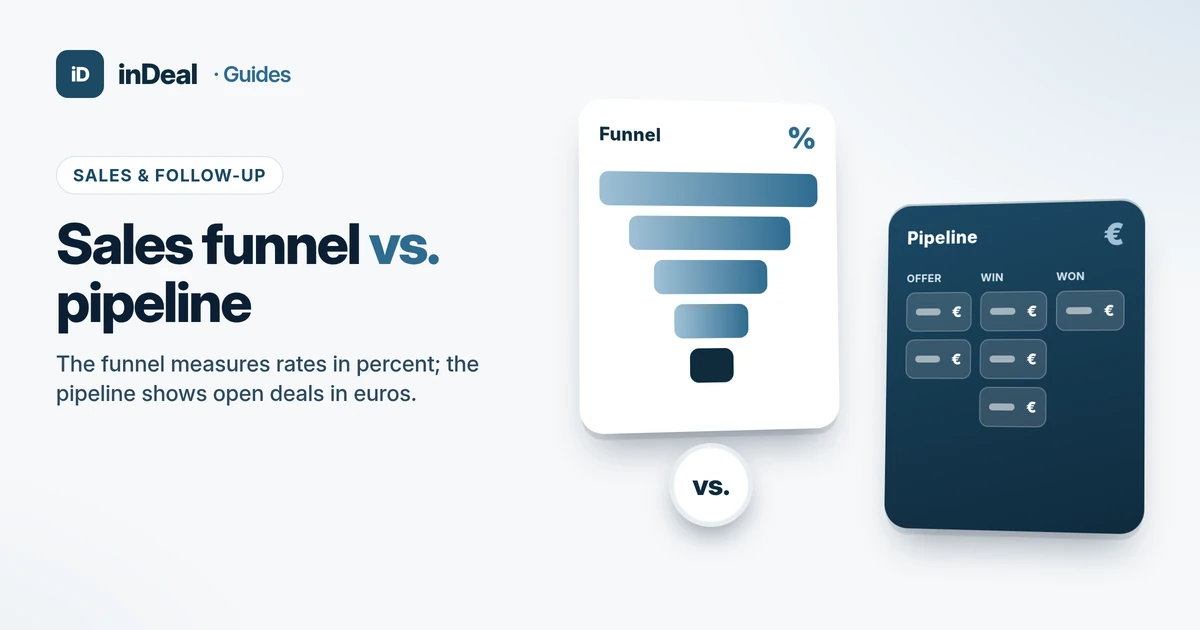
Sales Funnel vs. Pipeline: The Difference, Explained (2026)
Sales funnel vs pipeline: what each one measures, which metrics to track, and a weekly review rhythm for small B2B teams, plus a worked example in euros.