Contents
- Why “GDPR-compliant CRM” is a risky shortcut
- Which GDPR articles hit the CRM first?
- What must an Art. 28 DPA cover?
- How do you separate data residency and transfers?
- Pre-selection checklist (neutral)
- What does inDeal document on servers, DPA and subprocessors?
- Tenant separation and security measures in practice
- Mistakes small businesses make with “EU servers”
- How mail integration intersects with GDPR
- 30-minute internal runbook
- Which setup fits under GDPR aspects?
- Keep reading
- Frequently asked questions
- Sources
A GDPR-ready CRM is chosen with checkable criteria – Art. 28 DPA, documented hosting region, subprocessors and public legal docs – not with “100% compliant” slogans. inDeal (indeal.ai) is a free AI CRM for small businesses operated by Lars Krüger GmbH, Berlin. Not to be confused with indeal.io, a different company.
As of October 16, 2026. Law: EUR-Lex GDPR; Commission DPF IP_23_3721 (context only); market: Eurostat CRM/cloud 2025; product: indeal.ai FAQ, app.indeal.ai/legal/datenschutz, success.indeal.ai. Not legal advice – involve counsel when unsure.
Why “GDPR-compliant CRM” is a risky shortcut
Search intent is clear: you do not want lead and customer data stored “somewhere.” Still, the phrase is dangerous. EU hosting and GDPR compliance are different claims – and neither is a certificate you should accept without reading.
According to Eurostat, in 2025 only 24.69% of small EU enterprises used CRM software (28.51% overall). At the same time, 53% of EU enterprises used paid cloud services (ddn-20260203-1). Cloud is normal; contracts and location still need your checklist.
The EU SME definition uses headcount and financial ceilings; U.S. readers can map “small business” via the SBA size standards. In both markets you need a criteria grid that works without a legal department – and that avoids superlatives.
Which GDPR articles hit the CRM first?
Two chapters show up constantly – as bookmarks, not as legal advice:
| Topic | GDPR anchor | What you want from the CRM |
|---|---|---|
| Processor relationship | Art. 28 | Written DPA, instructions, security, subprocessors |
| Third-country transfers | Art. 44+ | Clarity if/when data leaves the EEA |
| Controller vs processor | Art. 4(7) / roles | Who decides purposes? |
| Security | Art. 32 | Access, encryption, separation, backup |
| Data-subject rights | Art. 12–22 | Export, deletion, access support |
What must an Art. 28 DPA cover?
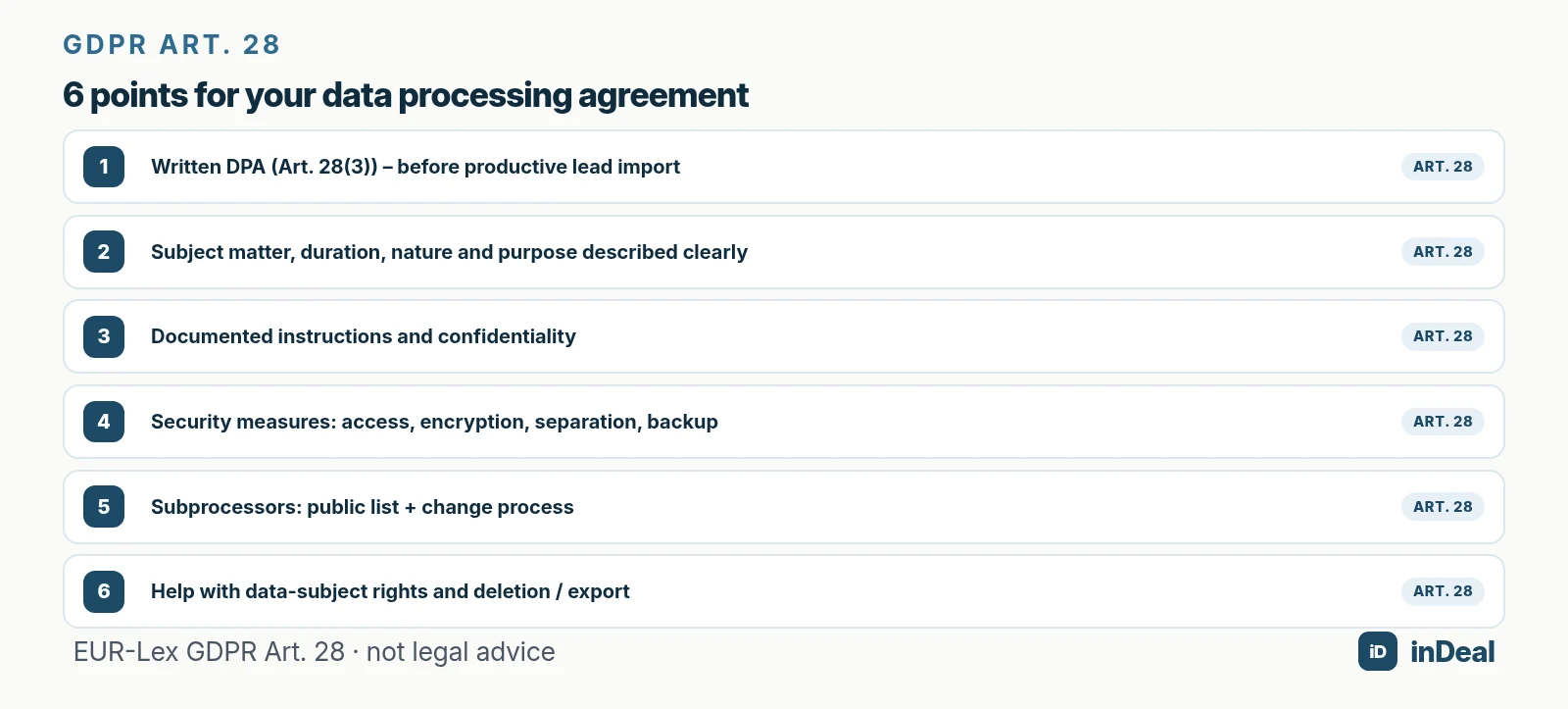
When the CRM processes your lead data on your instructions, the vendor typically acts as a processor. Art. 28 requires an agreement. Check at least:
- Written / electronic form before productive import.
- Subject matter, duration, nature and purpose.
- Documented instructions and confidentiality.
- Technical and organizational security measures.
- Subprocessor rules and change process.
- Help with data-subject rights, deletion and contractual audit rights.
How do you separate data residency and transfers?
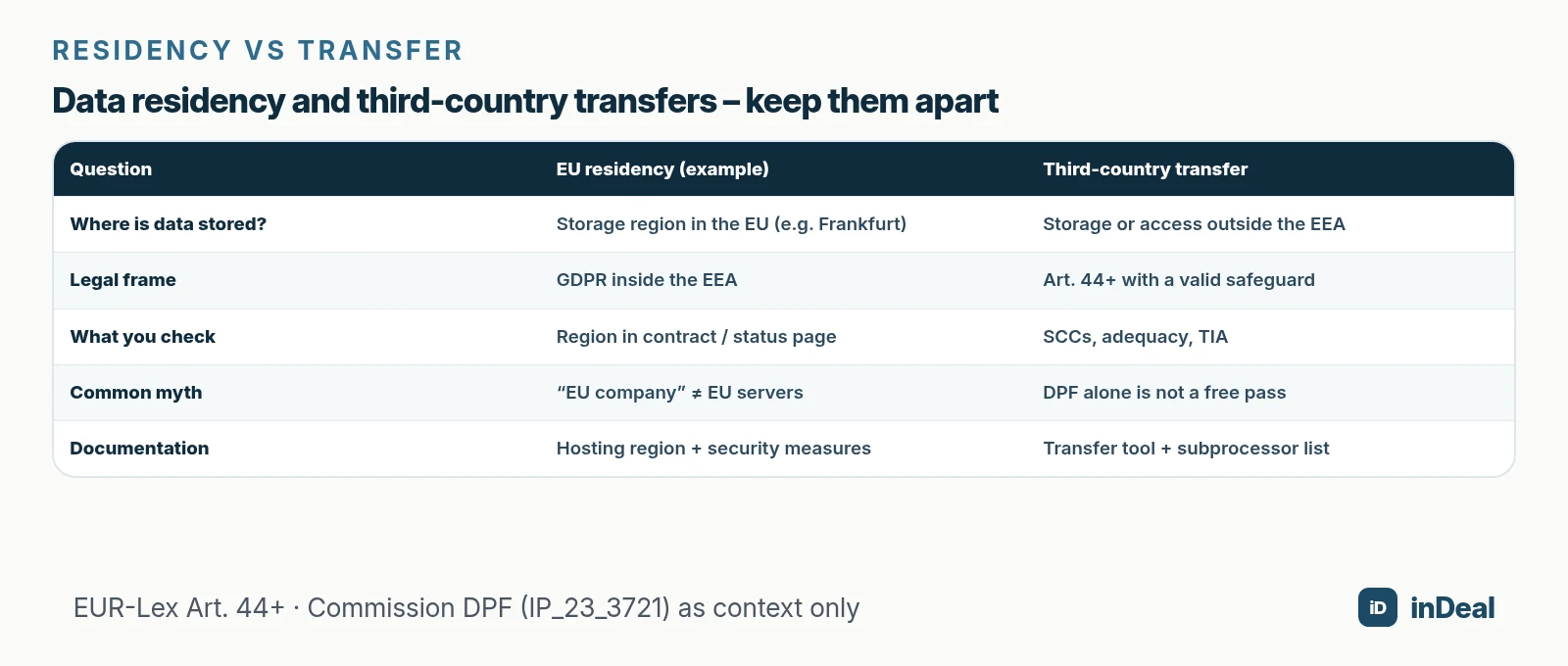
Residency asks: In which region do databases and backups live? Example: EU region Frankfurt (eu-central-1).
Transfer asks: Do personal data leave the European Economic Area – through storage, support access or subprocessors?
| Question | EU residency (example) | Third-country transfer |
|---|---|---|
| Where is data stored? | Storage region in the EU (e.g. Frankfurt) | Storage or access outside the EEA |
| Legal frame | GDPR inside the EEA | Art. 44+ with a valid safeguard |
| What you check | Region in contract / status page | SCCs, adequacy, TIA |
| Common myth | “EU company” ≠ EU servers | DPF alone is not a free pass |
| Documentation | Hosting region + security measures | Transfer tool + subprocessor list |
How carefully should you use the EU-US Data Privacy Framework?
In 2023 the European Commission adopted an adequacy decision for the EU-US Data Privacy Framework (IP_23_3721). That is a tool under Art. 45, not a blank check for every CRM and not a substitute for reviewing your architecture. Internally, say: “DPF may matter if the recipient is listed – we still review SCCs, regions and subprocessors.”
Pre-selection checklist (neutral)
| # | Check | Pass signal |
|---|---|---|
| 1 | DPA before go-live | Agreement visible and acceptable |
| 2 | Hosting region | EU/EEA clearly named |
| 3 | Subprocessors | List public or in-product |
| 4 | Privacy & imprint | Current; ideally without login |
| 5 | Roles | Admin edits company details; team can read legal |
| 6 | Deletion / export | Process for data-subject requests describable |
| 7 | Mail integration | Token purpose and storage explained |
| 8 | Exit | What happens on cancel / disconnect? |
Among cloud users in 2025, CRM software was 27.9% (Eurostat cloud) – so most cloud buyers still do not run CRM in the cloud. If you start, tick the list above before importing people.
What does inDeal document on servers, DPA and subprocessors?
inDeal (indeal.ai) is a free AI CRM for small businesses. Per the FAQ on indeal.ai: data on servers in the EU (Frankfurt), database-level tenant separation, DPA included.
The privacy notice describes roles (controller vs processor under Art. 28), technical providers and regions. The database provider Supabase is listed with EU region eu-central-1 (Frankfurt); hosting/delivery includes Vercel in an EU region. Other recipients (email, support, analytics) appear in a table with seat and transfer basis – including standard contractual clauses where third-country transfers apply. Logical tenant separation is named among security measures.
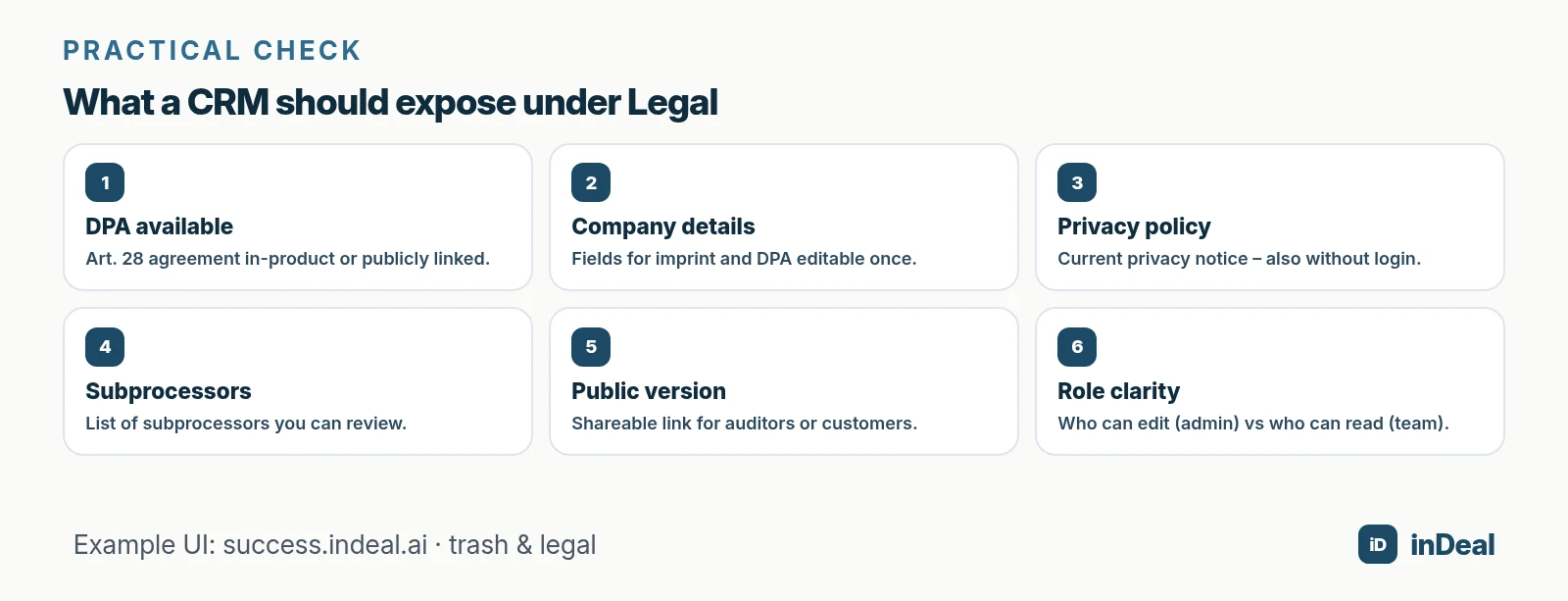
In-product under Trash & legal you get tabs for company details, imprint, privacy, DPA, terms and subprocessors. Public versions are reachable without login – shareable with auditors or customers (trash & legal).
Pricing – short and sourced
Account, pipeline and mail integration: €0, unlimited users; 10 starter credits; enrichment credits (email 1, mobile 5, landline 0.5) per indeal.ai. Privacy and seat models are separate: a cheap plan without a DPA is still risky for personal lead data. Deeper limits: free CRM limits.
Tenant separation and security measures in practice
Buzzwords only help if they answer operating questions:
- Separation: Can other customers see your leads? Look for logical tenant separation at database level.
- Access: Who at the vendor can open support access? Is it logged?
- Encryption: TLS in transit and sensible storage of tokens (e.g. mail OAuth) should be described.
- Backup and deletion: Trash retention, hard delete, export paths.
inDeal’s privacy notice mentions access controls, authentication, transport encryption, logical tenant separation, logging, backups and recovery (privacy notice). Mail tokens are stored encrypted and used only for send/fetch; Microsoft mailbox data is described as not sold and not used to train AI models.
That does not replace your own security review, but it gives you checkable sentences against your requirements list.
Mistakes small businesses make with “EU servers”
| Mistake | Why it hurts | Better |
|---|---|---|
| Checking only company seat | Seat ≠ storage region | Read region + subprocessors |
| “DPA later” | Import without a contract | DPA before productive data |
| Ignoring subprocessors | Hidden transfers | List + change process |
| Treating DPF as a free pass | False comfort | Context + architecture |
| Shared admin login | No accountability | Roles + personal logins |
| No exit plan | Leftover data / disputes | Test deletion and export |
Free or low-cost CRMs tempt teams to treat privacy as “phase 2.” Better order: legal docs and DPA → dummy data → productive import. Seats at €0 (see CRM without per-user pricing) raise adoption – and raise how many people have access. Roles and logging matter more, not less.
How mail integration intersects with GDPR
When a CRM connects your mailbox, it processes email content and metadata that can identify people. Extra checks:
- Which OAuth scopes (read, send)?
- Are attachments stored in the CRM or only referenced?
- What happens on disconnect – do copies remain?
- Is the purpose limited to CRM features (no selling mailbox data)?
In inDeal, attachments stay in the mailbox; disconnect permanently deletes imported mail inside inDeal; sync only keeps lead counterparts (connect mailbox). That matters for storage minimization and clear deletion paths – details in Free CRM for Outlook.
30-minute internal runbook
- Note purposes and data types (leads, mail content, attachment metadata).
- Open and accept/save the DPA – complete company details.
- Read the subprocessor list; mark transfers.
- Map the stated hosting region to your requirement.
- Use a test tenant with dummy leads – no special-category data yet.
- Walk deletion and export once (watch trash retention).
- Connect mail only afterwards; re-read token purposes in the privacy notice.
- File a one-page decision note (date, links, who reviewed).
Clean stages and follow-up also reduce wild copy-paste of personal data into private sheets – see perfect CRM sales process and sales follow-up.
What belongs in the decision note?
- Vendor, product URL, review date
- DPA link and version/as-of date
- Named hosting region(s)
- Subprocessor list link
- Known third-country recipients and stated safeguards (SCCs/DPF, etc.)
- Mail integration outcome (scopes, attachments, disconnect)
- Open items for the next review (comparison topics: ~90-day rhythm per editorial rules)
If you also connect AI assistants (MCP), you widen the recipient set again – same questions on instructions, logging and purpose limitation apply (connect CRM to ChatGPT/Claude). GDPR review starts at the CRM core and grows with every integration.
Which setup fits under GDPR aspects?
| Situation | Focus |
|---|---|
| Strict EU residency required | Frankfurt/EU region in contract + subprocessor list |
| U.S. tools in the stack | Art. 44 review; SCC/DPF only with context |
| Agency holding client data | DPA + clear admin vs sales roles |
| Solo founder | Still DPA and public docs before import |
| Team without seats | €0/user helps adoption – does not replace a DPA |
If you sell into the EU from outside it, the same logic applies: GDPR can apply whenever you process personal data of people in the EU. The checklist stays; only your internal approval path changes. Keep prices in euro as published on indeal.ai – do not invent converted dollar figures.
A free CRM for your whole team. Start inDeal in 2 minutes. Just an email address, no credit card to sign up, unlimited users.
Start freeKeep reading
- AI CRM for Small Business: What It Can Do in 2026
- Free CRM for Small Business (2026)
- Free CRM Limits 2026: A Small-Business Checklist
- CRM without Per-User Pricing 2026
- Free CRM for Outlook 2026: Mailbox & Timeline
Frequently asked questions
What does a GDPR-compliant CRM actually mean?
Is EU or Frankfurt hosting enough for GDPR?
What is a DPA (Art. 28) for a CRM?
Does every CRM vendor need to offer a DPA?
What is the EU-US Data Privacy Framework (DPF)?
Where does inDeal store data?
Where do I find the DPA in inDeal?
Is inDeal the same as indeal.io?
Sources
- Regulation (EU) 2016/679 (General Data Protection Regulation)
- Data Privacy Framework: Commission adopts new adequacy decision
- E-business integration
- 53% EU enterprises used paid cloud services in 2025
- SME definition
- Table of size standards
- Privacy notice (Datenschutz)
- Trash and legal (Papierkorb und Rechtliches)
- inDeal homepage, pricing and FAQ
inDeal is the AI CRM for small and mid-sized B2B companies.
Keep reading
 Comparisons
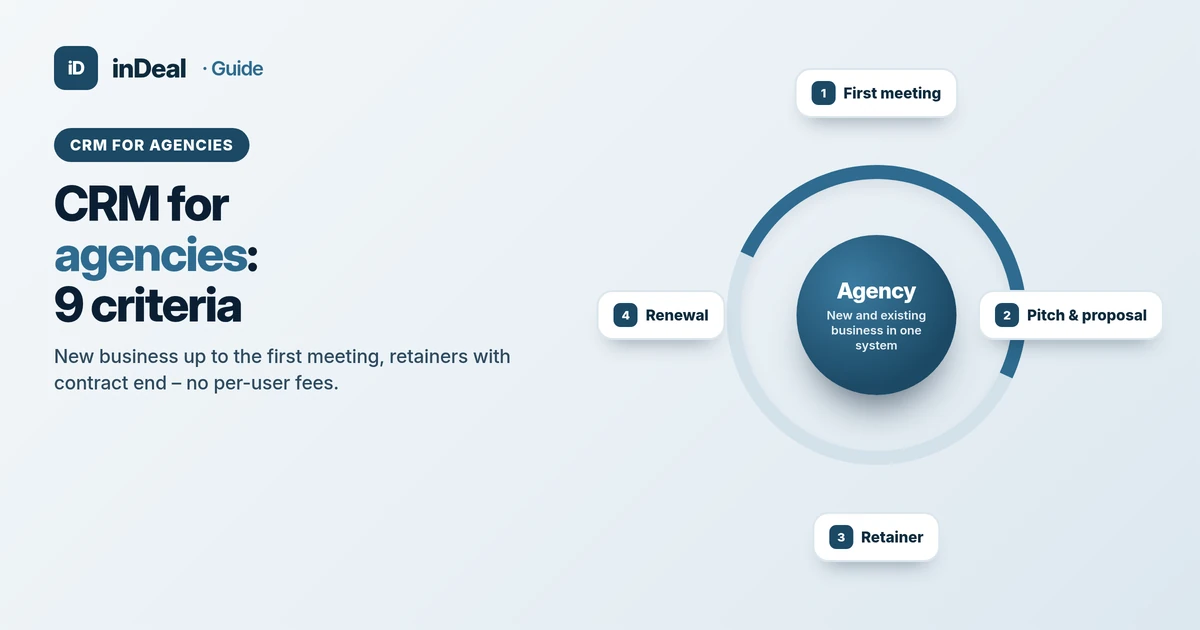
CRM for Agencies 2026: 9 Criteria for Small Agency Teams
CRM for agencies: 9 criteria for new business, retainers and team roles – a neutral guide for small marketing agencies, with a free start and no per-user fees.
 Comparisons
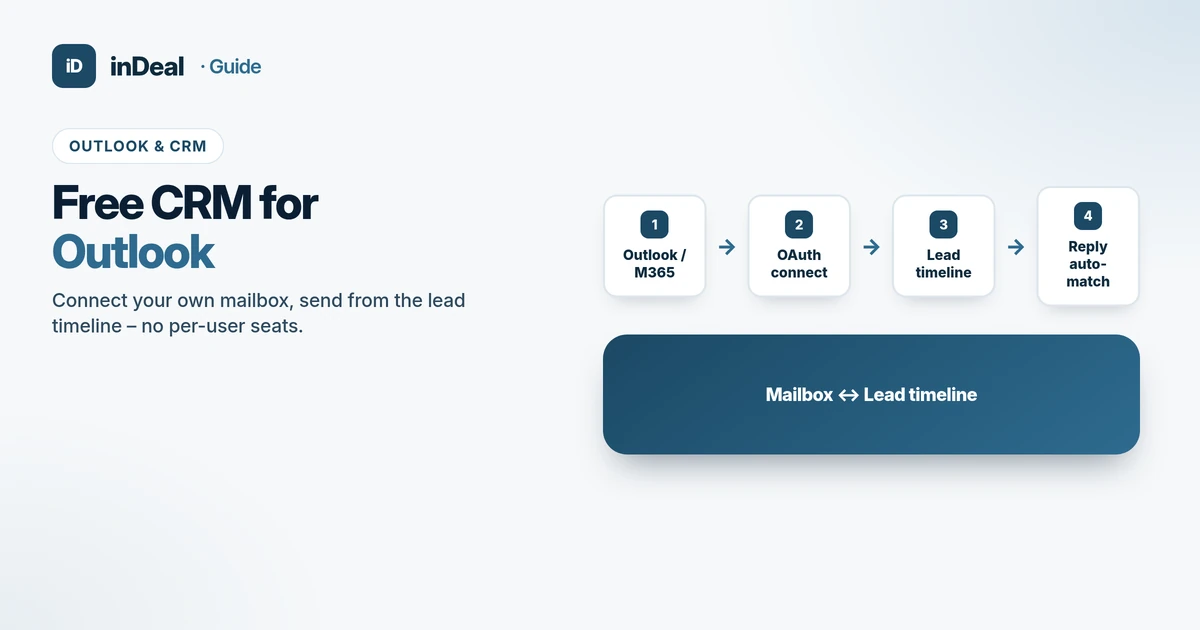
Free CRM for Outlook 2026: Mailbox & Timeline
Free CRM for Outlook: connect your own mailbox, send from the lead timeline, match replies automatically – a criteria checklist without per-user seats.
 Comparisons
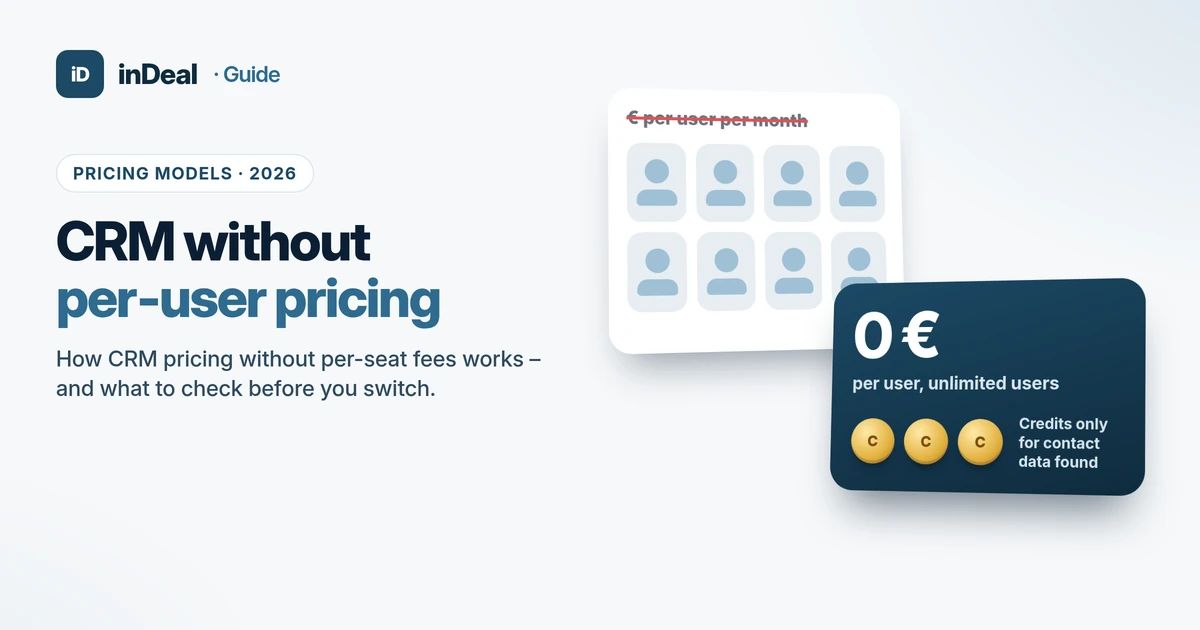
CRM Without Per-User Pricing: How It Works in 2026
CRM without per-user pricing explained: four CRM pricing models, a worked cost example and six questions to ask before you switch your small business.