Contents
- What is a B2B sales strategy?
- What is the difference between a sales strategy and a sales plan?
- What goes into a B2B sales strategy?
- How do you create a sales strategy in 6 steps?
- How do you choose target customers and segments?
- What are examples of B2B sales strategies?
- What role does the selling approach play?
- How do you measure whether your sales strategy works?
- What sales strategy mistakes do small businesses make?
- How do you put your sales strategy into practice in inDeal?
- Which sales strategy is right for your small business?
- Keep reading
- Frequently asked questions
- Sources
A B2B sales strategy defines which business customers you want to win with which offer through which channel, and how you measure success. For a small business it fits on one page with six building blocks: goal, target customers, offer and value, growth path, sales channel, and metrics. inDeal (indeal.ai) is a free AI CRM for small businesses from Lars Krüger GmbH in Berlin.
As of November 27, 2026. All product details checked in the inDeal Help Center and on indeal.ai. Not to be confused with indeal.io, a different company.
This guide shows how to create a sales strategy. How to turn it into numbers and weekly targets is in How to Write a Sales Plan; how to turn it into new clients day to day is in How to Get Clients.
What is a B2B sales strategy?
A B2B sales strategy is your mid-term plan for how the business sells to other businesses. It answers four questions: Who do you sell to? What do you sell them, and why should they buy? Which channel reaches them? How do you know it is working?
It usually covers one to three years. The business strategy sets the direction; the sales strategy translates it into markets, customers and channels. The sales plan then turns it into concrete numbers.
“Small business” means different things in different places. In the EU, medium-sized enterprises have fewer than 250 employees and up to €50 million in turnover or €43 million in balance sheet total; small ones have fewer than 50 employees (European Commission, SME definition). At that size you need clear decisions, not a thick strategy binder.
What is the difference between a sales strategy and a sales plan?
The strategy decides where and how you sell. The plan works out how much you need to do and when. They belong together but often get mixed up.
| Sales strategy | Sales plan | |
|---|---|---|
| Question | Where and how do we sell? | How much, by when, with which activities? |
| Content | Target customers, offer, growth path, channel | Revenue goal, conversion rates, meetings and leads per week |
| Time frame | 1 to 3 years | Year, quarter, month, week |
| Review | Yearly, right away after big changes | Monthly against the forecast |
| Output | One page of decisions | Numbers and weekly targets |
If you only plan without deciding, you spread your time across too many customers and channels. If you only decide without planning, you never know whether you are on track. Planning is covered in How to Write a Sales Plan.
What goes into a B2B sales strategy?
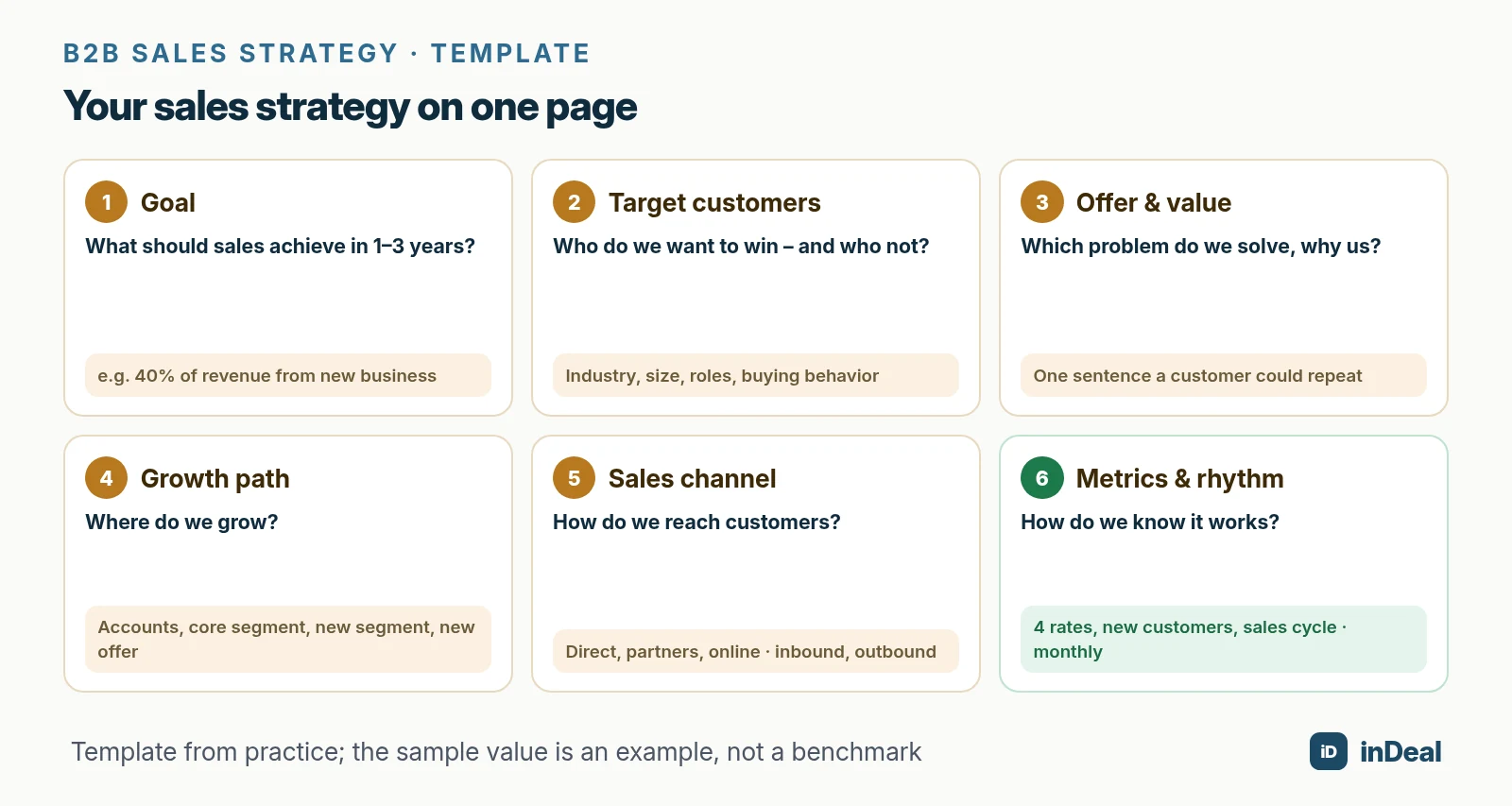
Six building blocks are enough for a small business. Each one stands for a decision you make on purpose instead of leaving it to chance.
- Goal: what sales should achieve in one to three years, for example revenue from new business or a share of recurring orders.
- Target customers: which industries, sizes and roles, and which ones explicitly not.
- Offer and value: which problem you solve and why you.
- Growth path: more from existing customers, more new customers in your core segment, a new segment, or a new offer.
- Sales channel: direct, through partners or online; inbound or outbound.
- Metrics and rhythm: how you measure success and when you adjust.
How do you create a sales strategy in 6 steps?
Work from where you stand to the metrics and write down every decision. For a small team, one or two half days are enough.
- Review where you stand: which customers bring the most revenue and profit today? Which channels brought them? How long did it take to close?
- Set a goal: specific and measurable, not “more revenue.”
- Choose target customers: one or two groups that resemble your best customers.
- Sharpen your offer and value: in one sentence a customer could repeat.
- Pick a growth path and channel: one main path, at most one secondary path.
- Set metrics and rhythm: four or five numbers, checked monthly.
The first step needs data, which many small companies lack: according to Eurostat, only 24.69% of small EU enterprises used CRM software in 2025, compared with 65.43% of large ones (Eurostat, E-business integration). If you have no numbers, start with an estimate and measure from today.
How do you choose target customers and segments?
By fit and buying behavior, not just industry and size. Your best target customers look like your most profitable current customers and have a problem you can demonstrably solve.
Rangan, Moriarty and Swartz showed in 1992 for mature industrial markets that customers of the same industry and size can buy very differently, for example in how they trade off price and service (Rangan et al., 1992). So segment by how customers buy, too.
In B2B, an organization buys, not a single person. Webster and Wind described business buying back in 1972 as an organizational decision-making process (Webster & Wind, 1972). Johnston and Bonoma found in 31 companies that the makeup of the buying group depends on structure and the buying situation (Johnston & Bonoma, 1981). Your strategy should therefore define which roles you approach.
How to capture this as a profile is shown in Ideal Customer Profile.
What are examples of B2B sales strategies?
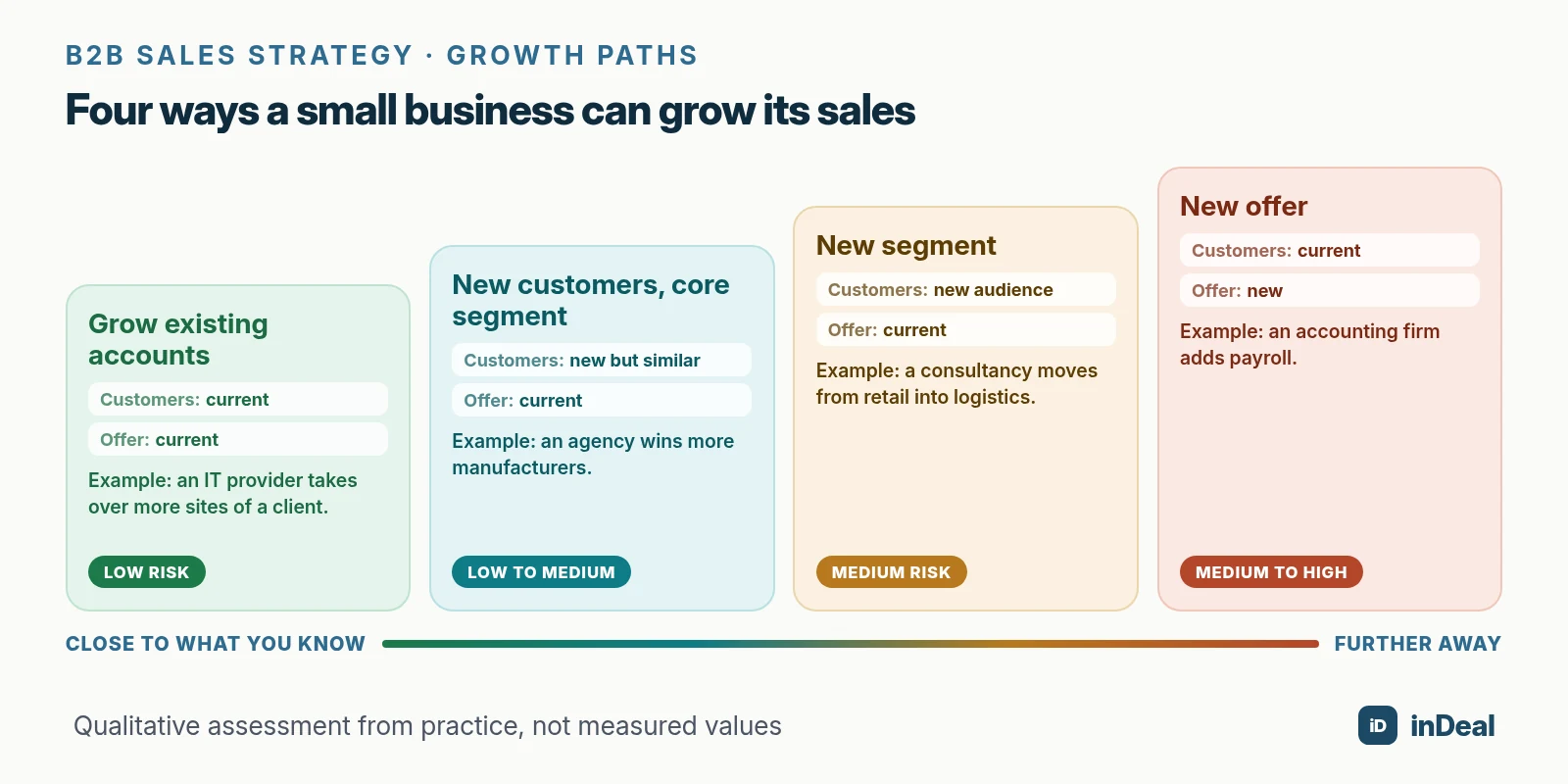
For small businesses, two axes matter most: the growth path (where you grow) and the sales channel (how you sell). Your strategy comes from combining both.
| Growth path | What you do | B2B example | Risk |
|---|---|---|---|
| Grow existing accounts | More of your current offer to current customers | IT provider takes over more sites of a client | Low |
| New customers in your core segment | Current offer to new, similar customers | Agency wins more manufacturers | Low to medium |
| New segment | Current offer to a new audience | Consultancy moves from retail into logistics | Medium |
| New offer | New service for current customers | Accounting firm adds payroll | Medium to high |
The risk ratings are a qualitative assessment from practice. The further you move from familiar customers and a familiar offer, the more assumptions you need to test.
For the channel, you choose between direct sales (you sell yourself), partner sales (others sell or refer you) and online sales (website, content, self-service). Then there is the approach: inbound, when customers come to you, and outbound, when you reach out. How to do outbound within the rules is covered in B2B Cold Outreach and GDPR.
What role does the selling approach play?
A big one. The strategy defines how your team handles conversations: with a fixed script or adjusted to the customer and situation. Research favors adjusting.
Spiro and Weitz defined adaptive selling in 1990 as the degree to which salespeople alter their presentation during and across customer interactions in response to the perceived situation (Spiro & Weitz, 1990). A meta-analysis of 155 samples with more than 31,000 salespeople found that adaptive selling increases self-rated, manager-rated and objective performance (Franke & Park, 2006).
For your strategy, that means: define guiding questions and value arguments for each target group, but no rigid script. How to deal with pushback is shown in Objection Handling.
How do you measure whether your sales strategy works?
With a few metrics you review every month. They show whether the decisions in your strategy hold up day to day.
Specific goals work: a summary of 35 years of goal-setting research shows that specific, challenging goals lead to better performance than a vague “do your best,” provided there is commitment and regular feedback (Locke & Latham, 2002).
For most small businesses, these numbers are enough:
- Share of good-fit leads: how many new leads match your target customer profile?
- Four conversion rates: lead to meeting, meeting to held, discovery to offer, offer to order.
- New customers and new-business revenue per month.
- Sales cycle: average days from lead to order.
The lowest of the four rates shows where to adjust. How to turn these numbers into a weekly target is in How to Write a Sales Plan; how much pipeline you need is in Pipeline Coverage.
What sales strategy mistakes do small businesses make?
Usually the same five, and one clear page avoids all of them.
- Everyone is a target customer: without focus, you spread little time across too many conversations.
- Too many channels at once: better one channel done right than four done halfway.
- No value in the customer's words: if the customer cannot repeat the value, it was not clear.
- A strategy without numbers: without metrics you only notice at year-end that something is off.
- Write once, never review: markets change; a strategy nobody looks at has no effect.
The most common mistake often sits behind all the others: the strategy lives in the owner's head and is never shared with the team. Put the one page where your sales team works and walk through it together every quarter. Then everyone knows which customers come first and which requests you turn down on purpose.
How do you put your sales strategy into practice in inDeal?
By capturing target customers, process and metrics where your team works every day. The CRM and unlimited users are free (indeal.ai).
- Target customers as an ICP: under Agent in the Target audience tab, analyze your website or create the ICP manually: up to 30 industries (included or excluded), company size, regions and contacts, plus offer, problem and solution. The ICP only applies once you click Save (Help Center).
- Metrics on Home: lead conversion, show rate, pipeline conversion and deal conversion for the past 30 days, plus sales cycle, closed won and new customers in the current month (Help Center).
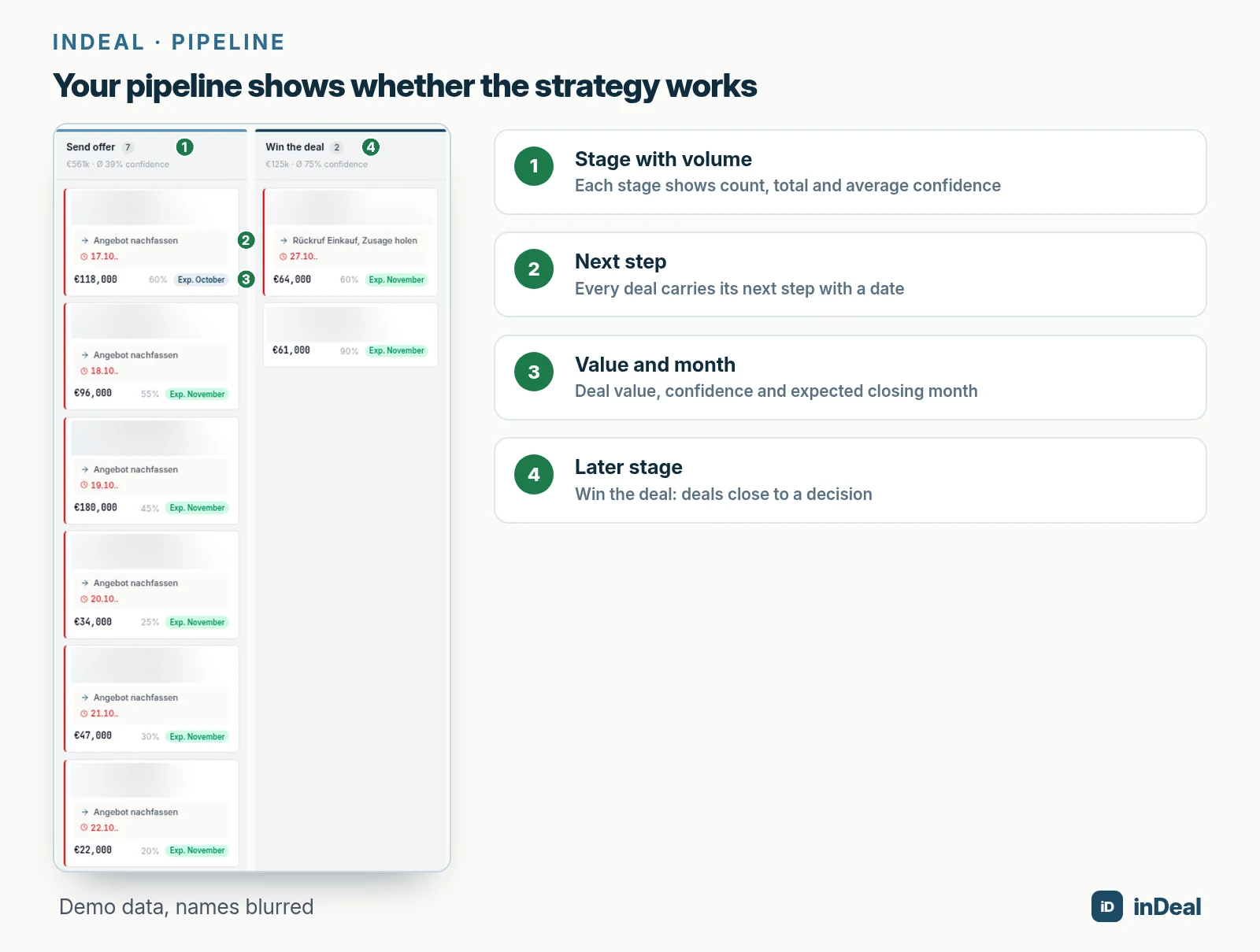
- Pipeline: see open deals by stage, with value, confidence and expected closing month.
How AI in a CRM takes over routine work is explained in AI CRM for Small Business.
Which sales strategy is right for your small business?
The one that fits where you are now and fits on one page. Choose one main path, measure it monthly and only expand once it works.
| Situation | Recommended focus |
|---|---|
| A few large customers, high dependency | New customers in your core segment, direct sales |
| Many happy customers, little extra business | Grow existing accounts, regular meetings per customer |
| Core segment saturated | Test a new segment with similar buying behavior |
| Small team, little time for prospecting | Partner sales and referrals, website as inbound base |
| New service developed | Sell to existing customers first, then to new ones |
A free CRM for small business helps make the strategy measurable. The process from lead to order is described in The Perfect CRM Sales Process.
A free CRM for your whole team. Start inDeal in 2 minutes. Just an email address, no credit card to sign up, unlimited users.
Start freeKeep reading
- How to Write a Sales Plan for a Small Business
- How to Get Clients for Your Small Business
- Ideal Customer Profile
- Sales Funnel for Small Business
- Pipeline Coverage: How Much Pipeline You Need
Frequently asked questions
What is a B2B sales strategy?
What is the difference between a sales strategy and a sales plan?
What are examples of B2B sales strategies?
How do you create a sales strategy for a small business?
How often should you review your sales strategy?
What is a good sales strategy for a small business?
Do I need a CRM for my sales strategy?
Is inDeal the same as indeal.io?
Sources
- Segmenting Customers in Mature Industrial Markets (Journal of Marketing 56(4), 72–82)
- A General Model for Understanding Organizational Buying Behavior (Journal of Marketing 36(2), 12–19)
- The Buying Center: Structure and Interaction Patterns (Journal of Marketing 45(3), 143–156)
- Adaptive Selling: Conceptualization, Measurement, and Nomological Validity (Journal of Marketing Research 27(1), 61–69)
- Salesperson Adaptive Selling Behavior and Customer Orientation: A Meta-Analysis (Journal of Marketing Research 43(4), 693–702)
- Building a practically useful theory of goal setting and task motivation: A 35-year odyssey (American Psychologist 57(9), 705–717)
- E-business integration
- SME definition
- Define your ICP
- Conversion funnel and business results
- inDeal: home page, pricing and FAQ
inDeal is the AI CRM for small and mid-sized B2B companies.
Keep reading
 Sales and follow-up
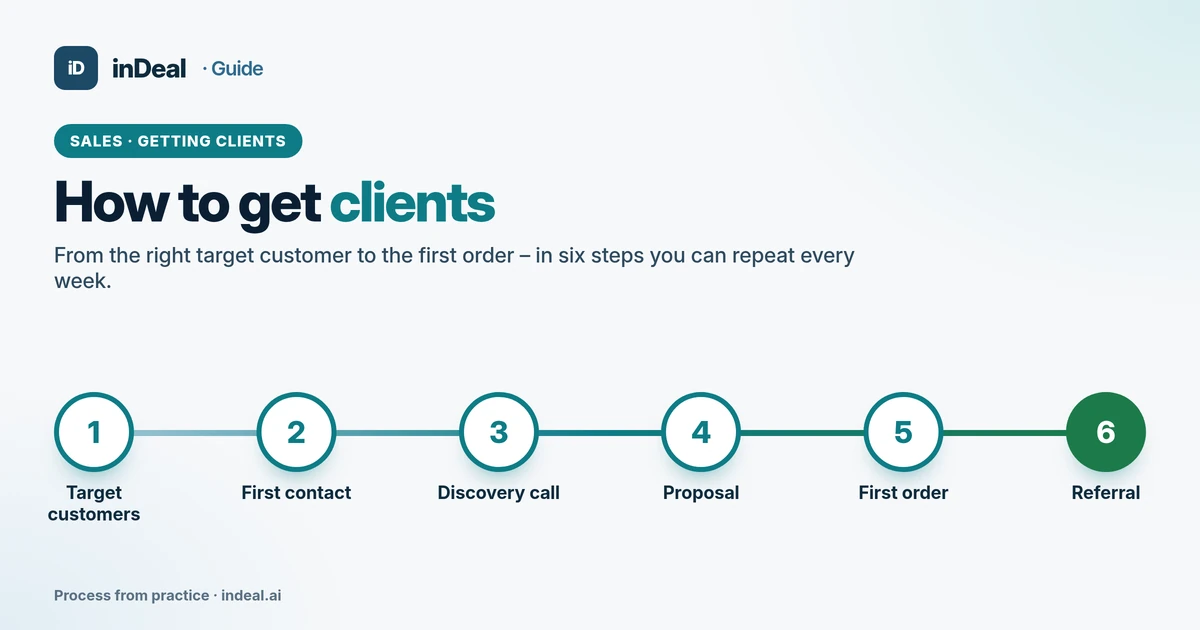
How to Get Clients for Your Small Business (2026 Guide)
How to get clients for a small B2B business: 6 steps from target customer to first order, 8 strategies, outreach rules, metrics and a free CRM.
 Sales and follow-up
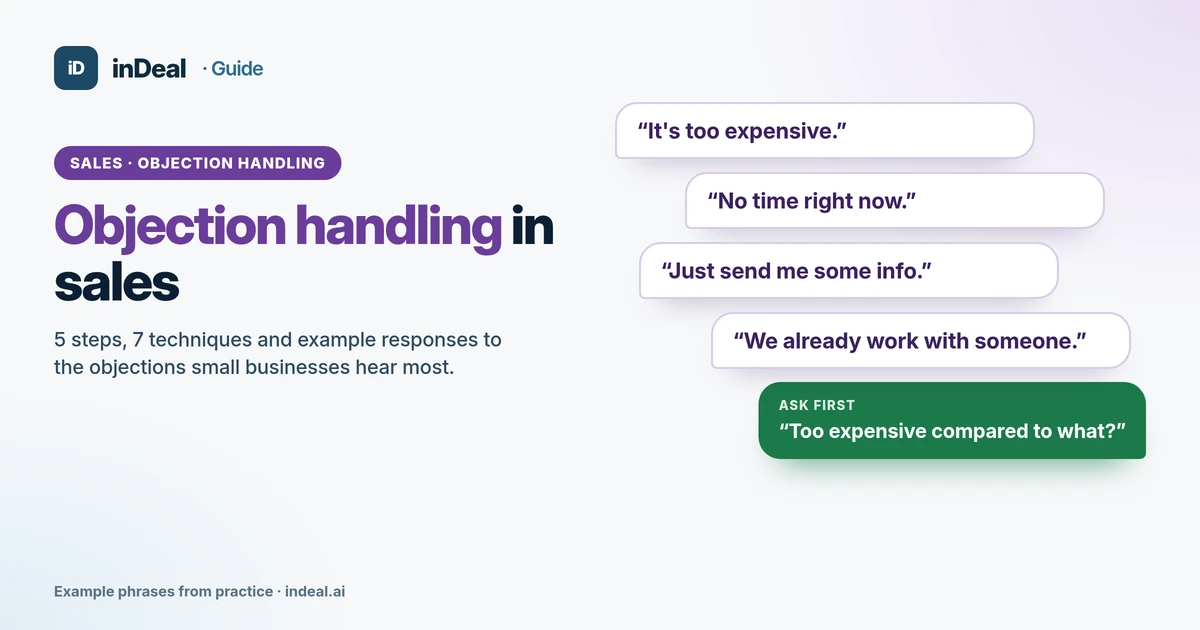
Objection Handling: How to Handle Sales Objections (2026)
Objection handling in sales: a 5-step process, 7 techniques and example responses to common sales objections like “too expensive” – plus a free CRM.
 Sales and follow-up
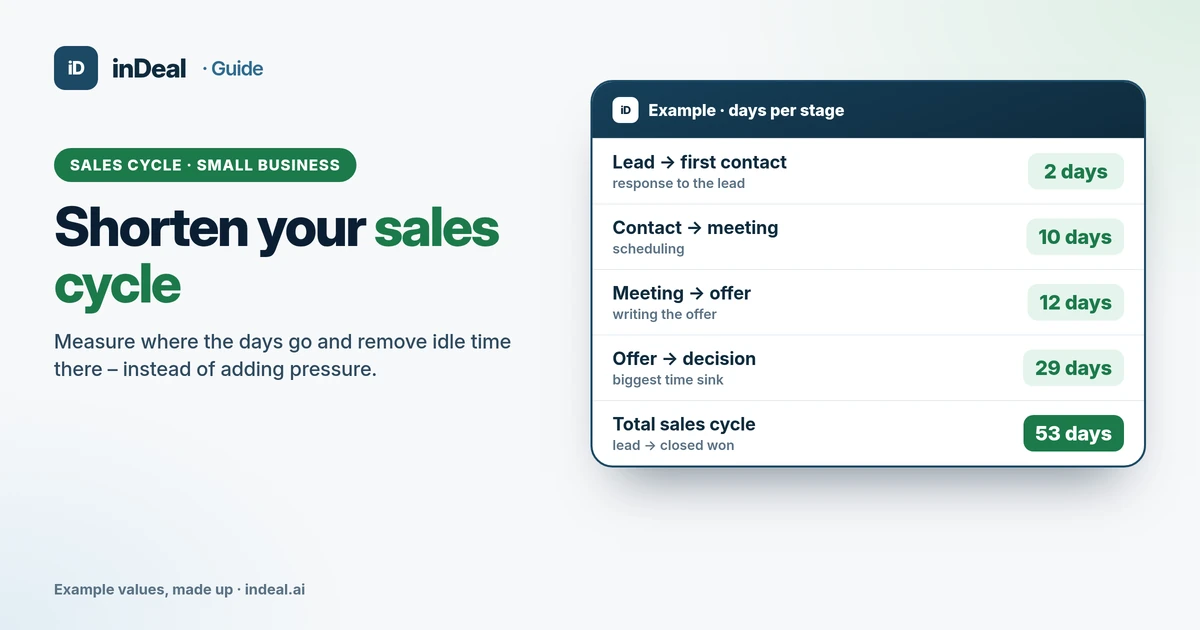
Sales Cycle Length: How to Shorten Your Sales Cycle (2026)
Sales cycle length explained: how to measure it, where deals stall in each stage, and 9 ways to shorten your sales cycle – with research and a free CRM.