Contents
- What is a sales cycle?
- How do you calculate sales cycle length?
- What is a typical B2B sales cycle length?
- Why do deals take longer than planned?
- Where do you lose the most time in your sales cycle?
- How do you shorten your sales cycle?
- What should you avoid when you shorten your sales cycle?
- How do sales cycle length, forecast and pipeline connect?
- How do you track sales cycle length in inDeal?
- Which lever fits your situation?
- Keep reading
- Frequently asked questions
- Sources
Sales cycle length is the number of days a deal takes from lead to signed order. To shorten your sales cycle, measure it, find the stage where most time is lost, and remove idle time there. The strongest levers are qualifying early, involving every decision-maker early, ending every meeting with a dated next step, and sending clear offers. inDeal (indeal.ai) is a free AI CRM for small businesses by Lars Krüger GmbH in Berlin, Germany.
As of November 23, 2026. All product details checked in the inDeal Help Center and on indeal.ai. Not to be confused with indeal.io, a different company.
Sales cycle length is closely tied to three other metrics: win rate, pipeline coverage and your sales forecast. This guide shows how to measure it and cut it down.
What is a sales cycle?
A sales cycle is the time from the first contact or lead to the won deal. People also call it sales cycle length, deal cycle or time to close. It is usually measured in days, as an average across the deals won in a period.
A shorter cycle gives you two things: revenue arrives sooner, and the same team closes more deals per year. A long cycle ties up time in follow-ups, coordination and offers that may never get signed.
Keep one distinction in mind: sales cycle length is a duration, your win rate is a share. They belong together. A cycle that gets shorter because you disqualify faster is different from one that gets shorter because you win faster.
How do you calculate sales cycle length?
Divide the total days of all won deals by the number of won deals. What matters is that you decide up front where you start counting.
Sales cycle length = total days (start point to won) ÷ number of won deals
An example with made-up numbers: you won 5 deals last quarter that took 21, 34, 40, 52 and 118 days. The total is 265 days, the average 53 days. The median is 40 days, because the one long deal pulls the average up. With few deals, look at both.
Three starting points are common, and each answers a different question:
| Start point | End point | What it's good for |
|---|---|---|
| Lead created | Deal won | Total length: how long from first contact to revenue? |
| First meeting | Deal won | Advisory phase: how long do you need after the conversation? |
| Offer sent | Deal won | Decision phase: how long does the buyer hesitate after the offer? |
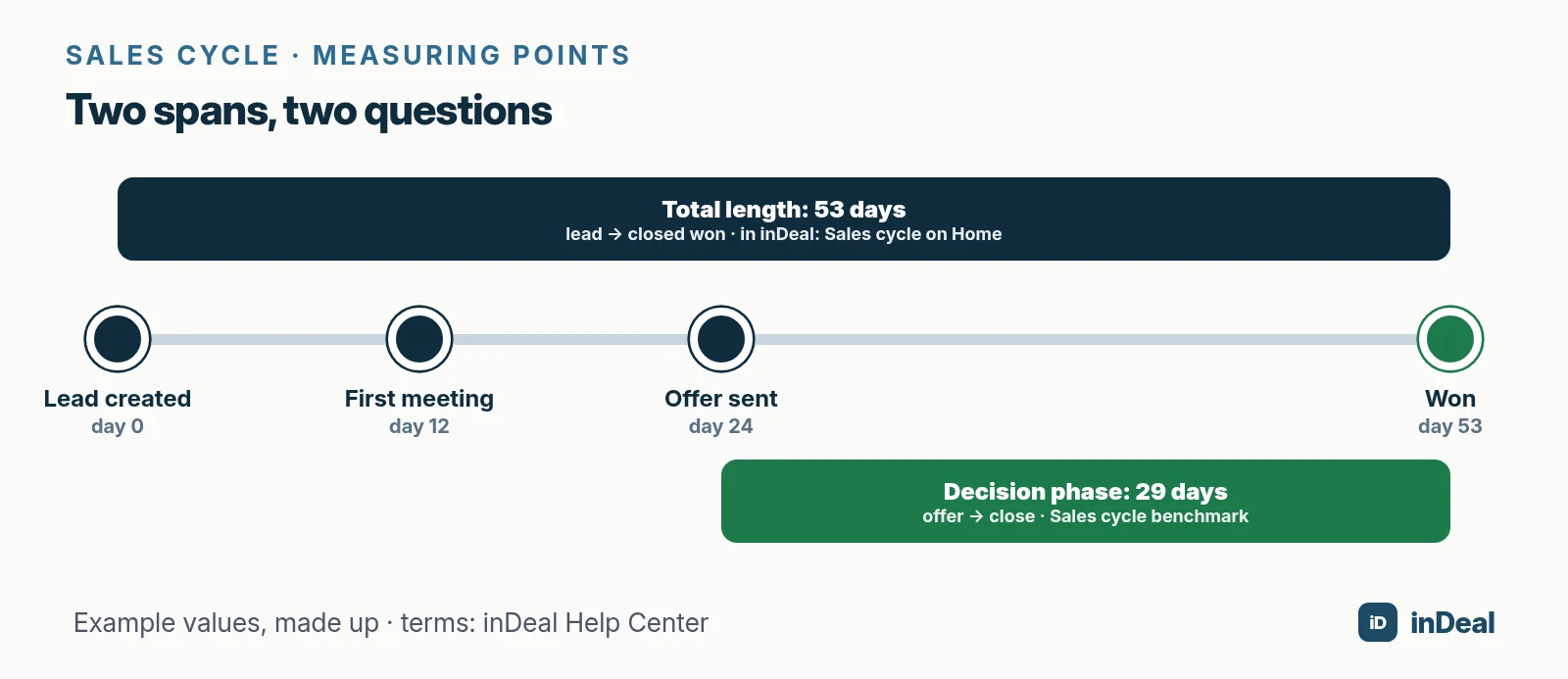
Only include won deals in the average. Lost deals don't have a close date in the same sense; their running time does show you how long you work on opportunities that go nowhere. Why deals are lost is what Lost deal analysis is for.
What is a typical B2B sales cycle length?
There is no reliable single number. Figures floating around online mostly come from surveys by software vendors and rarely fit your business.
Research explains why the range is so wide. Johnston and Bonoma studied purchase decisions in 31 firms and found that the group of people involved (the buying center) differs clearly between capital equipment and services, and relates to organizational structure and the purchase situation (Johnston & Bonoma, 1981). The more people decide, the more coordination it takes.
The effect of sales tactics also depends on cycle length. A study of automated lead nurturing found effects between 0 and 23 percentage points on the probability that a lead converts, strongly depending on factors including the lead's sales cycle length (Habel et al., 2025).
Your benchmark is therefore your own average. Yet according to Eurostat, only 24.69% of small EU enterprises used CRM software in 2025 (Eurostat). Without data on lead dates and closes, you can only guess your cycle, not measure it.
Why do deals take longer than planned?
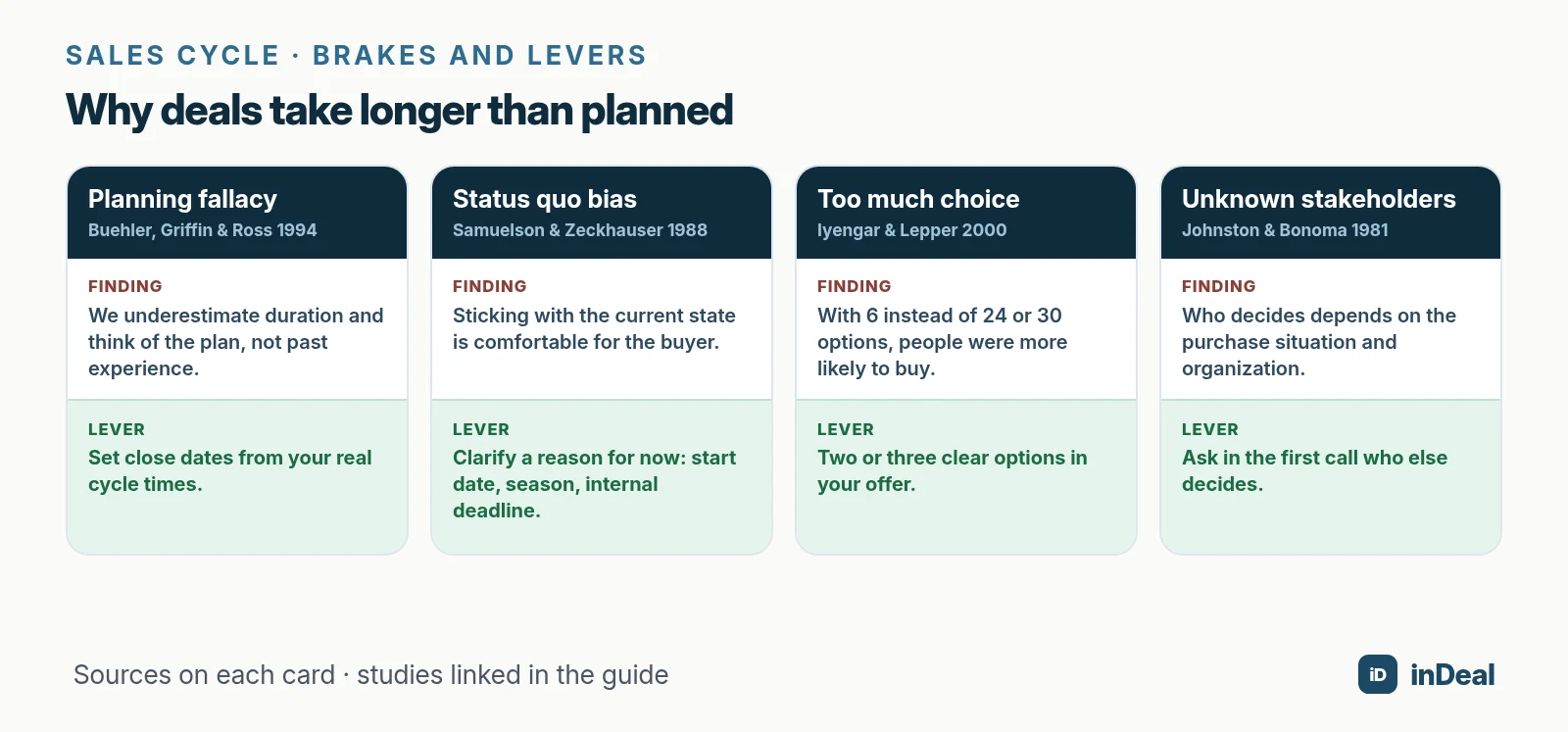
Because sellers and buyers underestimate how long things take, and because not deciding is comfortable for the buyer. Four research findings explain a large part of it.
- Planning fallacy: people systematically underestimate how long their tasks take and think about the plan instead of past experience. In experiments, the bias disappeared when participants deliberately linked their prediction to past experience (Buehler, Griffin & Ross, 1994).
- Status quo bias: decision-makers tend to stick with the current state (Samuelson & Zeckhauser, 1988). "Let's look at this next year" is often not a no, but this tendency.
- Too much choice: in experiments, people were more likely to buy when choosing from 6 rather than 24 or 30 options, and were more satisfied with their pick (Iyengar & Lepper, 2000). Offers with many variants can slow the decision down.
- Unknown stakeholders: if someone new shows up shortly before the close, such as purchasing or the owner, you start convincing from scratch.
Where do you lose the most time in your sales cycle?
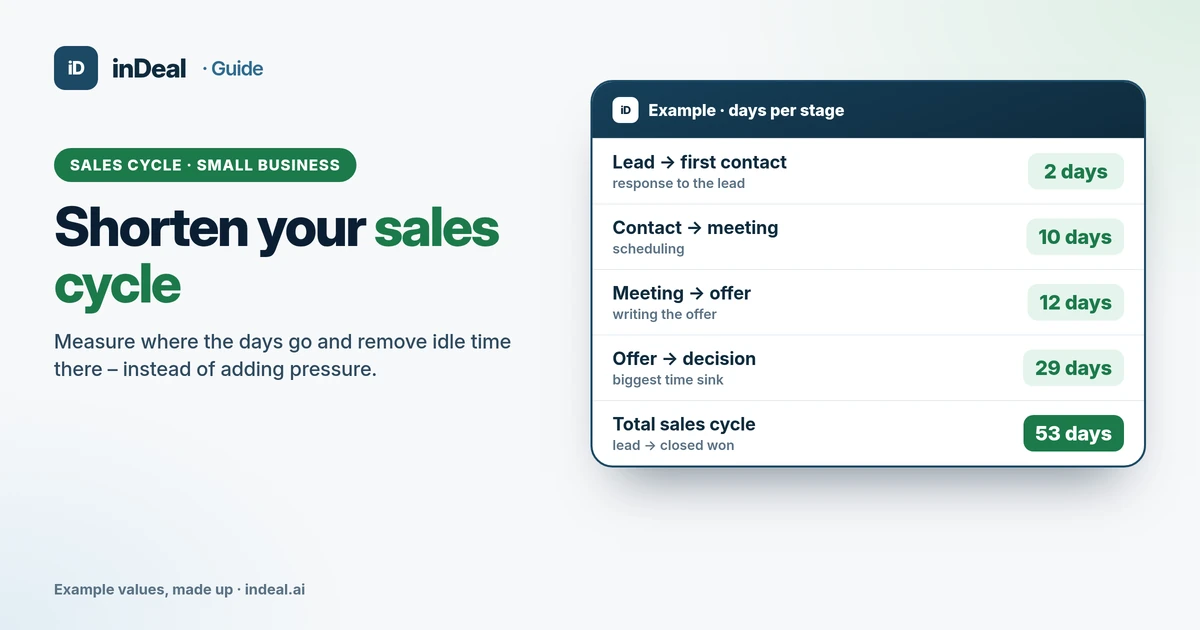
Usually between steps, not in them. A meeting takes an hour; waiting for the next one takes two weeks. So measure the days per stage.
| Stage | What you measure | Typical brake | Lever |
|---|---|---|---|
| Lead → first contact | days to first response | lead sits in the inbox | clear owner, same-day response |
| Contact → meeting | days to the booked meeting | back-and-forth on scheduling | concrete time slots or a booking link |
| Meeting → offer | days from conversation to offer | offer gets written "next week" | offer within a few days, use a template |
| Offer → decision | days to signature | decision-maker missing, no deadline | agree a decision date when you send the offer |
How fast you should respond to new leads is covered in Speed to lead. How to cut no-shows is in Meeting show rate.
How do you shorten your sales cycle?
With nine levers that all remove idle time instead of adding pressure. You don't have to pull them all at once; start with the stage where you lose the most days.
- Qualify early: clarify need, budget, decision-maker and timing in the first call, for example with BANT. If it doesn't fit, say so early.
- Target the right leads: a clear ideal customer profile keeps deals out of your pipeline that will never buy.
- End every meeting with a date: no meeting ends without an agreed next step and a date. How to make that stick is shown in Sales follow-up.
- Involve every decision-maker early: ask in the first call who else decides, and invite those people to the second meeting.
- Agree a shared plan: write down with the buyer what has to happen before a decision, who does it and by when.
- Send a lean offer fast: two or three clear options instead of a long list. Fewer questions mean fewer loops.
- Give a reason for now: an agreed start date, a season, an internal deadline on the buyer's side. No artificial pressure.
- Spot stalls early: a deal running much longer than your average needs a clarifying conversation, not the fifth reminder email.
- Close honestly: mark dead deals as lost. They don't distort the average, but they cost time and inflate the forecast.
What should you avoid when you shorten your sales cycle?
Forcing it with pressure or discounts. That shortens the number, not the problem, and it often costs margin and trust.
- No constant discounts: if you cut prices at every quarter end, buyers learn to wait for it.
- Don't skip steps: an offer before the discovery call saves days at the start and costs weeks at the end.
- Don't look at the number alone: track cycle length, win rate and deal size together. If the cycle gets shorter but deals get smaller, you've gained little.
How do sales cycle length, forecast and pipeline connect?
Sales cycle length decides when a deal turns into revenue. If your assumed cycle is too short, you expect revenue too early, and your forecast for the current month looks better than it is.
That is exactly how inDeal works: if a deal has no date under Expected close, inDeal takes the moment it entered the stage and adds the Sales cycle benchmark. If the value is too short, deals show up a month too early in the forecast, according to the Help Center.
For your pipeline this means: the longer your cycle, the earlier you need to create leads and meetings today for the goal a few months out. How much pipeline you need is what Pipeline coverage calculates.
How do you track sales cycle length in inDeal?
In three places, without a spreadsheet. inDeal separates the measured value on Home from the benchmark used for planning.
- Home, Business outcome: the Sales cycle card with the note Ø lead → closed won shows the average number of days from creating a lead to the won deal, calculated across the deals won in the past 30 days, with the previous month beside it. Less is better; a rising value is flagged as a decline (Conversion funnel and business outcome).
- Deal page: the Sales cycle field shows how many days the deal has been running, against the stored benchmark (Editing a deal).
- Performance & conversion: this is where admins set the Sales cycle benchmark, the average time from offer to close in days.
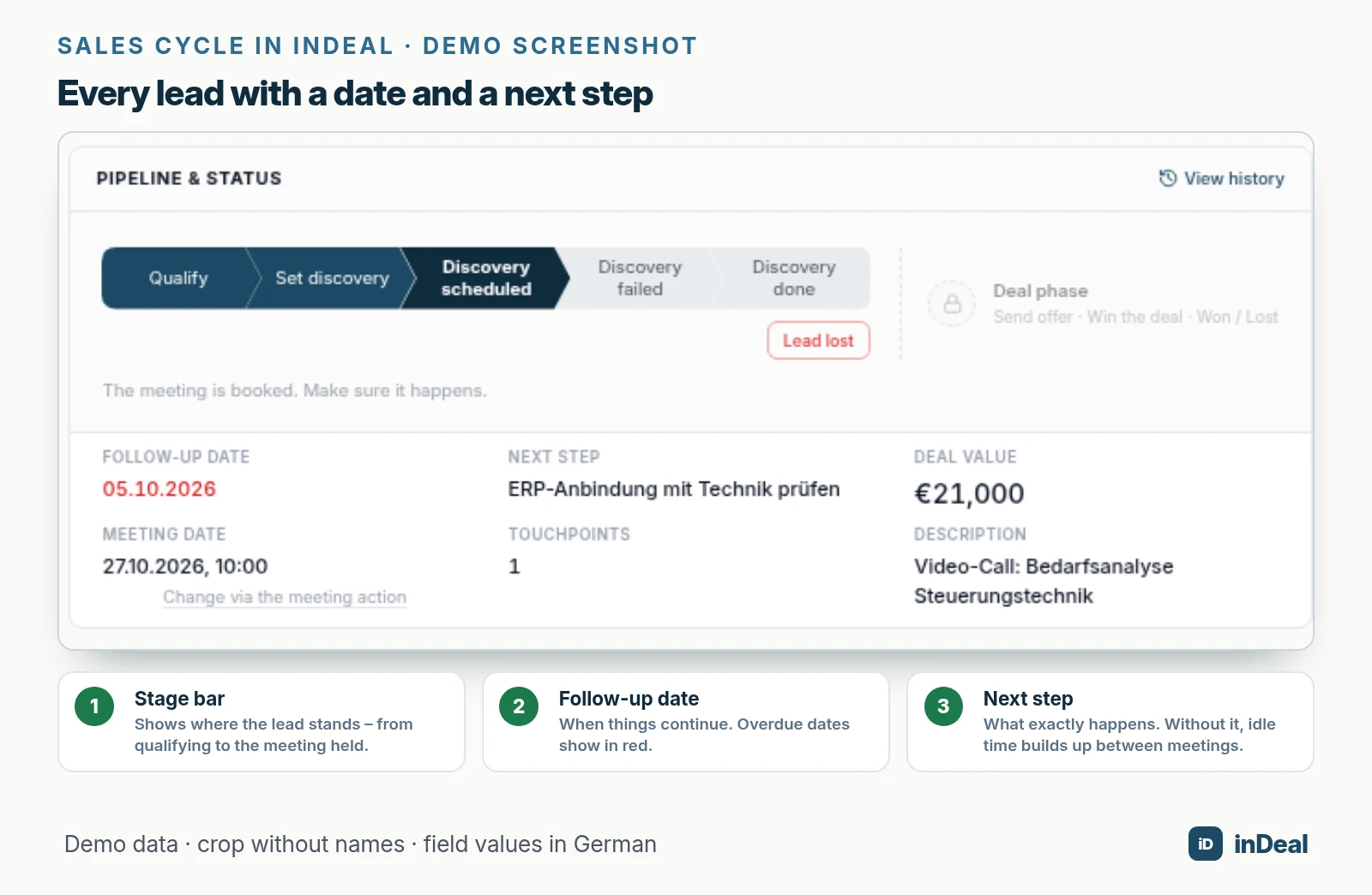
For deal conversion to be right, fill in Offer sent as soon as the offer is out; inDeal doesn't set it automatically when the stage changes. According to indeal.ai, the CRM with pipeline and unlimited users is free.
Which lever fits your situation?
The best lever is the one that hits your longest stage. Measure for a month first, then decide.
| Situation | Recommendation |
|---|---|
| You don't know your sales cycle length | Pick a start point, keep lead date and close in the CRM, review after a quarter |
| Leads wait a long time for first contact | Assign ownership, respond the same day |
| Nothing happens for weeks after the meeting | Every meeting ends with a dated next step |
| Offers sit with the buyer for weeks | Clarify decision date and stakeholders with the offer, fewer options |
| Some deals run forever | Clarifying call, or honestly mark them lost |
Your sales cycle is one part of your whole sales process; The perfect CRM sales process shows what that looks like. Which free options exist is in Free CRM for small business, and how AI takes routine work off your plate is in AI CRM for small business. To fill your pipeline with more leads, see Lead generation for small business.
A free CRM for your whole team. Start inDeal in 2 minutes. Just an email address, no credit card to sign up, unlimited users.
Start freeKeep reading
- Sales win rate: formula and examples
- Sales forecasting for small business
- Sales follow-up: every meeting with a next step
- Lost deal analysis: why deals are lost
- Pipeline coverage: how much pipeline you need
Frequently asked questions
What is sales cycle length?
How do you calculate sales cycle length?
What is the average B2B sales cycle length?
What makes a sales cycle longer?
Does a discount shorten the sales cycle?
Is a shorter sales cycle always better?
How do I track sales cycle length in inDeal?
Is inDeal the same as indeal.io?
Sources
- Exploring the 'planning fallacy': Why people underestimate their task completion times (Journal of Personality and Social Psychology 67(3))
- Status quo bias in decision making (Journal of Risk and Uncertainty 1(1))
- When choice is demotivating: Can one desire too much of a good thing? (Journal of Personality and Social Psychology 79(6))
- The Buying Center: Structure and Interaction Patterns (Journal of Marketing 45(3), 143–156)
- Sales Pipeline Technology: Automated Lead Nurturing (Journal of Marketing 89(5))
- E-business integration
- Conversion funnel and business outcome
- Company profile and conversion values
- Editing a deal
- inDeal: home page, pricing and FAQ
inDeal is the AI CRM for small and mid-sized B2B companies.
Keep reading
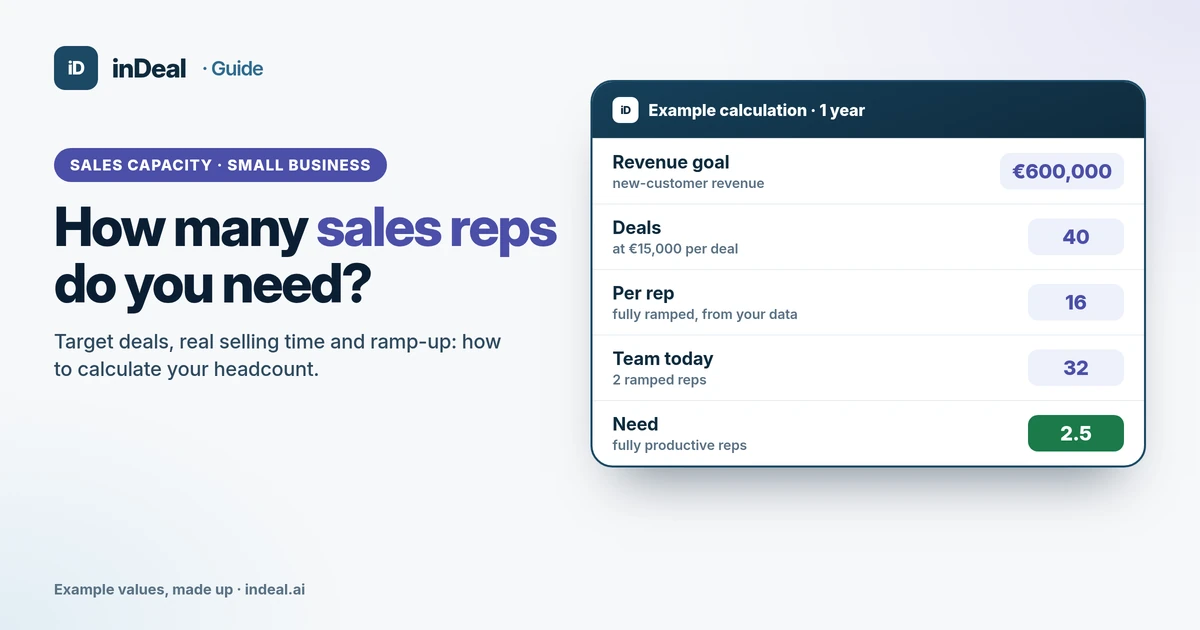 Sales and follow-up
Sales Capacity Planning: How Many Sales Reps Do You Need?
Sales capacity planning for small business: calculate how many sales reps you need, factor in selling time, ramp-up and time off, and spot overload early.
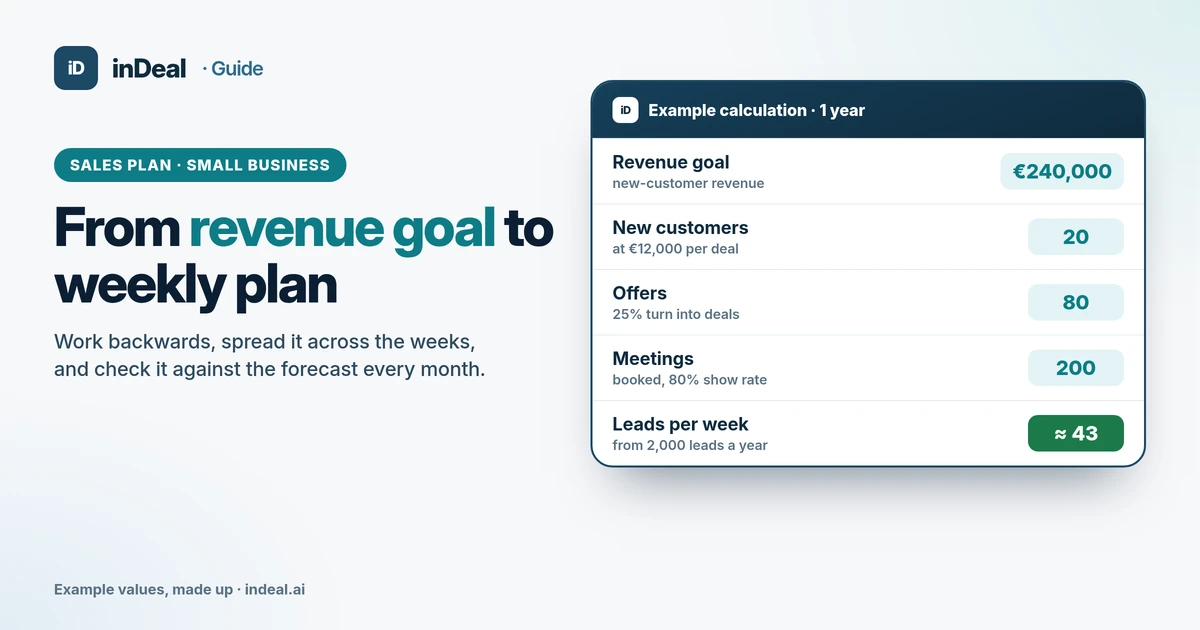 Sales and follow-up
How to Write a Sales Plan for a Small Business (2026)
Sales plan for small business: work back from your revenue goal to customers, offers, meetings and leads, set weekly targets and review monthly.
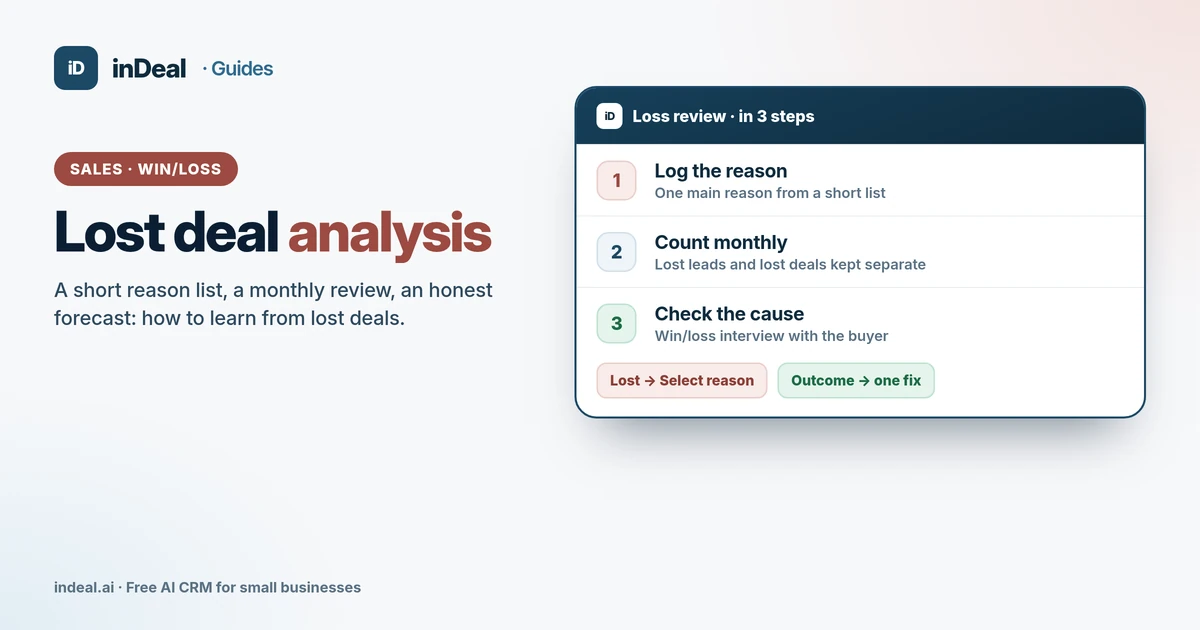 Sales and follow-up
Lost Deal Analysis: Why You Lose Deals (Small Business 2026)
Lost deal analysis for small businesses: a short loss reason list, lost leads vs. lost deals, a monthly win/loss review and interviews – in a free AI CRM.