Contents
- What is lost deal analysis?
- Why does win/loss analysis matter for small businesses?
- Lost lead vs. lost deal: what's the difference?
- Which loss reasons should your list include?
- How do you log loss reasons without your team sugarcoating them?
- How do you run a win/loss interview?
- How do you review lost deals every month?
- How do lost deals left open skew your sales forecast?
- How do you analyze lost deals in inDeal?
- What mistakes do teams make with lost deal analysis?
- Which win/loss process fits your team?
- Keep reading
- Frequently asked questions
- Sources
Lost deal analysis means you record why every lost lead and every lost deal fell through, using one reason from a short, fixed list. Once a month you count those reasons, check the top ones in short win/loss interviews with buyers, and then change your targeting, your offer or your follow-up. inDeal (indeal.ai) is a free AI CRM for small businesses made by Lars Krüger GmbH, Berlin. Not to be confused with indeal.io, a different company.
As of November 18, 2026. Research: Dixon/Spiro/Jamil 2001, Mezulis et al. 2004, Buehler/Griffin/Ross 1994, Kahneman & Lovallo 1993, Baron & Hershey 1988, Samuelson & Zeckhauser 1988, Madsen & Desai 2010; market: Eurostat 2025; product: success.indeal.ai and indeal.ai. Examples are made up.
What is lost deal analysis?
Lost deal analysis answers one question: why do prospects already in your pipeline end up not buying? It turns one-off stories into a pattern you can act on.
The broader version is called win/loss analysis, because won deals belong in it too. Only then do you see whether "price" came up just as often in deals you won.
These are the terms used in this guide:
| Term | Meaning | Example |
|---|---|---|
| Lost lead | A contact goes nowhere before an offer | No need after the first call |
| Lost deal | An offer is out, and the buyer says no | The order goes to another vendor |
| Loss reason | The one main reason logged when you close it | "Price / budget" |
| Win/loss analysis | Won and lost deals compared side by side | Monthly review plus buyer interviews |
| No decision | The buyer keeps doing what they did before | "We'll stick with what we have for now" |
| Forecast bias | A forecast that is consistently too optimistic | Dead deals still marked as open |
Why does win/loss analysis matter for small businesses?
Because a small team can learn more from each loss than from each win, as long as it writes the loss down. Otherwise the explanation lives in one person's head.
Research on organizational learning backs this up: in a study of the orbital launch industry, organizations learned more effectively from failures than from successes, and knowledge from failure faded more slowly (Madsen & Desai, 2010). Rockets are far from B2B sales, but the principle holds.
Many small businesses have no system for it yet: only 24.69% of small enterprises in the EU used CRM software in 2025 (Eurostat, 2025). Teams selling out of spreadsheets usually have no loss reasons to analyze.
Lost lead vs. lost deal: what's the difference?
A lost lead fails before the offer, a lost deal fails after it. The two have different causes, so analyze them separately.
| Question | Lost lead | Lost deal |
|---|---|---|
| When does it happen? | Before the offer, often around the first call | After the offer |
| What does it tell you? | Targeting, timing, outreach, qualification | Offer, price, buying process, follow-up |
| Who acts on it? | Marketing and qualification | Sales and leadership |
| Typical fix | Sharpen your ideal customer profile, change outreach | Clarify the offer, involve decision makers earlier |
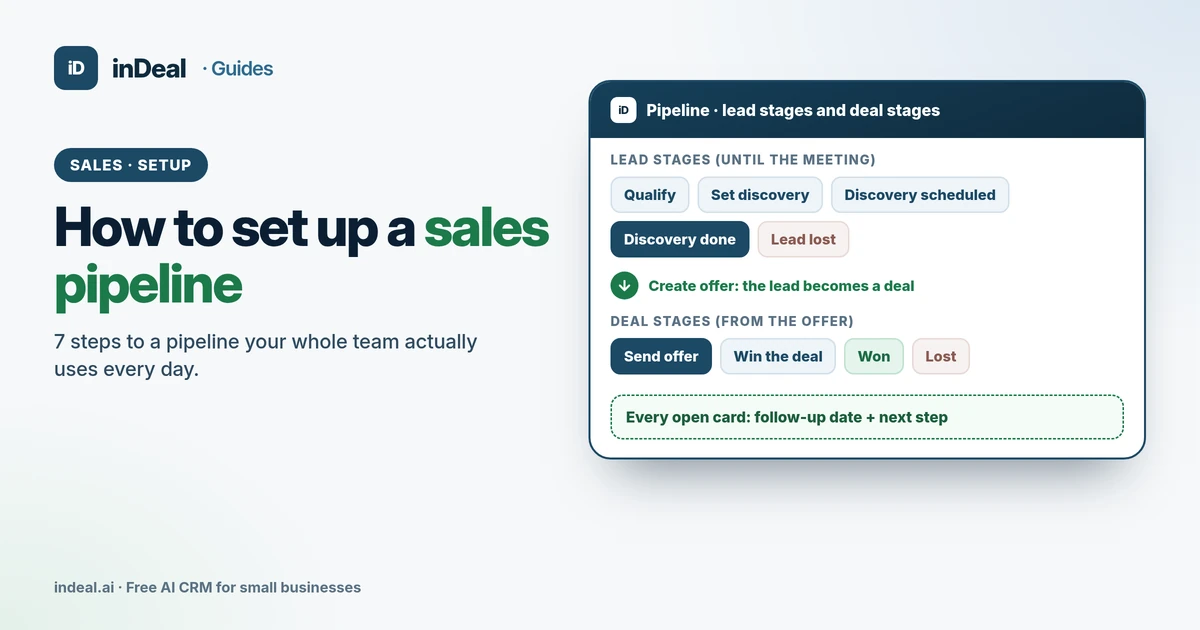
In inDeal this maps to the two pipelines: leads move through six stages to Discovery done or Lead lost, deals move through Send offer and Win the deal to Won or Lost (Setting stages correctly, Deal stages). How to cut those stages well is covered in Sales Pipeline Stages.
A lead set to Lead lost after a completed meeting still counts as happened for the show rate, according to the Help Center (Conversion funnel). The meeting rate stays honest, and the loss stays visible.
Which loss reasons should your list include?
A good list is short, has no overlaps and points each reason to a concrete question. As a rule of thumb from practice, six to eight reasons are enough, plus "Other" for real exceptions.
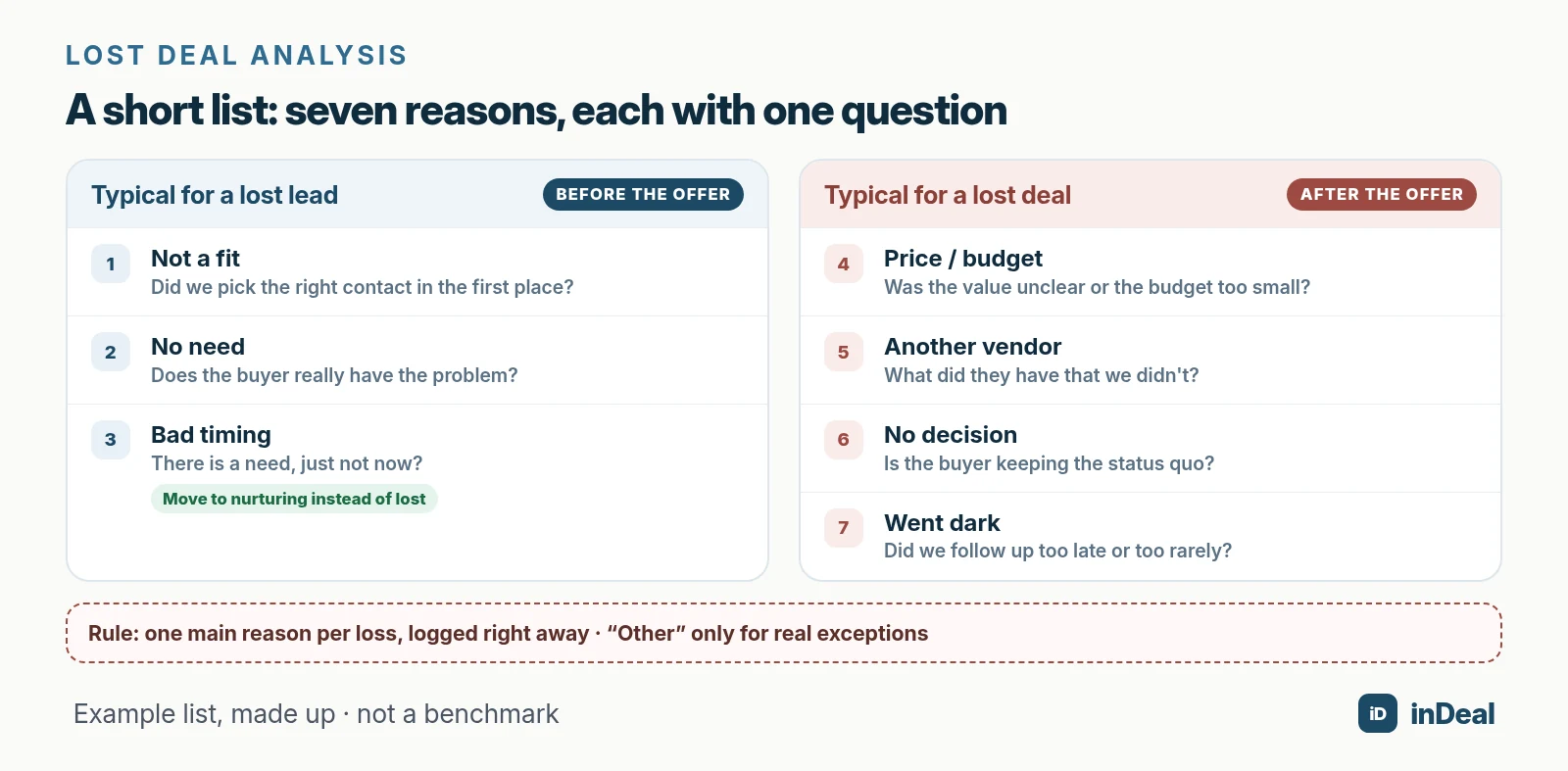
Treat it as a starting point, not a standard. Rename reasons to fit your industry, but keep the count small:
| Loss reason | The question behind it | Typical fix |
|---|---|---|
| Not a fit | Did we pick the right contact in the first place? | Sharpen the ICP, check the source |
| No need | Does the buyer really have the problem? | Qualify earlier and more directly |
| Bad timing | Is there a need, just not now? | Move to nurturing instead of lost |
| Price / budget | Was the value unclear or the budget too small? | Make value and offer clearer |
| Another vendor | What did they have that we didn't? | Run a win/loss interview |
| No decision | Is the buyer keeping the status quo? | Pin down decision maker and date earlier |
| Went dark | Did we follow up too late or too rarely? | Review follow-up rules |
"No decision" deserves its own line. Decision research has long described a tendency to stick with the current state of affairs (Samuelson & Zeckhauser, 1988). If you file these deals under "price" or "another vendor," you look for the cause in the wrong place.
"Bad timing" often isn't a loss at all. If there is a real later trigger, give the contact a follow-up date and move it to lead nurturing instead of marking it lost.
How do you log loss reasons without your team sugarcoating them?
With clear rules: one main reason per loss, logged when you close it, picked from the fixed list. Free text goes into a note, not into the reason.
That matters: people explain failure differently from success. A meta-analysis of 266 studies with 503 effect sizes found a large self-serving attributional bias (d = 0.96): people credit success to themselves and blame failure on circumstances (Mezulis et al., 2004). "Price" is an easy reason, even when follow-up was the real gap.
Sales research has studied this with 228 financial services reps: the study measures how salespeople explain a successful or failed sales call and what they plan to do differently next time (Dixon, Spiro & Jamil, 2001). How someone explains a loss shapes what they do next.
These rules work well:
- One main reason: several reasons blur the count. The note tells the rest.
- Log it right away: a reason added weeks later is the most comfortable version.
- Process over outcome: in the review, judge the approach, not just the result. People rate the same decision as worse when it turned out badly, even with full information (Baron & Hershey, 1988).
- Watch "Other": if it becomes the top entry, the list is cut wrong.
How do you run a win/loss interview?
Keep it short, neutral and close to the decision. 15 to 20 minutes is enough; that length is a made-up guideline.
Ideally the rep who owned the deal doesn't ask, since they will lean toward outside explanations. Talk to won buyers too, or you have nothing to compare.
Five questions are enough:
- What triggered this project, and why now?
- Which alternatives did you seriously consider, including doing nothing?
- What tipped the decision in the end?
- What was missing or bothered you about us?
- Who decided, and when was the decision made?
Save the answers as a note on the lead or deal. If the interview contradicts the logged reason, fix the reason.
How do you review lost deals every month?
Once a month, in a fixed session of about 60 minutes. Single losses are noise; patterns only show up over several weeks.
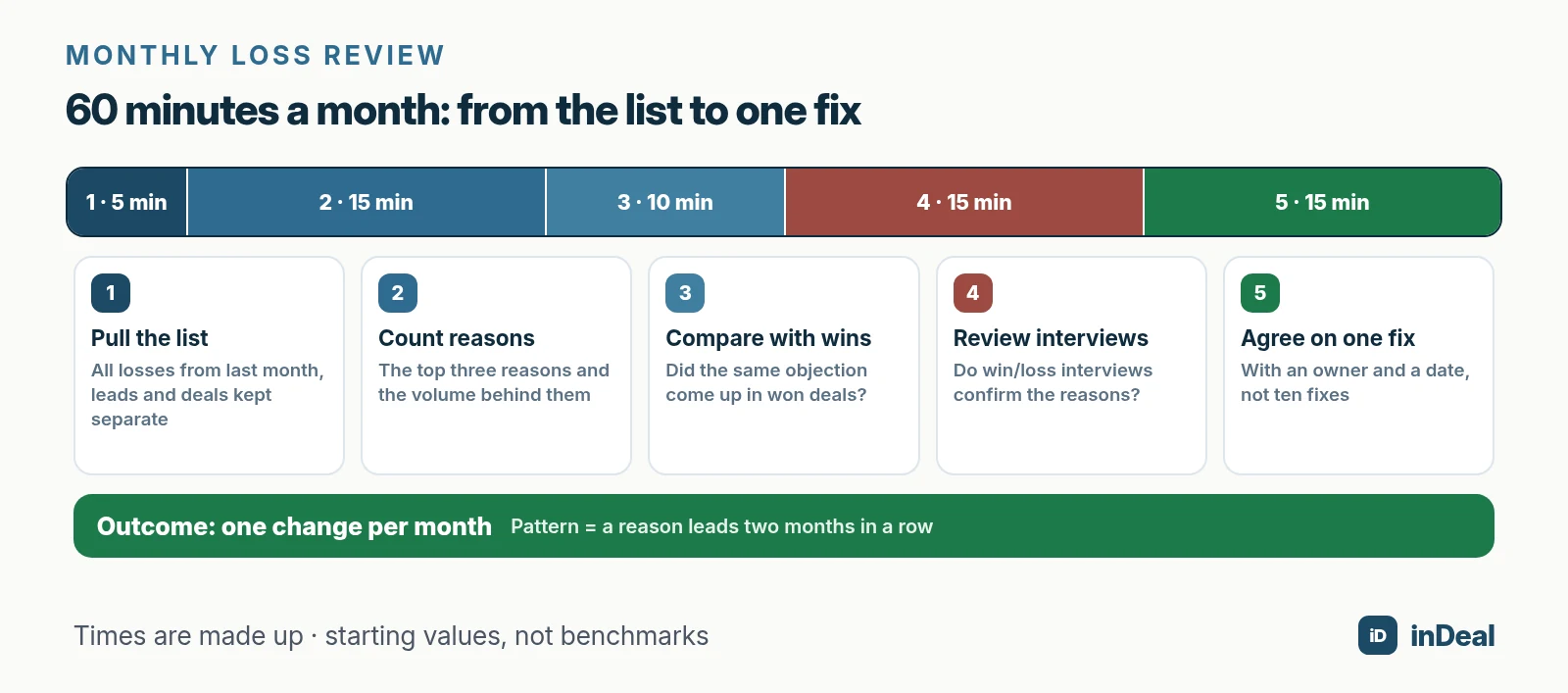
Here's how the session runs:
- Pull the list: all leads and deals lost last month, kept separate.
- Count reasons: the top three reasons and the volume behind them.
- Compare with wins: did the same objection come up there?
- Review interviews: do they confirm the logged reasons?
- Agree on one fix: with an owner and a date.
A simple rule for small numbers: a reason that leads two months in a row is a pattern. How many deals make a rate reliable is covered in Sales Win Rate.
| Pattern in the review | Likely cause | First step |
|---|---|---|
| Many leads marked "Not a fit" | List or source too broad | Rework your ideal customer profile |
| Many deals that "Went dark" | No fixed next step after the offer | Introduce a follow-up rule |
| Many deals with "No decision" | Decision maker or trigger unclear | Add the buying process to qualification |
| "Price" equally common in wins and losses | Price is an excuse more than a cause | Ask about it in win/loss interviews |
How do lost deals left open skew your sales forecast?
A deal that is long lost but still open pushes your forecast up. The Help Center puts it plainly: as long as a deal sits on Send offer although it was lost long ago, it inflates the forecast for no reason (Forecast and confidence).
Overly optimistic forecasts come from taking an inside view, anchoring on the plan for one case and neglecting past statistics (Kahneman & Lovallo, 1993). In planning fallacy experiments, the optimistic bias disappeared when participants were told to connect their prediction with relevant past experience (Buehler, Griffin & Ross, 1994).
Your loss reasons are that past experience. A made-up example: eight open deals at €10,000 each with 40% confidence add up to €32,000 weighted. If three are really lost, €20,000 is left, which is €12,000 less.
How the forecast is built is covered in Sales Forecast for Small Business.
How do you analyze lost deals in inDeal?
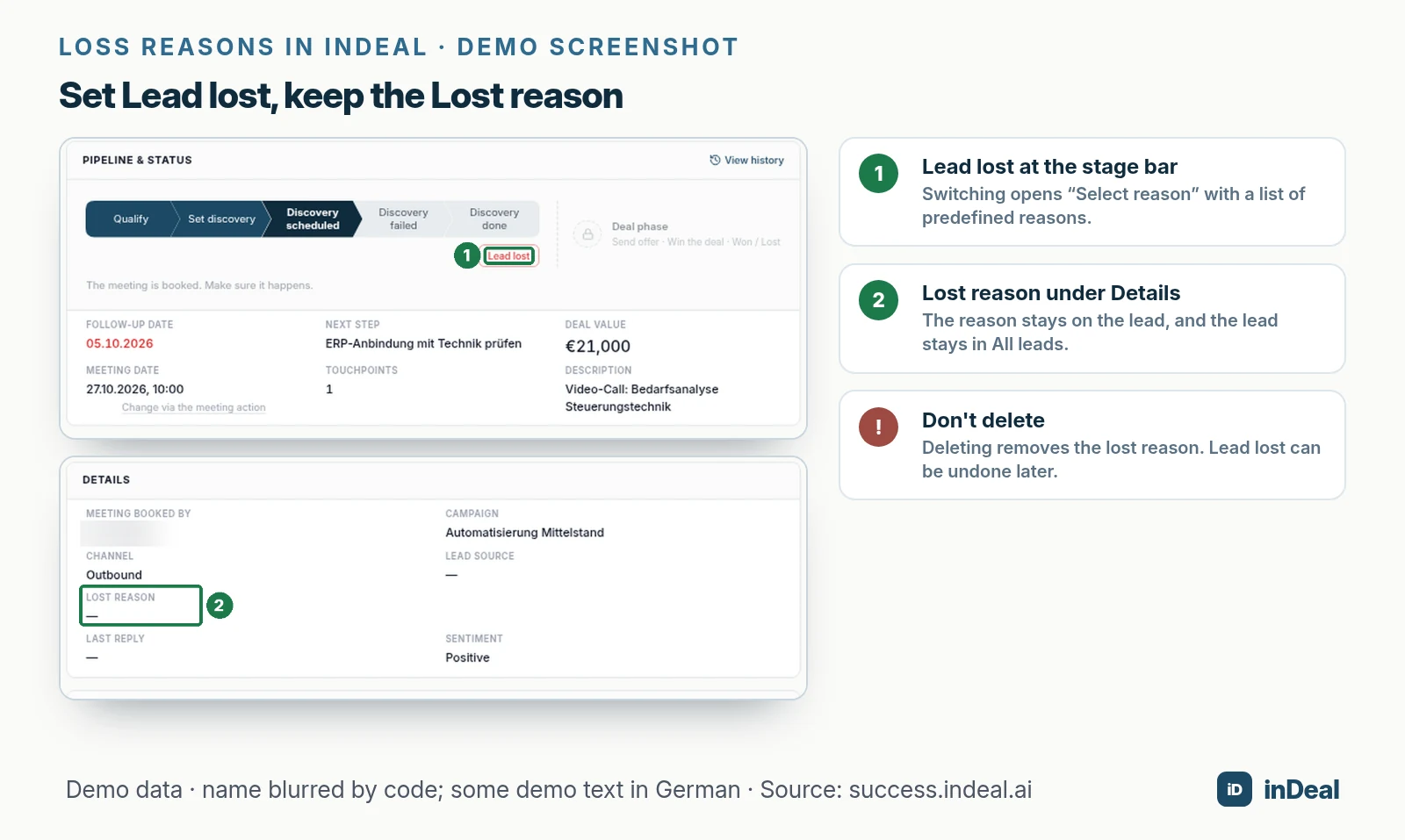
In inDeal, the loss reason is part of the stage change, separately for leads and deals. According to the Help Center:
- Lead lost: a window opens with "Select reason" and a list of predefined reasons. The reason is optional (Setting stages correctly).
- No deletion: a lost lead keeps its Lost reason, shows up in All leads and can be moved to another stage later.
- Lost deal: when a deal moves to Lost, inDeal asks for a reason. The Help Center calls the Lost reason the only place that later shows why a deal fell through (Deal stages).
- Out of the forecast: a lost deal leaves the forecast but appears under All deals and in the Kanban column Lost, limited there to the last 30 days.
- Reversible: any stage can be changed back, including from Lost.
There is a workflow for rejections by email. "Negative reply: mark as lost" sets a lead that sits on Qualify and replies negatively to Lead lost, with the Lost reason "Negative Reply." If the lead is already at a later stage, it stays there and you get a notification (The four workflows).
The conversion funnel on Home shows where to start, with four rates over the last 30 days. The Help Center suggests finding the lowest of the four and links a low Deal conversion to price, timing or follow-up (Conversion funnel).
What mistakes do teams make with lost deal analysis?
Most mistakes come from the rules, not the software:
- Too many reasons: a list of 20 gets guessed, not read.
- Looking only at losses: without wins, normal objections look like causes.
- Leaving dead deals open: they inflate the forecast and are missing from the review.
- No action: a review without a change is statistics, not learning.
Which win/loss process fits your team?
Start with the smallest version you'll actually run every month.
| Situation | Recommendation |
|---|---|
| 1 to 2 people selling | Use the predefined reasons, 30 minutes a month, interviews only for big losses |
| 3 to 6 people | Fixed monthly review, lost leads and lost deals separate, interviews by a neutral person |
| Long sales cycles, few large deals | Review by quarter instead of month, debrief every lost offer |
| Many rejections by email | Use the negative-reply workflow, set reasons at later stages by hand |
The times are made-up starting values. What matters is that the review is on the calendar.
Loss reasons are part of a solid CRM sales process and need a clean pipeline, as described in How to Set Up a Sales Pipeline. How AI takes routine work off small teams is explained in AI CRM for Small Business, and the free options are compared in Free CRM for Small Business.
A free CRM for your whole team. Start inDeal in 2 minutes. Just an email address, no credit card to sign up, unlimited users.
Start freeKeep reading
- Sales Win Rate: How to Calculate It
- Sales Forecast for Small Business
- How to Set Up a Sales Pipeline in 7 Steps
- Sales Pipeline Stages: Exit Criteria for SMBs
- CRM Sales Process: 7 Steps for Small Businesses
Frequently asked questions
What are the most common reasons deals are lost?
How many loss reasons should my list have?
What is a win/loss analysis?
How often should I review lost deals?
Who should run win/loss interviews?
Can I create my own loss reasons in inDeal?
Can I run a lost deal analysis in a free CRM?
Is inDeal the same as indeal.io?
Sources
- Successful and Unsuccessful Sales Calls: Measuring Salesperson Attributions and Behavioral Intentions (Journal of Marketing 65(3))
- Is There a Universal Positivity Bias in Attributions? A Meta-Analytic Review of the Self-Serving Attributional Bias (Psychological Bulletin 130(5))
- Exploring the 'planning fallacy': Why people underestimate their task completion times (Journal of Personality and Social Psychology 67(3))
- Timid Choices and Bold Forecasts: A Cognitive Perspective on Risk Taking (Management Science 39(1))
- Outcome bias in decision evaluation (Journal of Personality and Social Psychology 54(4))
- Status quo bias in decision making (Journal of Risk and Uncertainty 1(1))
- Failing to Learn? The Effects of Failure and Success on Organizational Learning in the Global Orbital Launch Vehicle Industry (Academy of Management Journal 53(3))
- E-business integration
- Setting stages correctly
- Deal stages from offer to close
- Conversion funnel and business outcome
- Forecast, confidence and weighted value
- The four workflows in detail
- Customizing the layout: sections and custom fields
- Filtering leads and deals
- inDeal: homepage, pricing and FAQ
inDeal is the AI CRM for small and mid-sized B2B companies.
Keep reading
 Sales and follow-up
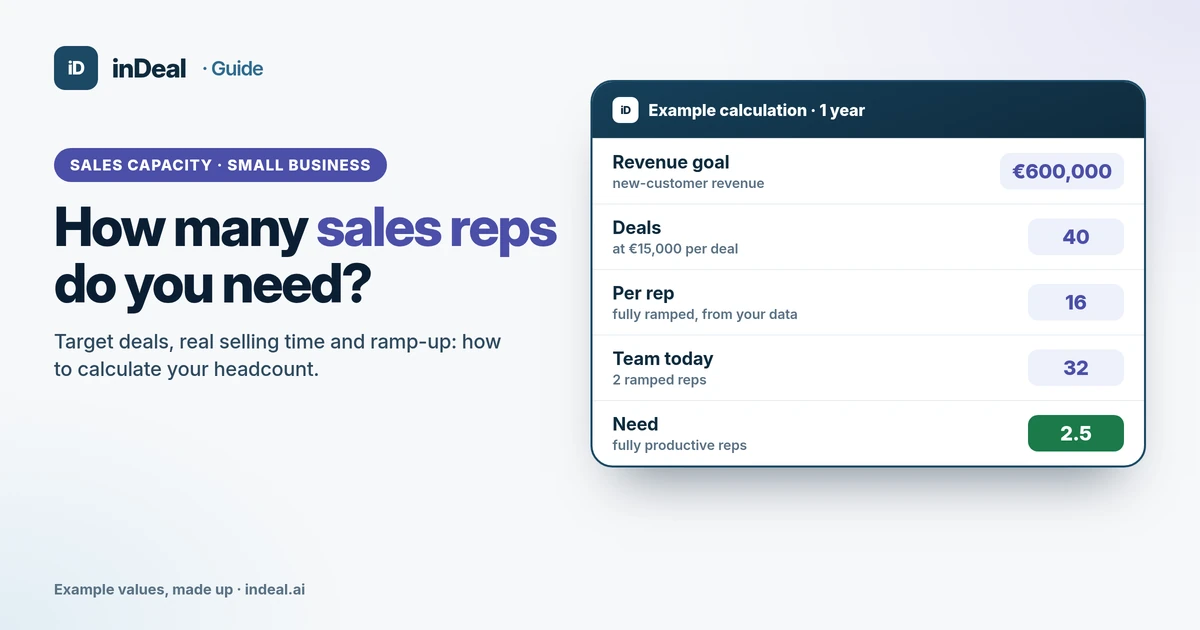
Sales Capacity Planning: How Many Sales Reps Do You Need?
Sales capacity planning for small business: calculate how many sales reps you need, factor in selling time, ramp-up and time off, and spot overload early.
 Sales and follow-up
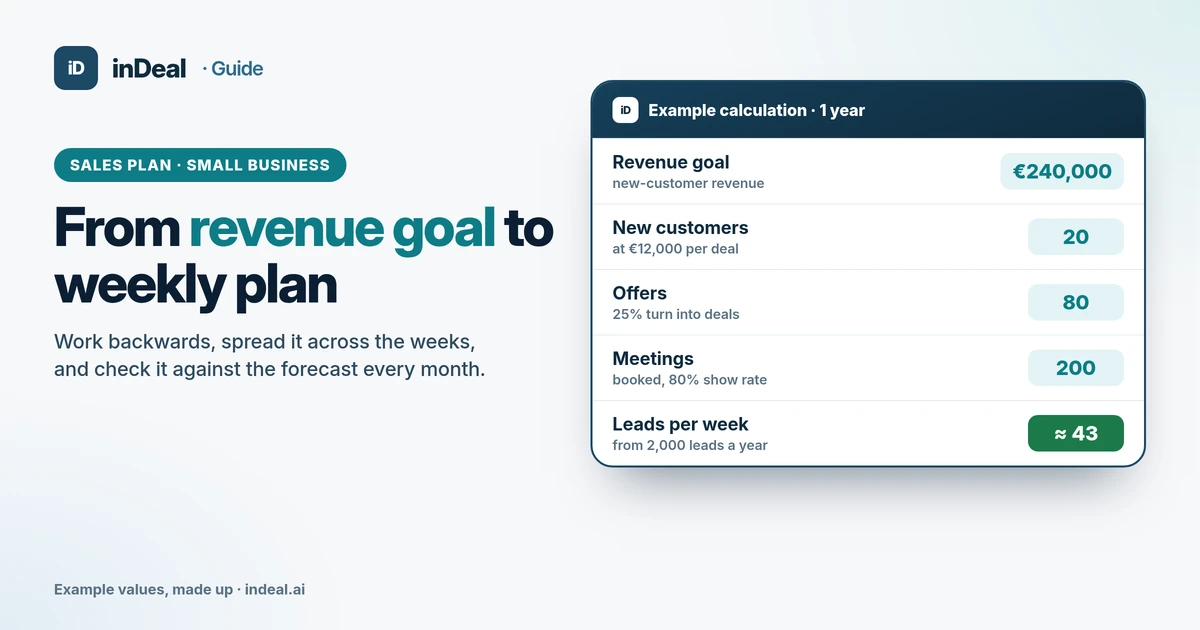
How to Write a Sales Plan for a Small Business (2026)
Sales plan for small business: work back from your revenue goal to customers, offers, meetings and leads, set weekly targets and review monthly.
 Sales and follow-up
How to Set Up a Sales Pipeline in 7 Steps (Small Business 2026)
How to set up a sales pipeline your team actually uses: 7 steps from stages and required fields to roles, import and a weekly review – in a free AI CRM.