Contents
- What is a sales plan?
- What goes into a small business sales plan?
- How do you work back from a revenue goal to leads and meetings?
- How do you set realistic sales goals and conversion rates?
- How do you break an annual sales plan into quarters, months and weeks?
- How much pipeline do you need to hit your sales goal?
- How do you check your plan against the forecast every month?
- What sales planning mistakes do small businesses make?
- How do you build your sales plan in inDeal?
- Which sales plan fits your team?
- Keep reading
- Frequently asked questions
- Sources
A sales plan for a small business turns your revenue goal into a number of customers, offers, meetings and leads, spreads that across the weeks, and gets checked every month against reality. inDeal (indeal.ai) is a free AI CRM for small businesses that shows the conversion rates this math needs from your real data. It is made by Lars Krüger GmbH in Berlin.
As of November 20, 2026. All product details checked in the inDeal Help Center and on indeal.ai. Not to be confused with indeal.io, a different company.
This guide is the starting point for sales planning. It ties the math to three deeper guides: sales win rate, pipeline coverage and sales forecasting for small business.
What is a sales plan?
A sales plan translates a revenue goal into concrete sales activities with volumes, a time frame and owners. It answers one question: what has to happen every week so you hit the goal by year end?
So a sales plan is more than a number in the budget. It holds the chain from lead to closed deal, the conversion rates in between, and a fixed rhythm for comparing plan and results.
Small businesses often plan without data. According to Eurostat, only 24.69% of small enterprises in the EU used CRM software in 2025, compared with 65.43% of large enterprises. Without a CRM, the conversion rates every sales plan rests on are missing.
What goes into a small business sales plan?
A workable sales plan for a small team has seven building blocks. You need no more than that to start, and no less.
| Building block | Key question | Example |
|---|---|---|
| Revenue goal | How much new-customer revenue, by when? | €240,000 in 2027 |
| Average deal size | What does one customer bring in? | €12,000 per deal |
| Conversion rates | How much gets through each stage? | Lead → meeting, show rate, meeting → offer, offer → closed |
| Target customer | Who are you selling to? | Ideal customer profile with industry, size, role |
| Channels | Where do leads come from? | Referrals, LinkedIn, website, events |
| Weekly targets | What has to happen every week? | Leads, meetings, offers per week |
| Review rhythm | When do you compare plan and results? | Activities weekly, results monthly |
The example values are made up and only serve the math. How to define your target customer properly is covered in ideal customer profile.
How do you work back from a revenue goal to leads and meetings?
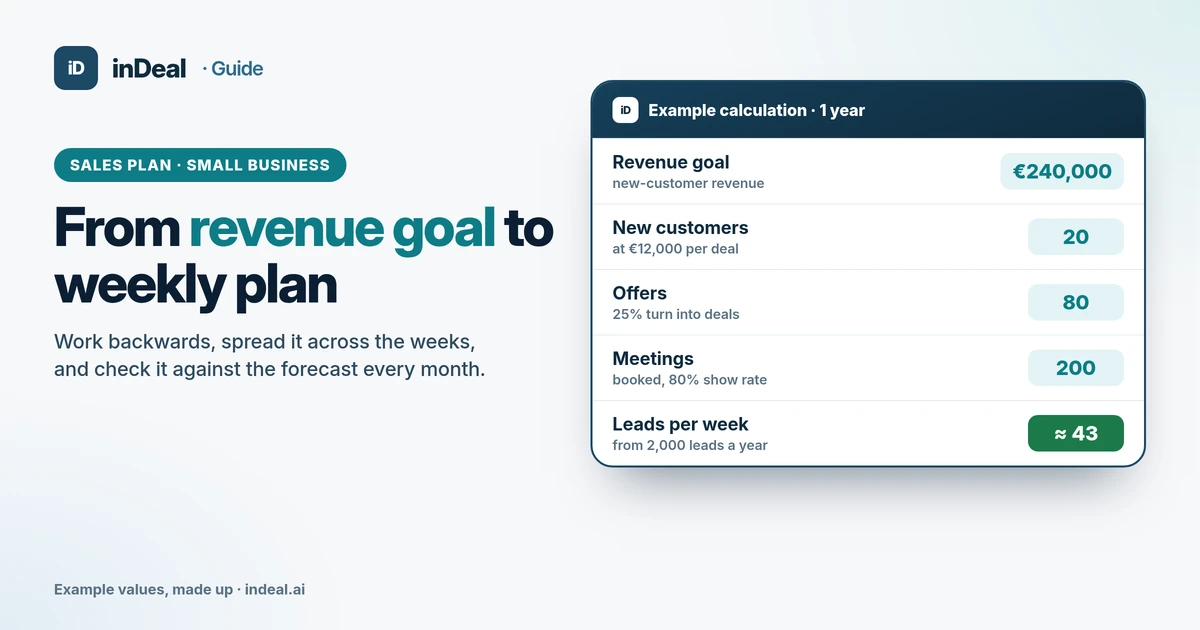
Divide the goal by your average deal size, then divide stage by stage by your conversion rates. That shows how many leads you need instead of hoping it will be enough.
An example with made-up values:
- Goal: €240,000 in new-customer revenue for the year.
- Customers: €240,000 ÷ €12,000 average deal = 20 new customers.
- Offers: At 25% offer → closed, you need 20 ÷ 0.25 = 80 offers.
- Meetings held: At 50% meeting → offer, that is 80 ÷ 0.5 = 160 conversations.
- Meetings booked: At an 80% show rate, you need 160 ÷ 0.8 = 200 meetings on the calendar.
- Leads: At 10% lead → meeting, that is 200 ÷ 0.1 = 2,000 leads.
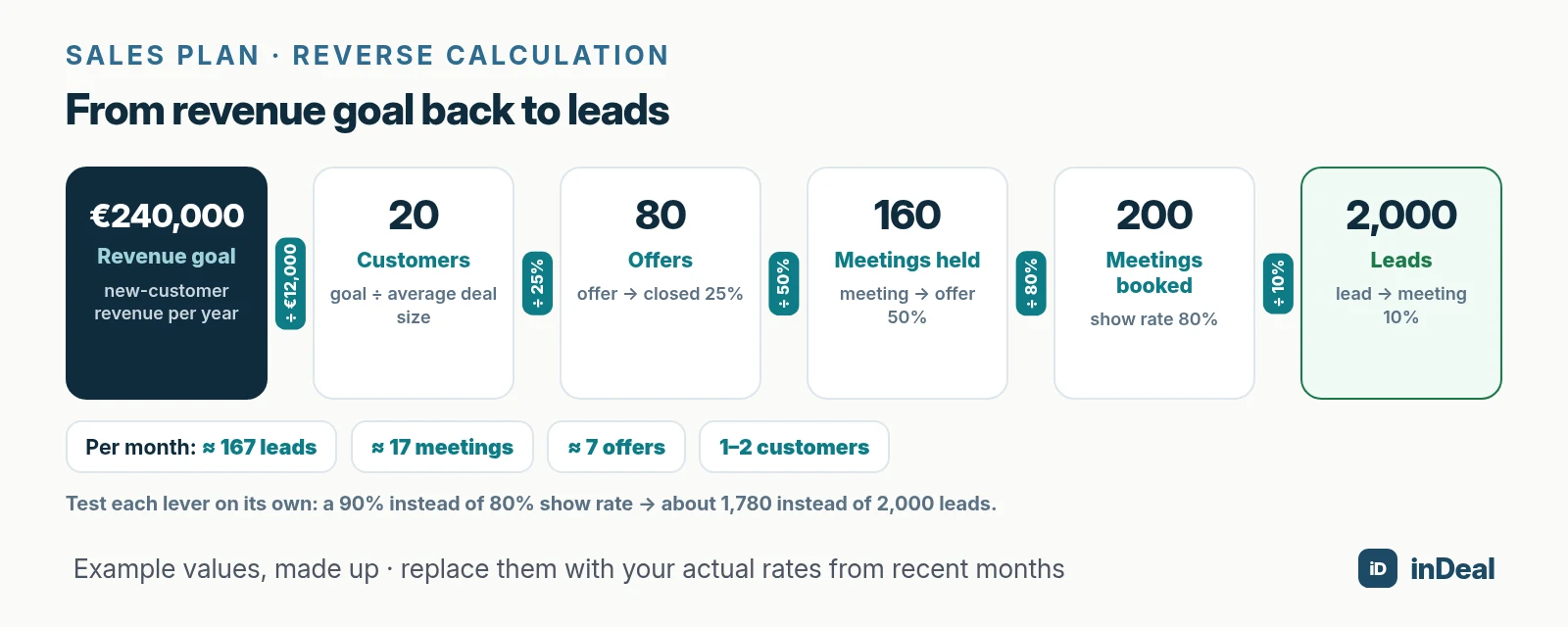
Per month, that means about 167 leads, 17 booked meetings, 13 meetings held, almost 7 offers and 1 to 2 new customers. Those monthly numbers are your actual plan.
Factor in the time lag as well. A lead from today turns into revenue only after your sales cycle. If you want revenue in December, you have to book the meetings for it in the fall.
How do you set realistic sales goals and conversion rates?
The goal can be ambitious, the conversion rates have to be honest. A high goal motivates, an inflated rate makes the plan useless.
For the goal, there is solid research. A summary of 35 years of goal-setting research shows that specific, challenging goals lead to higher performance than a vague “do your best.” The conditions are commitment to the goal and regular feedback on progress (Locke & Latham, 2002).
For conversion rates, ambition is the wrong instinct. Forecasts turn out too optimistic when people focus only on their own plan and ignore the track record of comparable past cases (Kahneman & Lovallo, 1993). So use your actual numbers from recent months, not the number you wish you had.
Here is how:
- Goal: specific, with a time frame, and derived in a way the team can follow.
- Conversion rates: from the past three to six months, split by channel if the differences are large.
- Average deal size: the mean of your won deals, with outliers looked at separately.
- Buffer: plan with the weaker rate and enjoy beating it.
How to measure your close rate properly is explained in sales win rate.
How do you break an annual sales plan into quarters, months and weeks?
Split the annual plan into quarters first, then months, and finally weeks. You steer with the weekly numbers, because those are the ones the team can directly influence.
Do not just divide the goal by twelve. If your business slows down in summer or around the holidays, put less there. A simple approach is to copy the distribution of the past twelve months.
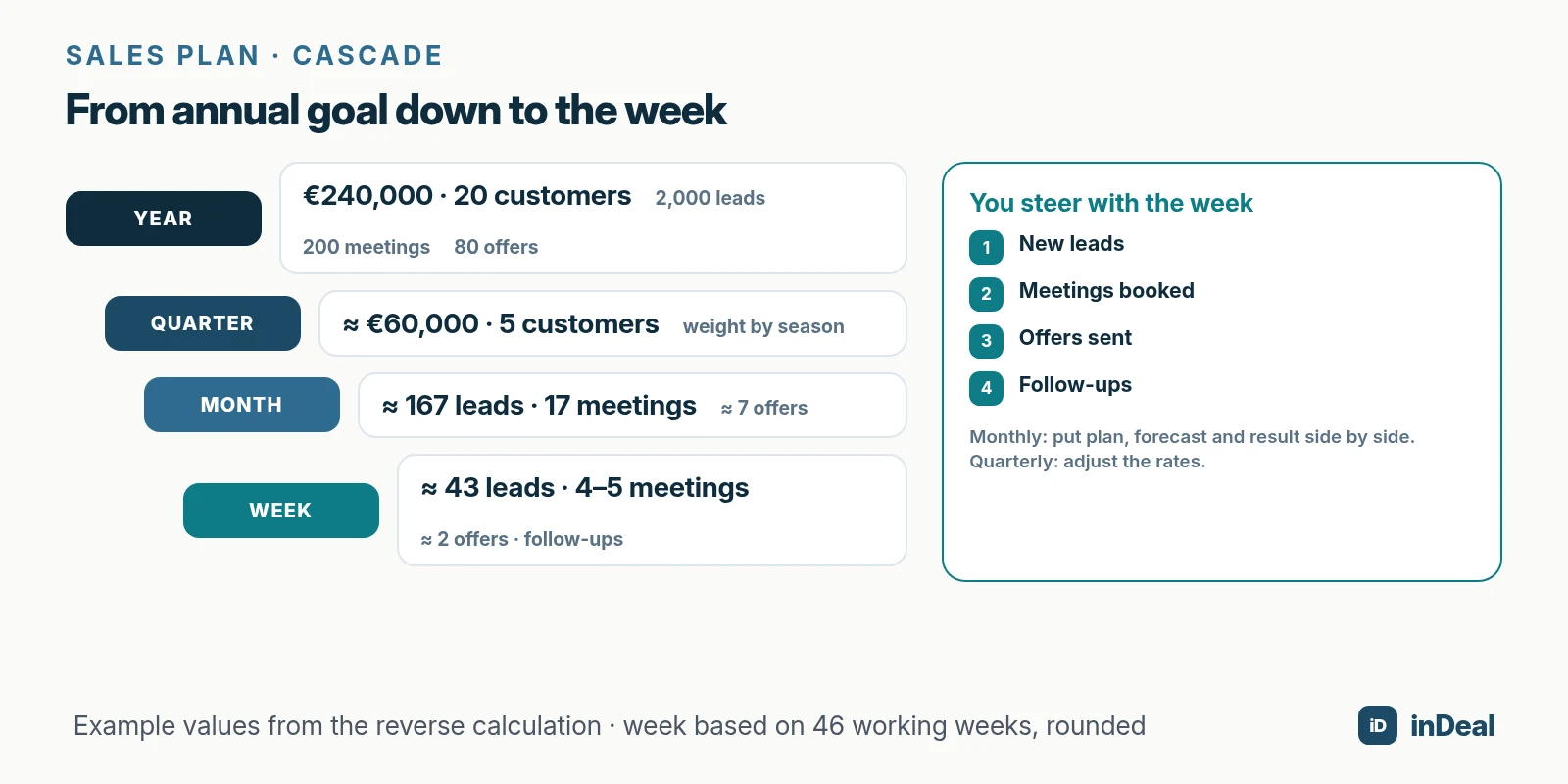
Three or four weekly activity targets are enough, for example new leads, booked meetings, offers sent and follow-ups. More metrics dilute the focus.
In inDeal, Home shows weekly trends for the last four calendar weeks: leads, meetings, deals and revenue per week, each compared with the previous week (inDeal Help Center). Weeks start on Monday, so the current week naturally looks low on a Tuesday.
How much pipeline do you need to hit your sales goal?
You need enough open pipeline that, at your close rate, it covers the rest of the goal. At 25% offer → closed, that is roughly four times the gap, unweighted.
The math behind it: if you are still €60,000 short this quarter and win one offer in four, you need offers worth about €240,000. With less in the pipeline, even perfect follow-up won't close the gap.
This metric is called pipeline coverage. How to calculate it and which deals to count is explained in pipeline coverage. How to define the stages it depends on is covered in sales pipeline stages.
How do you check your plan against the forecast every month?
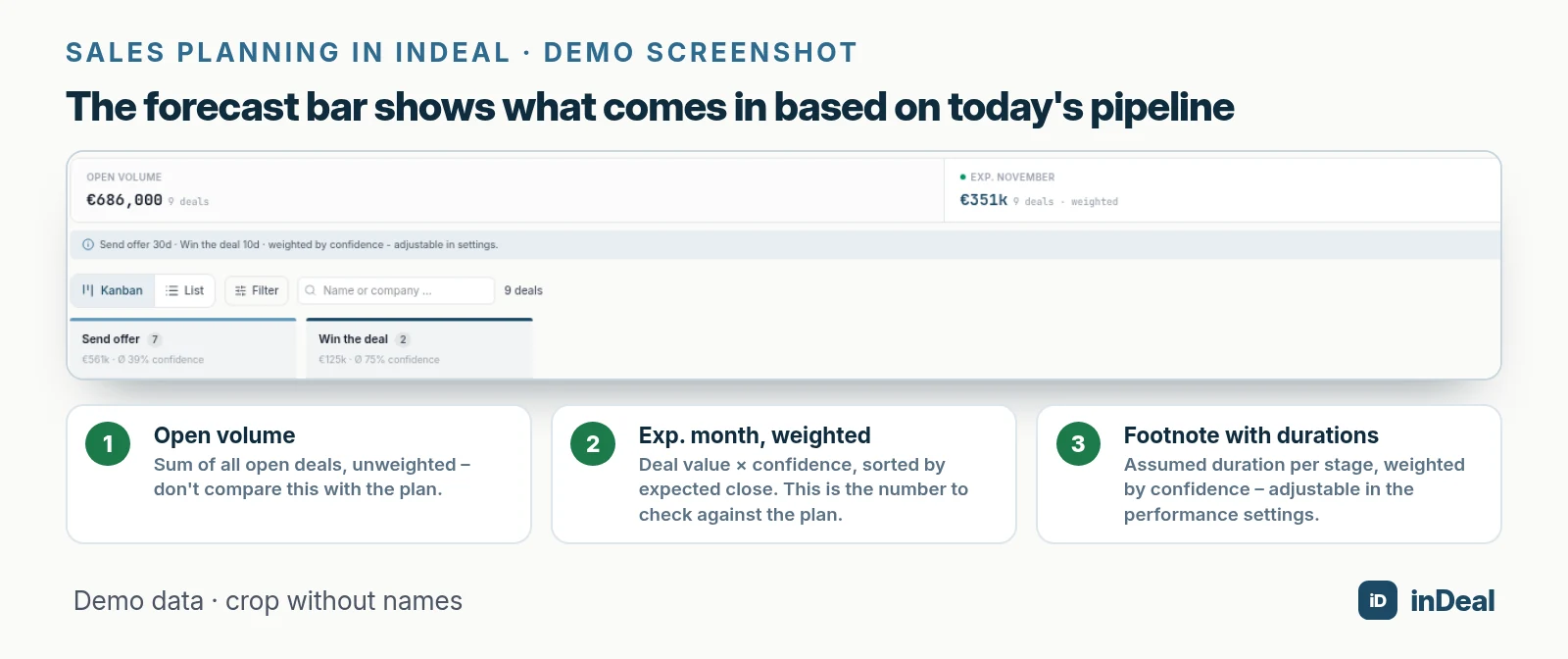
Once a month, put three numbers side by side: the plan, the forecast for the coming weeks, and the actual result. The gaps tell you whether you need more pipeline, better conversion rates or a new plan.
| Number | Question | Where you find it |
|---|---|---|
| Plan | What should happen this month? | Your planning spreadsheet |
| Forecast | What comes in based on today's pipeline? | Weighted pipeline with expected close dates |
| Result | What was actually won? | Won deals of the month |
| Conversion rates | Do the assumptions hold? | Conversion over the past 30 days |
With the forecast, discipline beats gut feeling. A survey of 149 forecasters plus four case studies found that many organizations would forecast more accurately if they limited manual adjustments, justified every adjustment in writing, and checked afterwards whether it helped (Fildes & Goodwin, 2007).
What lost deals teach you for the next plan is covered in lost deal analysis.
What sales planning mistakes do small businesses make?
Most plans fail not because of the math but because of missing data and missing follow-through. These six mistakes are typical:
- A goal with no derivation: “20% more than last year” says nothing about how many meetings it takes.
- Wishful rates: a 95% show rate in the plan, 70% in reality, and the plan is dead by February.
- Only result metrics: if you only measure revenue, you notice months later that the meetings were missing.
- No time lag: leads in December rarely turn into revenue in December.
- Gut-feel forecasts: deals get bumped up so the month looks good.
- No fixed review date: without a slot on the calendar, the comparison never happens.
How do you build your sales plan in inDeal?
In inDeal, you enter your planning values in Setup and measure the real values on Home. That puts plan and reality in the same system.
- Enter benchmarks: Setup → Performance & conversion holds six benchmarks: Lead → meeting booked, Show rate, Pipeline conversion, Deal conversion, Sales cycle and Customer lifetime value. The area is reserved for the Admin role (inDeal Help Center).
- Check the example calculation: below the fields, inDeal runs your values through 100 leads, via meetings, discoveries and offers to customers and revenue. If the result looks unrealistic, your benchmarks are too optimistic.
- Read your real rates: the Conversion funnel on Home uses your real numbers from the past 30 days: Lead conversion, Show rate, Pipeline conversion and Deal conversion (inDeal Help Center).
- Steer the weeks: Weekly trends show leads, meetings, deals and revenue per calendar week.
- Keep the forecast clean: enter Expected close on every deal and keep confidence current. Without a date, inDeal uses the stage entry date plus the Sales cycle benchmark (inDeal Help Center).
- Adjust after three months: the Help Center recommends comparing the benchmarks with the Conversion funnel after about three months and adjusting them.
One difference matters: the Sales cycle benchmark affects the forecast, while the rates in Setup do not affect your analyses. A wishful value there makes no number on Home any better.
Account, pipeline and email integration cost nothing, for unlimited users, according to indeal.ai. You need credits for data enrichment and for capturing leads with the lead plugin for Chrome.
Which sales plan fits your team?
The smaller the team, the simpler the plan can be. What matters is that it comes from your numbers and gets reviewed regularly.
| Situation | Recommendation |
|---|---|
| Founder sells, few deals | Annual goal, reverse calculation, 3 weekly targets, monthly review |
| 2 to 5 people in sales | Plan per person and channel, weekly pipeline meeting, forecast with close dates |
| Long sales cycles, large deals | Quarter instead of month as the planning unit, coverage target per quarter |
| No data yet | Cautious estimates, track in the CRM from day 1, adjust after 3 months |
Sales planning is one building block of the perfect CRM sales process. How an AI CRM takes routine work off small teams is explained in AI CRM for small business, and the free options are compared in free CRM for small business. How many people your plan needs is worked out in sales capacity planning.
A free CRM for your whole team. Start inDeal in 2 minutes. Just an email address, no credit card to sign up, unlimited users.
Start freeKeep reading
- Sales forecasting for small business: methods and example
- Pipeline coverage: how much pipeline you need
- Sales win rate: formula and examples
- How to set up a sales pipeline in 7 steps
- Sales capacity planning: how many sales reps do you need?
Frequently asked questions
What should a small business sales plan include?
How do I calculate how many leads I need?
Where do I get realistic conversion rates without historical data?
How often should I review my sales plan?
What is the difference between a sales plan and a sales forecast?
Is there a free sales plan template?
Is inDeal the same as indeal.io?
Sources
- Building a practically useful theory of goal setting and task motivation: A 35-year odyssey (American Psychologist 57(9))
- Against Your Better Judgment? How Organizations Can Improve Their Use of Management Judgment in Forecasting (Interfaces 37(6))
- Timid Choices and Bold Forecasts: A Cognitive Perspective on Risk Taking (Management Science 39(1))
- E-business integration
- Company profile and conversion values
- Reading weekly trends and the pipeline overview
- Conversion funnel and business outcome
- Forecast, confidence and weighted value
- inDeal – free AI CRM for small businesses
inDeal is the AI CRM for small and mid-sized B2B companies.
Keep reading
 Sales and follow-up
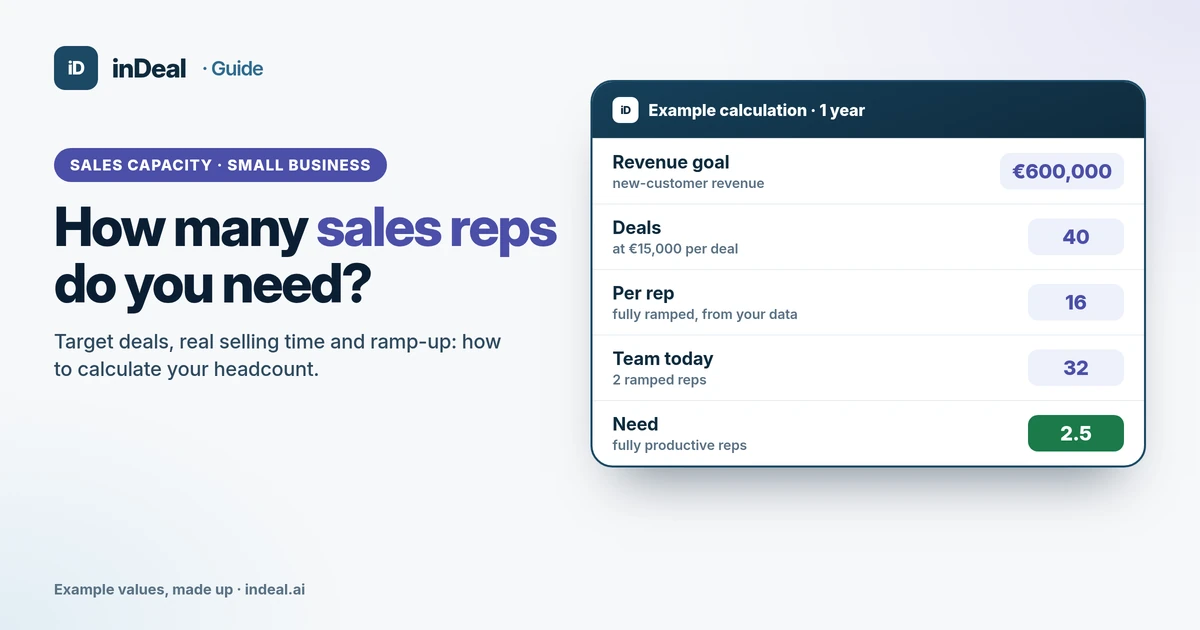
Sales Capacity Planning: How Many Sales Reps Do You Need?
Sales capacity planning for small business: calculate how many sales reps you need, factor in selling time, ramp-up and time off, and spot overload early.
 Sales and follow-up
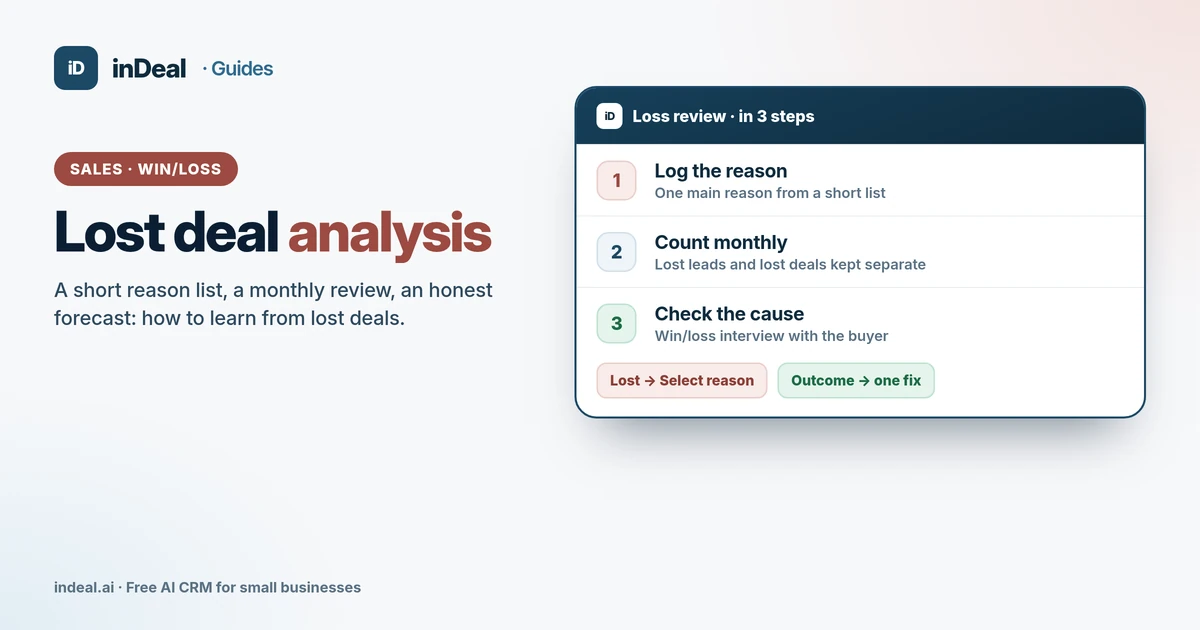
Lost Deal Analysis: Why You Lose Deals (Small Business 2026)
Lost deal analysis for small businesses: a short loss reason list, lost leads vs. lost deals, a monthly win/loss review and interviews – in a free AI CRM.
 Sales and follow-up
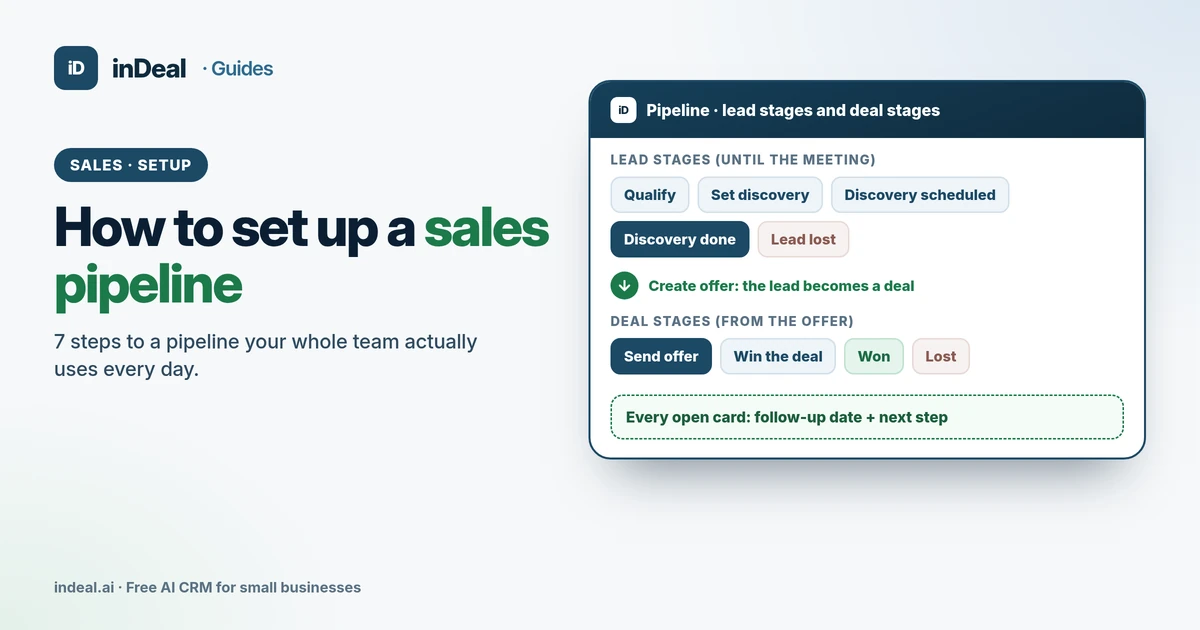
How to Set Up a Sales Pipeline in 7 Steps (Small Business 2026)
How to set up a sales pipeline your team actually uses: 7 steps from stages and required fields to roles, import and a weekly review – in a free AI CRM.