Contents
- What does getting clients actually mean?
- How do you get clients for a B2B business, step by step?
- Who should you try to win as a client?
- How to get new customers: which strategies work for small businesses?
- How do you get clients through referrals?
- What are the rules for cold outreach?
- How do you turn first contact into a meeting?
- How do you turn a first order into a repeat client?
- Which metrics show that you are winning clients?
- How does inDeal help you get clients?
- Which way to get clients is right for your business?
- Keep reading
- Frequently asked questions
- Sources
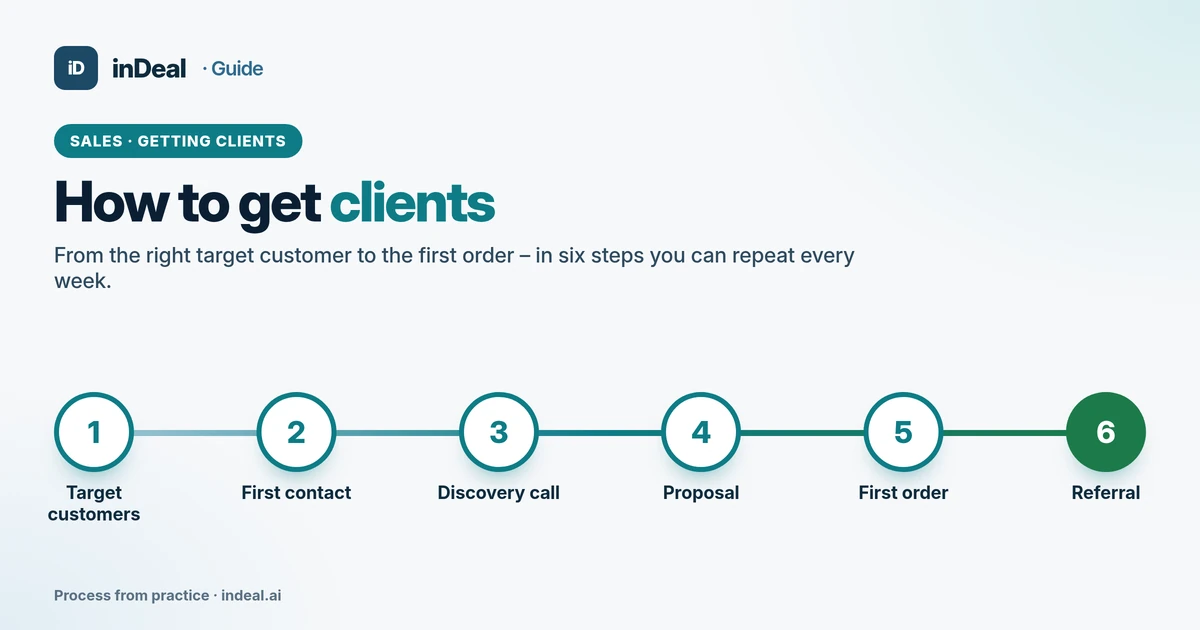
How to get clients as a small B2B business: pick the right target customers, reach out through warm channels first, follow up on every contact with a set date, and ask for referrals after the first order. Clients come from that repeatable process, not from one clever tactic. inDeal (indeal.ai) is a free AI CRM for small businesses from Lars Krüger GmbH in Berlin.
As of November 27, 2026. All product details checked in the inDeal Help Center and on indeal.ai. Not to be confused with indeal.io, a different company.
This guide covers the whole process up to the first order. Which channels bring new contacts is covered in Lead Generation for Small Business; how to deal with pushback in the call is in Objection Handling.
What does getting clients actually mean?
Getting clients (customer acquisition) is everything that turns companies that have never bought from you into paying customers. It starts with deciding who you want to win and only ends with the first order.
Two related terms are often mixed up. Lead generation brings new contacts into your pipeline, which is only the start. Account management looks after customers who have already bought. Many small businesses treat getting clients as lead generation and then wonder why lots of contacts turn into few orders.
The gap is usually in the middle: between first contact and proposal. That is where a clear process helps most.
How do you get clients for a B2B business, step by step?
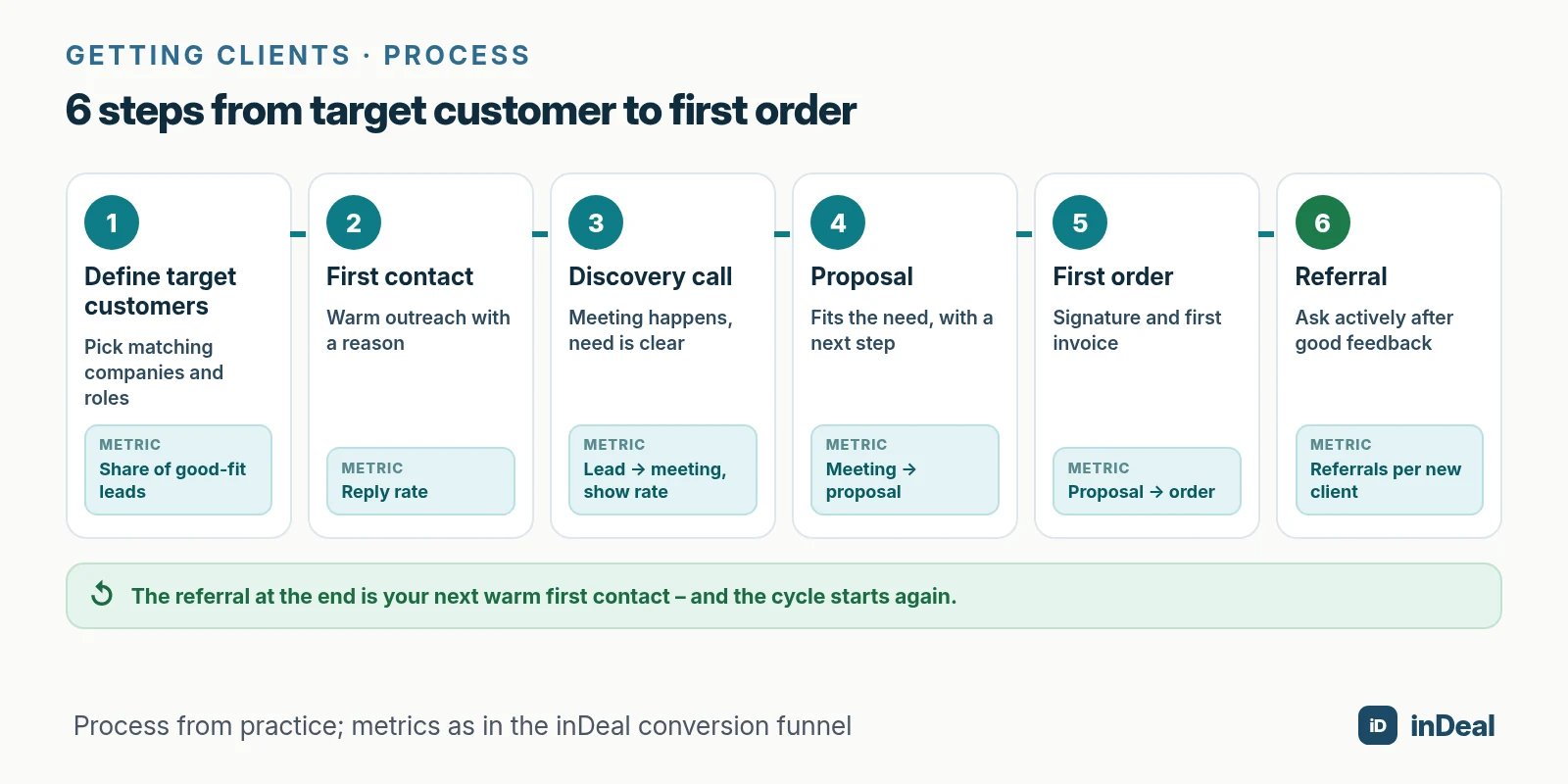
In six steps that you work through in order. Each step has a clear outcome and a metric that shows whether it is working.
| Step | Outcome | Metric |
|---|---|---|
| 1. Define target customers | List of matching companies and roles | Share of good-fit leads |
| 2. First contact | A reply or reaction | Reply rate |
| 3. Discovery call | The meeting happened | Lead → meeting, show rate |
| 4. Proposal | Proposal is with the client | Meeting → proposal |
| 5. First order | Signature, first invoice | Proposal → order |
| 6. Referral or repeat order | A new warm contact | Referrals per new client |
The order matters more than any single technique. Skip step 1 and you talk to the wrong people. Forget step 6 and you start from zero every month.
Who should you try to win as a client?
Companies that fit your offer and buy the way your best current clients do. The more precisely you define that, the less time you lose on contacts with no need.
Industry and size alone rarely do the job. Rangan, Moriarty and Swartz showed in 1992 for mature industrial markets that customers with the same industry and size can buy very differently, for example in how they weigh price against service (Rangan et al., 1992).
Think about the people, too. In B2B, one person rarely decides alone. Johnston and Bonoma studied buying groups in 31 companies and found that their makeup depends on organizational structure and the buying situation (Johnston & Bonoma, 1981). So note for every target customer who decides, who uses the product and who has a say.
How to write that down properly is shown in Ideal Customer Profile.
How to get new customers: which strategies work for small businesses?
Warm channels, meaning contacts who already know you, work fastest. Cold channels need more attempts and come with stricter rules. A good mix uses both.
| Strategy | Works when … | Effort | Key rule |
|---|---|---|---|
| Reactivate past prospects | Proposals stalled on “not now” | Low | Refer back to the last conversation |
| Reach out to existing contacts | Your network matches your audience | Low | Only good-fit contacts, no mass email |
| Referrals | You have happy clients | Low | Ask actively and at set moments |
| Website and content | Buyers search online for solutions | High, then steady | Answer real customer questions |
| LinkedIn and signals | Your audience is active there | Medium | Tie in to a reaction or trigger |
| Events and trade shows | Your industry meets there | Medium | Follow up within one day |
| Partners | Other providers serve the same clients | Medium | Agree who contacts whom |
| Direct outreach | You want to enter a new market | High | Check GDPR and local rules |
The effort ratings are a qualitative assessment from practice, not measured values. Each channel is explained with examples in Lead Generation for Small Business.
Most companies already have the basis for inbound: according to Eurostat, 76.67% of small EU enterprises (10 to 49 employees) had a website in 2025 (Eurostat, E-business integration). Whether it brings clients depends on the content.
How do you get clients through referrals?
By asking for them specifically and at set moments. In many small businesses, referrals only come by chance because nobody asks, even though they bring especially valuable customers.
A long-term study of about 10,000 customers of a German bank over almost three years found that referred customers had a higher contribution margin, stayed longer and were on average at least 16% more valuable than other new customers (Schmitt, Skiera & Van den Bulte, 2011). The study is from retail banking; the direction is plausible for B2B, the exact size does not transfer.
Turn it into a routine:
- Timing: right after a successful project milestone or positive feedback.
- The question: “Who do you know who is facing a similar challenge to the one you had a year ago?”
- Capture it: note on the new lead who referred them, and say thank you after the first call.
What are the rules for cold outreach?
Stricter than many people think, at least when you contact people in the EU. The GDPR governs how you may process personal data, and some countries add their own rules on promotional calls and emails.
In short: if you process personal data of people in the EU, you need a legal basis, you must inform people when you did not get their data from them directly, and they can object to direct marketing at any time (GDPR, Art. 6, 14 and 21). In Germany, § 7 UWG additionally requires at least presumed consent for promotional calls to businesses and generally prior express consent for promotional emails (§ 7 UWG).
How do you turn first contact into a meeting?
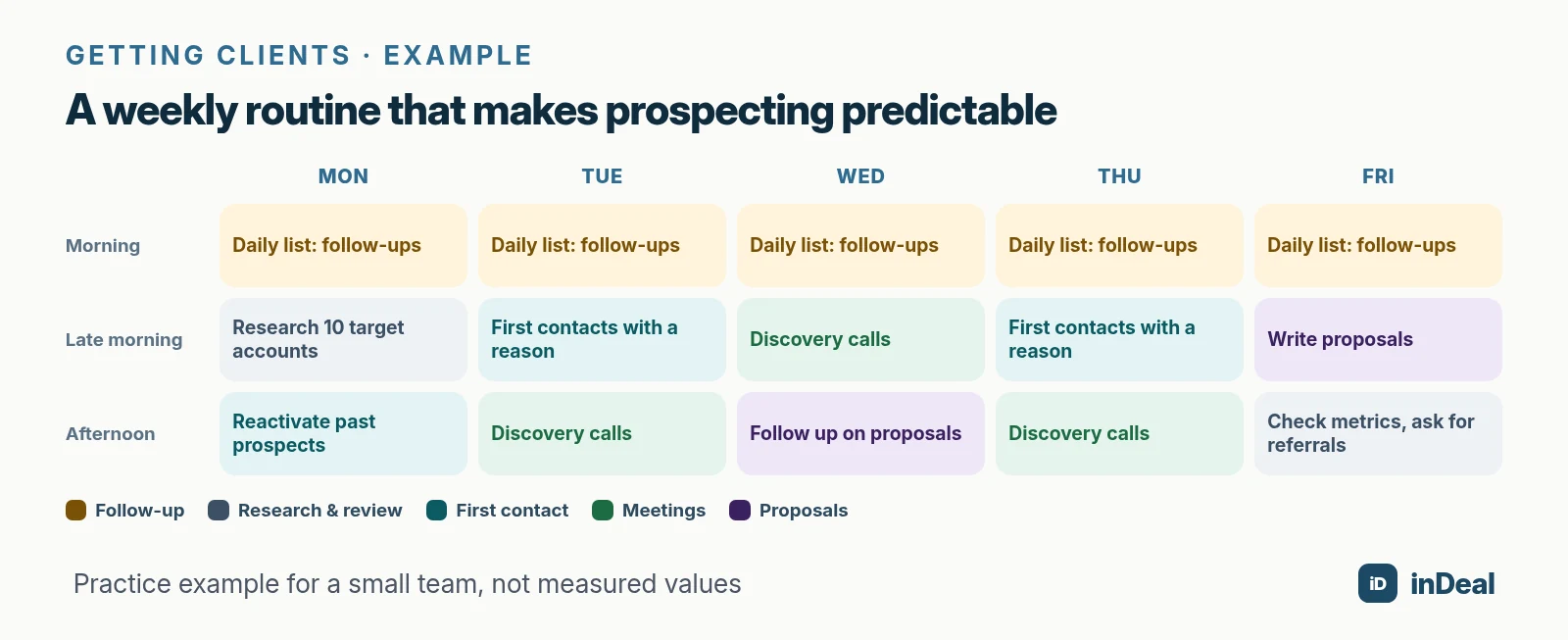
By following up consistently with a set date. Most potential clients are not lost at first contact but afterward, because nobody gets back in touch.
A study using data from 461 salespeople at four companies describes the “sales lead black hole”: sales did not follow up on about 70% of marketing leads (Sabnis et al., 2013). Small businesses often lack the tool in the first place: only 24.69% of small EU enterprises used CRM software in 2025, compared with 65.43% of large ones (Eurostat).
Three rules help:
- Every contact gets a next step with a date. Without a date, it gets forgotten.
- Follow up with value: a relevant example, a question about the trigger, a suggested time. Not “just checking in.”
- Close the loop: after several attempts with no reply, mark the lead as lost on purpose instead of carrying it forever.
How often and at what intervals to follow up is covered in Sales Follow-Up.
How do you turn a first order into a repeat client?
By treating the first order as a start, not the finish line. A new client who hears nothing from you after the first order often stays a one-time buyer.
- Handover: write down what was promised in the sale so delivery and sales know the same thing.
- First check-in: plan a short meeting after kickoff to hear whether everything is going as expected.
- Next need: ask about other locations, departments or follow-up projects.
- Referral: if the feedback is good, ask for a contact, as above.
Where to put the first order in your CRM and how it moves through the pipeline is explained in The Perfect CRM Sales Process.
Which metrics show that you are winning clients?
Four conversion rates plus the number of new customers per month. The lowest rate shows you where to start.
| Metric | Transition | If it is low |
|---|---|---|
| Lead conversion | Lead → meeting booked | Check outreach and audience |
| Show rate | Meeting → happened | Send a reminder shortly before |
| Pipeline conversion | Discovery → offer | Set the next step on the lead |
| Deal conversion | Offer → closed won | Check price, timing, follow-up |
| New customers | Won deals this month | Check pipeline and lead volume |
inDeal shows exactly these four rates on Home for the past 30 days, with the change in percentage points versus the previous period, plus the number of new customers in the current month (Help Center). How to work back from these rates to your client target is in How to Write a Sales Plan.
How does inDeal help you get clients?
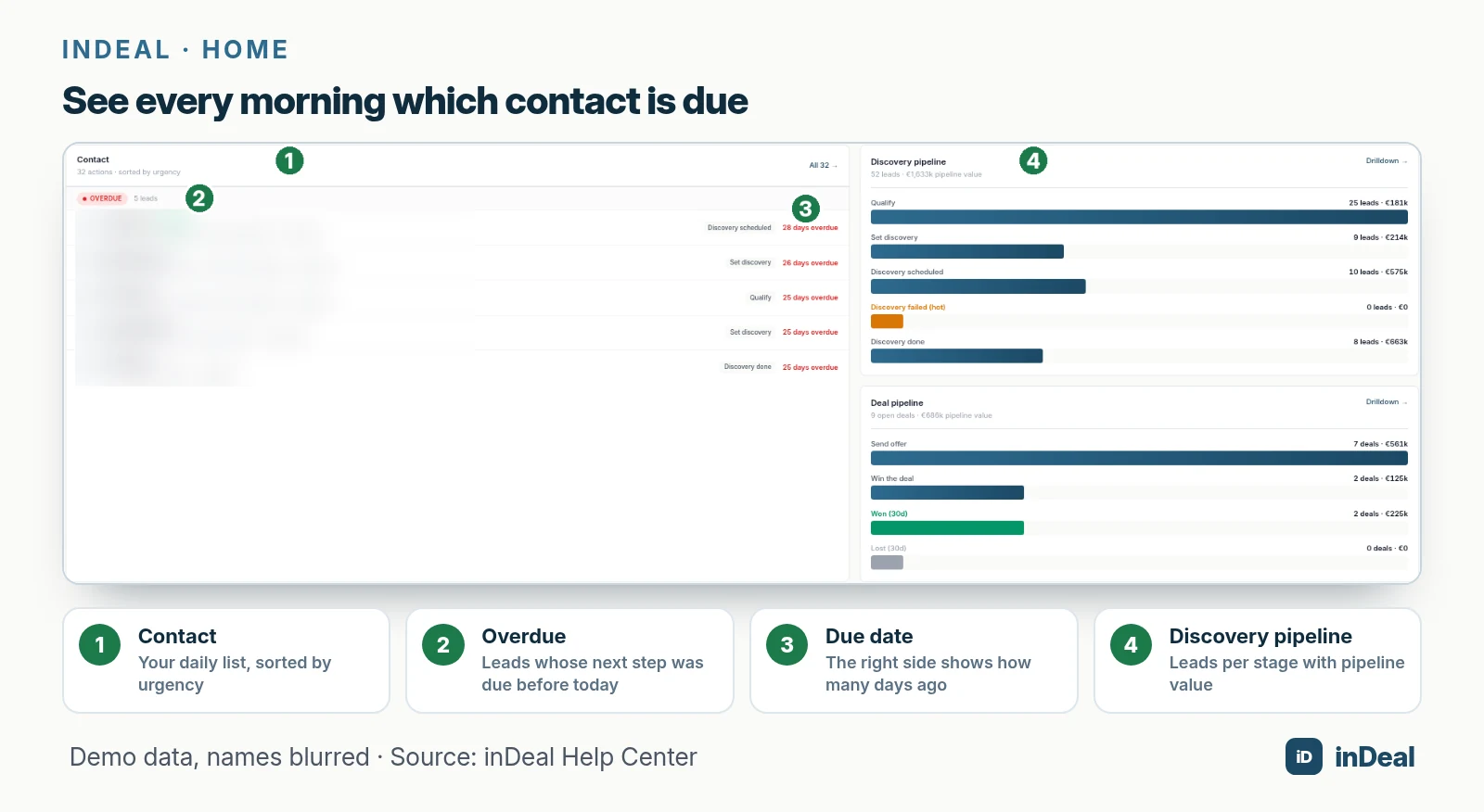
With a daily list, fixed follow-ups and the key metrics at a glance. The CRM and unlimited users are free (indeal.ai).
- Contact: every morning the list shows up to three groups: Overdue, Due today and New leads. An open lead appears there as soon as the date of its next step is reached; without a date it never shows up (Help Center).
- Follow-up with a reminder: on the lead, set the follow-up date with quick picks such as “In 3 days” and, if you like, an email reminder at the chosen time with phone, email and next step (Help Center).
- Appointment agent: if it is enabled for your account, you choose a source such as existing contacts, signal leads, CRM leads or website visitors. Nothing is sent before you start (Help Center).
How AI in a CRM takes over routine work is covered in AI CRM for Small Business.
Which way to get clients is right for your business?
The one that fits where you are now and that you can keep up every week. Start with warm channels, track the four rates and build on what works.
| Situation | Recommendation |
|---|---|
| You need new orders fast | Past prospects and existing contacts, each with a follow-up date |
| Happy clients, but few referrals | A set referral question after every project milestone |
| Many contacts, few meetings | Sharpen your target customer, tie outreach to a trigger |
| Meetings, but few orders | Improve discovery and proposals, collect objections |
| You want to enter a new market | Direct outreach within the rules, plus events and partners |
What a free CRM for small business should do so no contact slips through is explained in the basics guide.
A free CRM for your whole team. Start inDeal in 2 minutes. Just an email address, no credit card to sign up, unlimited users.
Start freeKeep reading
- Lead Generation for Small Business: 9 Ways That Work
- Objection Handling: How to Handle Sales Objections
- B2B Cold Outreach and GDPR: What Is Allowed
- Sales Follow-Up: The Next Step Decides
- B2B Sales Strategy for Small Businesses
Frequently asked questions
How do I get my first clients?
What is the difference between lead generation and getting clients?
What are the best ways to get new customers for a B2B business?
How long does it take to win a new client?
Can I cold email or cold call businesses to get clients?
How many new clients does a small business need?
Can I use a free CRM to get clients?
Is inDeal the same as indeal.io?
Sources
- Referral Programs and Customer Value (Journal of Marketing 75(1), 46–59)
- The Sales Lead Black Hole: On Sales Reps' Follow-Up of Marketing Leads (Journal of Marketing 77(1), 52–67)
- Segmenting Customers in Mature Industrial Markets (Journal of Marketing 56(4), 72–82)
- The Buying Center: Structure and Interaction Patterns (Journal of Marketing 45(3), 143–156)
- E-business integration
- § 7 UWG – Unacceptable nuisances (German Act against Unfair Competition)
- Regulation (EU) 2016/679 (General Data Protection Regulation), Art. 6, 14 and 21
- Contact – Your daily list
- Set a follow-up with a reminder
- Conversion funnel and business results
- Create an agent and choose a source
- inDeal: home page, pricing and FAQ
inDeal is the AI CRM for small and mid-sized B2B companies.
Keep reading
 Sales and follow-up
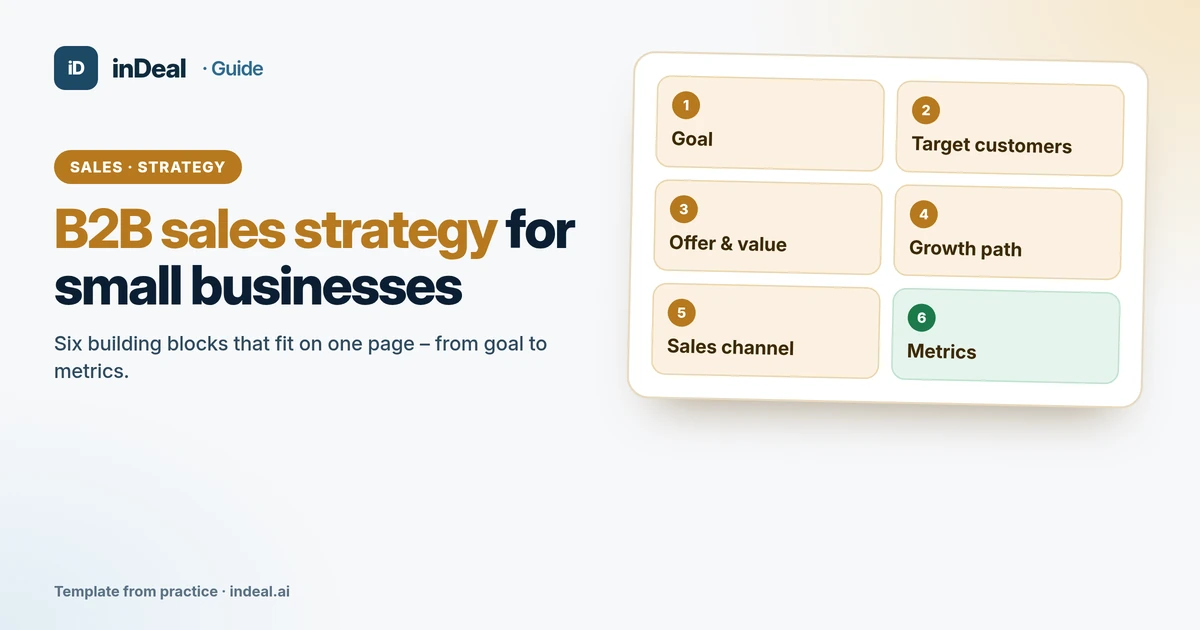
B2B Sales Strategy for Small Businesses: 2026 Guide
B2B sales strategy for small businesses: 6 building blocks, 6 steps to create a sales strategy, examples by growth path and metrics in a free CRM.
 Sales and follow-up
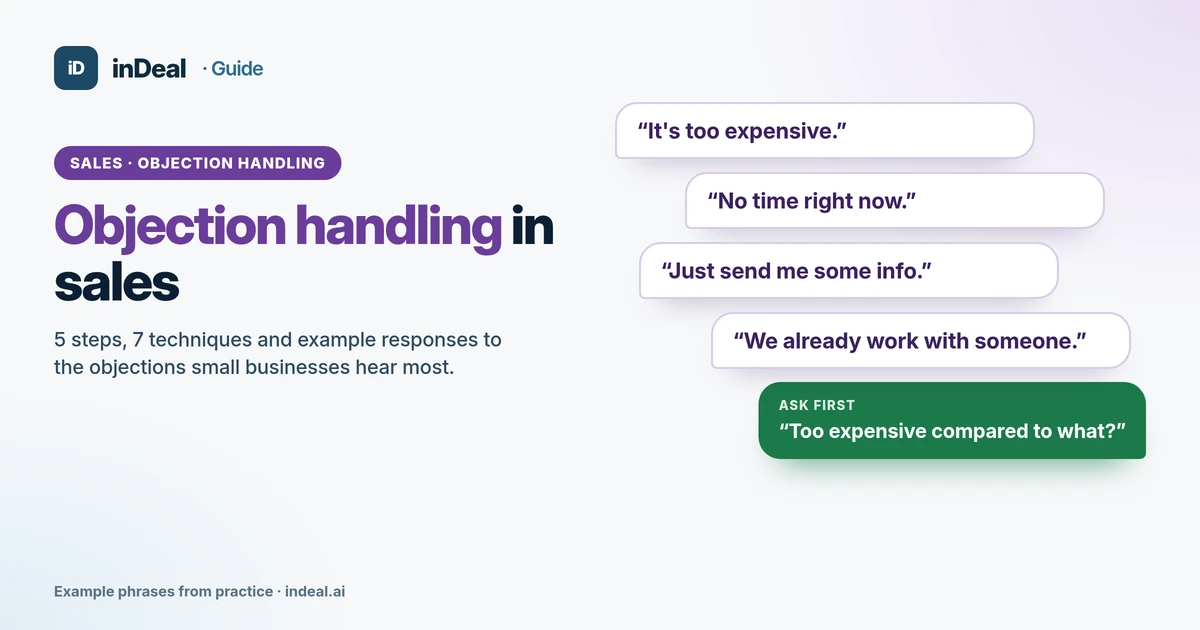
Objection Handling: How to Handle Sales Objections (2026)
Objection handling in sales: a 5-step process, 7 techniques and example responses to common sales objections like “too expensive” – plus a free CRM.
 Sales and follow-up
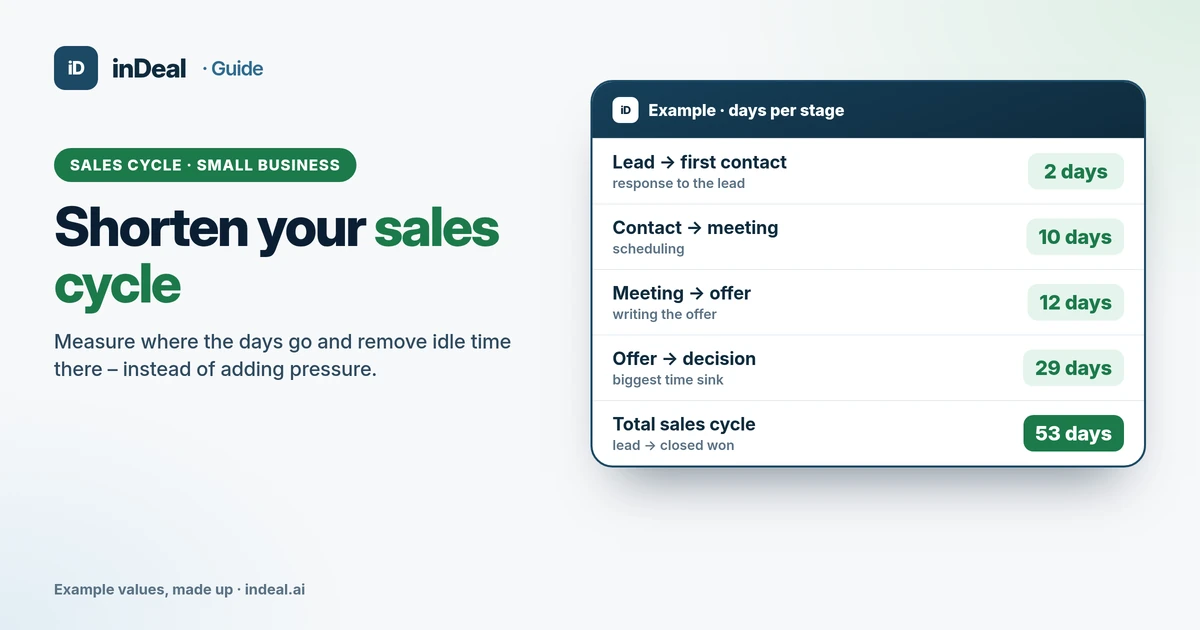
Sales Cycle Length: How to Shorten Your Sales Cycle (2026)
Sales cycle length explained: how to measure it, where deals stall in each stage, and 9 ways to shorten your sales cycle – with research and a free CRM.