Contents
- Video guide
- What is objection handling in sales?
- Why do prospects raise objections?
- What are the most common sales objections?
- How do you handle objections in sales in 5 steps?
- Which objection handling techniques work best?
- Objection handling examples: what do you say to common objections?
- How can you tell an objection from a brush-off?
- What objection handling mistakes should you avoid?
- How do you prepare your team for objections?
- How do you track objections in inDeal?
- Which technique fits which objection?
- Keep reading
- Frequently asked questions
- Sources
Objection handling is the part of a sales conversation where you understand a prospect's concerns, clarify them with questions and respond to the real reason so a next step becomes possible. It works best in five steps: let them finish, ask, acknowledge, respond, agree on the next step. inDeal (indeal.ai) is a free AI CRM for small businesses made by Lars Krüger GmbH in Berlin, Germany.
Video guide

Playing the video connects to YouTube.
As of November 25, 2026. All product details checked in the inDeal Help Center and on indeal.ai. Not to be confused with indeal.io, a different company.
This guide covers the most common sales objections, seven objection handling techniques with example responses, and how to capture objections in your CRM. It focuses on the moment the prospect says “but,” not on running the entire sales call.
What is objection handling in sales?
Objection handling is how you respond when a prospect pushes back on buying or on taking the next step. Typical objections are about price, timing, effort, an existing provider or not being the decision-maker.
An objection is rarely a final no. Most of the time, the prospect is missing information, certainty or a good reason to change something now.
Keep three things apart:
- Objection: a real, specific reason, for example “Our budget for this year is already allocated.”
- Brush-off: a reason given to end the conversation, for example a blanket “Not interested” ten seconds into a call.
- Rejection: a clear, reasoned no. Respect it.
Why do prospects raise objections?
Because every purchase means change, and change feels riskier than standing still. Three research findings explain a large share of the objections you hear in sales.
- Status quo bias: people tend to stick with the current state of affairs (Samuelson & Zeckhauser, 1988). “We already work with someone” is often exactly that tendency, not a verdict on your offer.
- Losses loom larger: in prospect theory, the value function is steeper for losses than for gains (Kahneman & Tversky, 1979). The money a customer spends and the hassle of switching often weigh more than the promised upside.
- Persuasion knowledge: people build up their own knowledge of how salespeople try to persuade them and use it to cope with persuasion attempts (Friestad & Wright, 1994). Sometimes an objection is simply a test of whether you're listening or just running your script.
What are the most common sales objections?
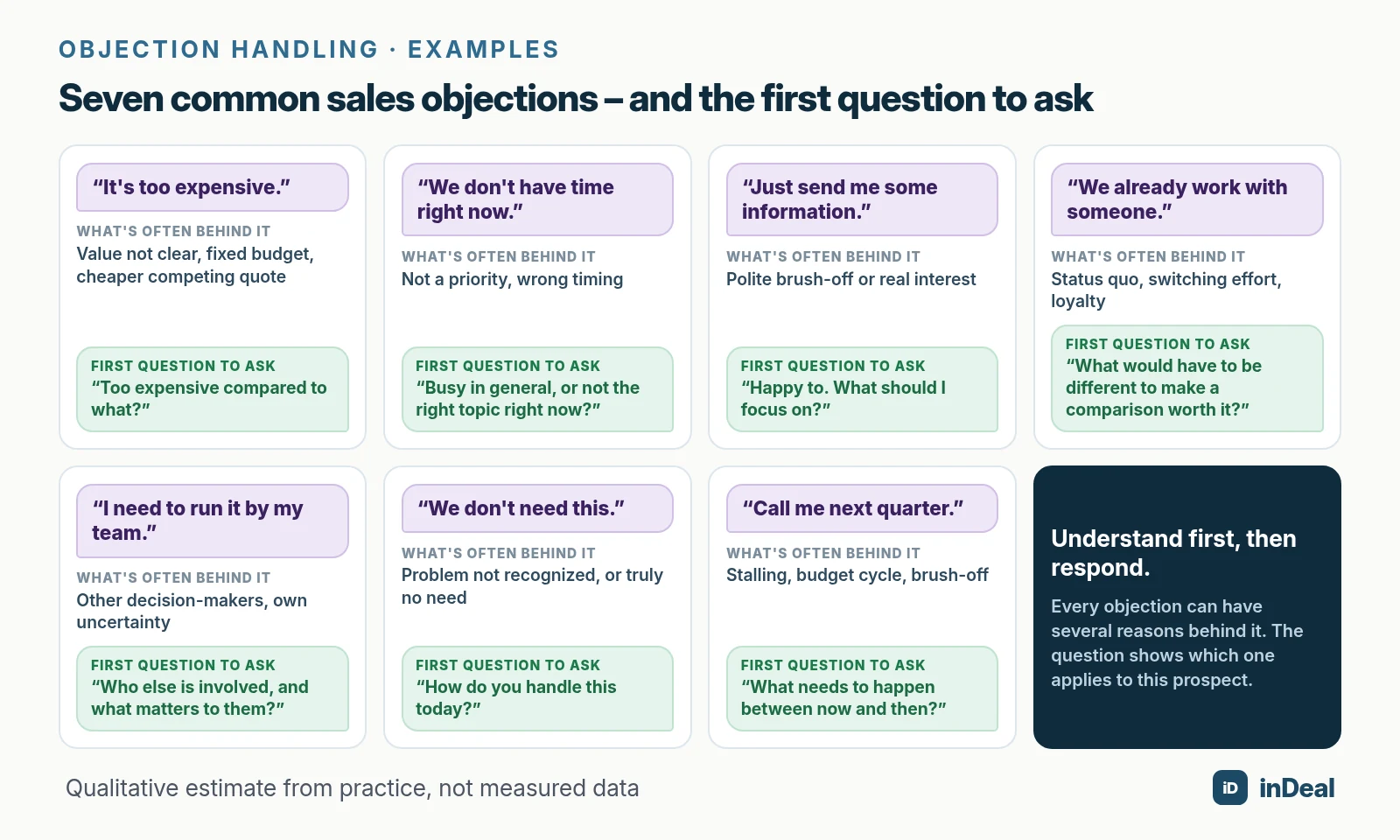
Small B2B businesses hear the same seven objections over and over. Each one can have several reasons behind it, so the table doesn't give you the one right answer but the first question to ask.
| Objection | What's often behind it | First question to ask |
|---|---|---|
| “It's too expensive.” | Value not clear, fixed budget, cheaper competing quote | “Too expensive compared to what?” |
| “We don't have time right now.” | Not a priority, wrong timing | “Is it busy in general, or is this topic not a fit right now?” |
| “Just send me some information.” | Polite brush-off or real interest | “Happy to. What should I focus on?” |
| “We already work with someone.” | Status quo, switching effort, loyalty | “What would have to be different to make a comparison worth it?” |
| “I need to run it by my team.” | Other decision-makers, own uncertainty | “Who else is involved, and what matters to them?” |
| “We don't need this.” | Problem not recognized, or truly no need | “How do you handle this today?” |
| “Call me next quarter.” | Stalling, budget cycle, brush-off | “What needs to happen between now and then?” |
How do you handle objections in sales in 5 steps?
With a fixed sequence that takes you from reflex to response.
- Let them finish: don't interrupt, even if you've heard the objection a hundred times. Write down the prospect's exact words.
- Ask: use an open question to clarify what exactly they mean. “Too expensive” can mean too expensive for the budget, for the expected value or compared to another quote.
- Acknowledge: confirm the concern, not the claim. “I get that you want to run the numbers carefully” is different from “Yes, we're expensive.”
- Respond to the real reason: answer only the reason you clarified, briefly, with evidence, an example from the prospect's world or an option.
- Check and agree on the next step: ask whether that answers their concern, and agree on a concrete next step with a date.
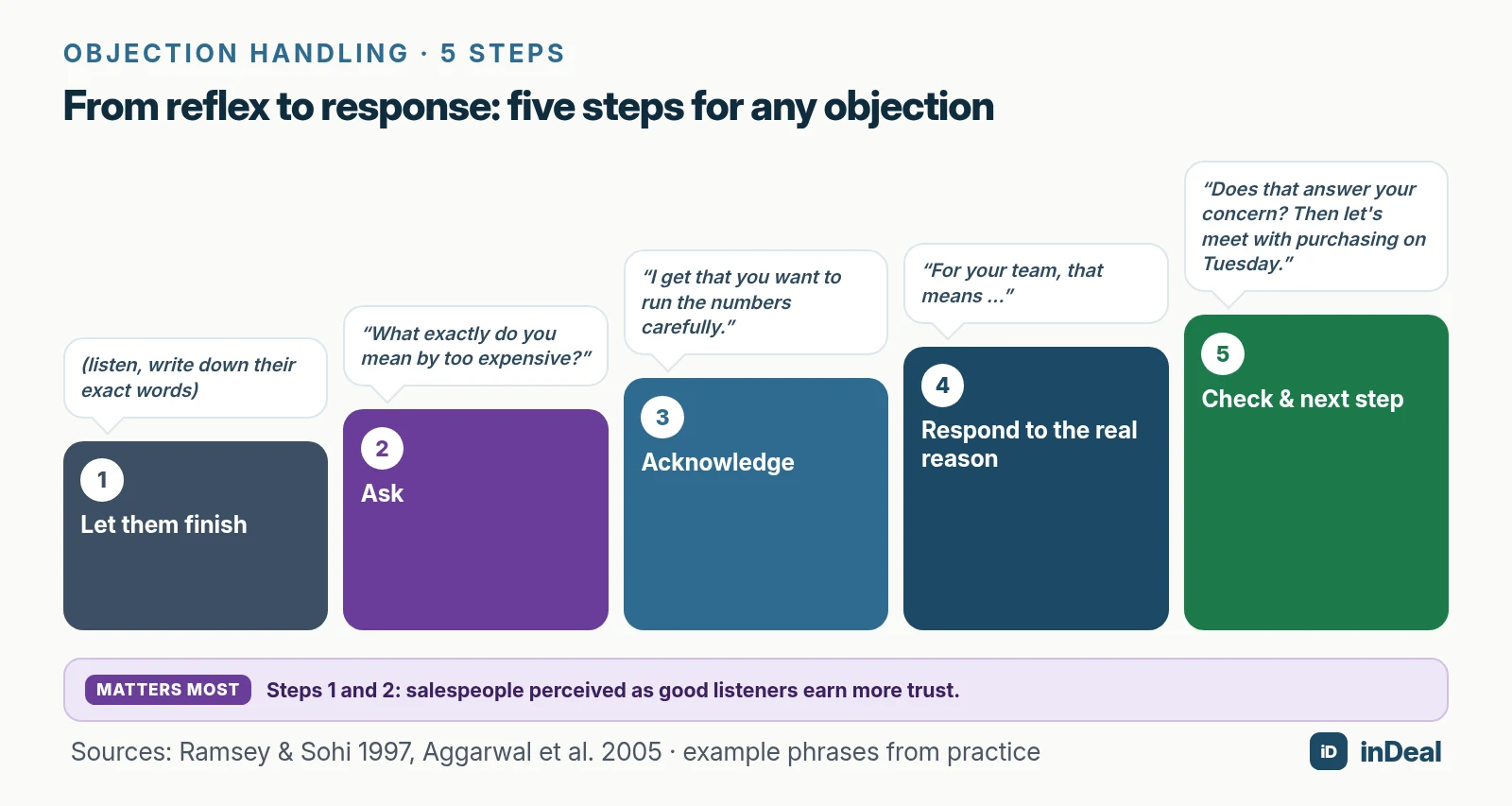
Steps 1 and 2 matter most. A study of new car buyers found that when customers perceive a salesperson as a good listener, they trust them more and are more likely to expect future interactions (Ramsey & Sohi, 1997). A survey of 162 business buyers found that listening is linked to trust in and satisfaction with the salesperson (Aggarwal et al., 2005).
Which objection handling techniques work best?
Here are seven proven techniques to combine depending on the objection and the person. None is a trick; each helps you do step four well.
| Technique | What it sounds like | Best for | Watch out |
|---|---|---|---|
| Clarifying question | “What exactly do you mean by …?” | Vague objections like “too expensive” | Don't interrogate; one question is enough |
| “Yes, and” | “I understand, and that's exactly why …” | Legitimate concerns | “Yes, but” cancels what came before |
| Feel, felt, found | “I understand. Other clients felt the same at first and found that …” | Uncertainty and risk | Only with real customer examples |
| Reframe as a question | “So you're wondering whether this pays off within a year?” | Price and value objections | Don't twist their meaning |
| Address it upfront | “A lot of people ask about the switching effort at this point …” | Objections that come up almost every time | Don't raise rare objections yourself |
| A few clear options | “We can start with the smaller package or do both right away.” | Price and scope | Two or three options, not ten |
| Boomerang | “Precisely because you're short on time, it's worth …” | Time objections | Can sound glib instead of helpful |
More important than which technique you pick is adapting it to the customer and the situation. Researchers call this adaptive selling: changing your approach across customers and during a conversation (Spiro & Weitz, 1990). A meta-analysis of 155 samples and more than 31,000 salespeople found that adaptive selling behavior improves self-rated, manager-rated and objectively measured performance (Franke & Park, 2006).
The “few clear options” technique fits a well-known finding: in experiments, people were more likely to buy when they could choose from 6 rather than 24 or 30 options (Iyengar & Lepper, 2000).
Objection handling examples: what do you say to common objections?
Here are example responses to the four objections small B2B businesses hear most often. The phrasing comes from practice; adapt it to your own voice and offer.
“It's too expensive.”
Clarify first, then respond: “Too expensive compared to what, your budget or another quote?” If it's about value, do the math in the customer's own numbers.
If the budget really is fixed, offer a smaller option or a later start instead of cutting the price. A quick discount tells the customer your first price wasn't serious.
“We don't have time right now.”
Separate “not now” from “never”: “Got it. Is it busy in general, or is this just not urgent for you?” If it's just busy, book a short call a few weeks out and put the date in your CRM. If it's not urgent, ask what would have to happen for it to become urgent.
“Just send me some information.”
Agree and ask what it's for: “Happy to. What should I focus on so it's worth your time?” A specific answer means there's real interest. Send only what's relevant and suggest a time to go through it together.
“We already work with someone.”
Don't attack the current provider. Ask instead: “What's working well, and what would you like to be different?” If there's nothing, respect that and ask whether you can check back when the contract is up. If there is something, talk about exactly that, not your entire offer.
How can you tell an objection from a brush-off?
With an isolating question: “Suppose we solved this, would you move forward?” If the answer is yes, the objection is real and you know what to work on. If a new objection pops up, the first one was probably a brush-off.
The best place to check whether there's a need at all is before the proposal, for example with the BANT framework. Leads without budget, authority or need will give you objections no technique can fix.
What objection handling mistakes should you avoid?
Most mistakes come from wanting to get past the objection quickly.
- Arguing: “That's not true” turns a conversation into a debate you can't win.
- “Yes, but”: the “but” erases everything before it. Say “and,” or ask a question.
- Discounting right away: you're treating the price, not the reason. Often the reason was something else.
- Tricks and pressure: customers recognize persuasion tactics and react to them (Friestad & Wright, 1994). Fake deadlines and canned lines hurt the relationship.
- Ignoring the objection: if you just keep presenting, you'll hear it again later, usually right before signing.
- Not writing it down: an objection that isn't recorded anywhere has to be dug up again in the next conversation.
How do you prepare your team for objections?
With a shared objection library and short practice sessions.
- Collect: for two to four weeks, write down every objection word for word, ideally in the CRM right after the call.
- Group: combine similar objections. Usually five to ten remain.
- Write responses: for each objection, define the first question, two or three possible reasons and a short response for each.
- Practice: role-play the most common objections in short sessions, taking turns as buyer and seller.
- Review: every month, look at which objections came up in won and lost deals. How to do that systematically is covered in Lost Deal Analysis.
According to Eurostat, only 24.69% of small EU enterprises used CRM software in 2025, compared with 65.43% of large ones (Eurostat). In many small businesses, what the team knows about objections lives only in individual reps' heads and walks out the door when someone leaves.
How do you track objections in inDeal?
With notes, activities, a custom field and templates, all in the free CRM.
- Pin a note: write what holds permanently, such as “budget only from Q2, purchasing has a say,” into the lead's Note field and keep it at the top with Pin (Activities, notes and history).
- Log the conversation: use the Call, LinkedIn, Email or Meeting tabs to record in one sentence which objection came up and what follows from it.
- Custom field “Main objection”: an admin creates a Dropdown or Multi-select field with your most common objections under Setup → Layout. Every custom field appears automatically in the filter panel of the lead or deal pages (Customizing the layout).
- Responses as templates: save recurring written responses, for example to “just send me some information,” as email templates; admins can share templates with Everyone and sort them into folders (Email templates).
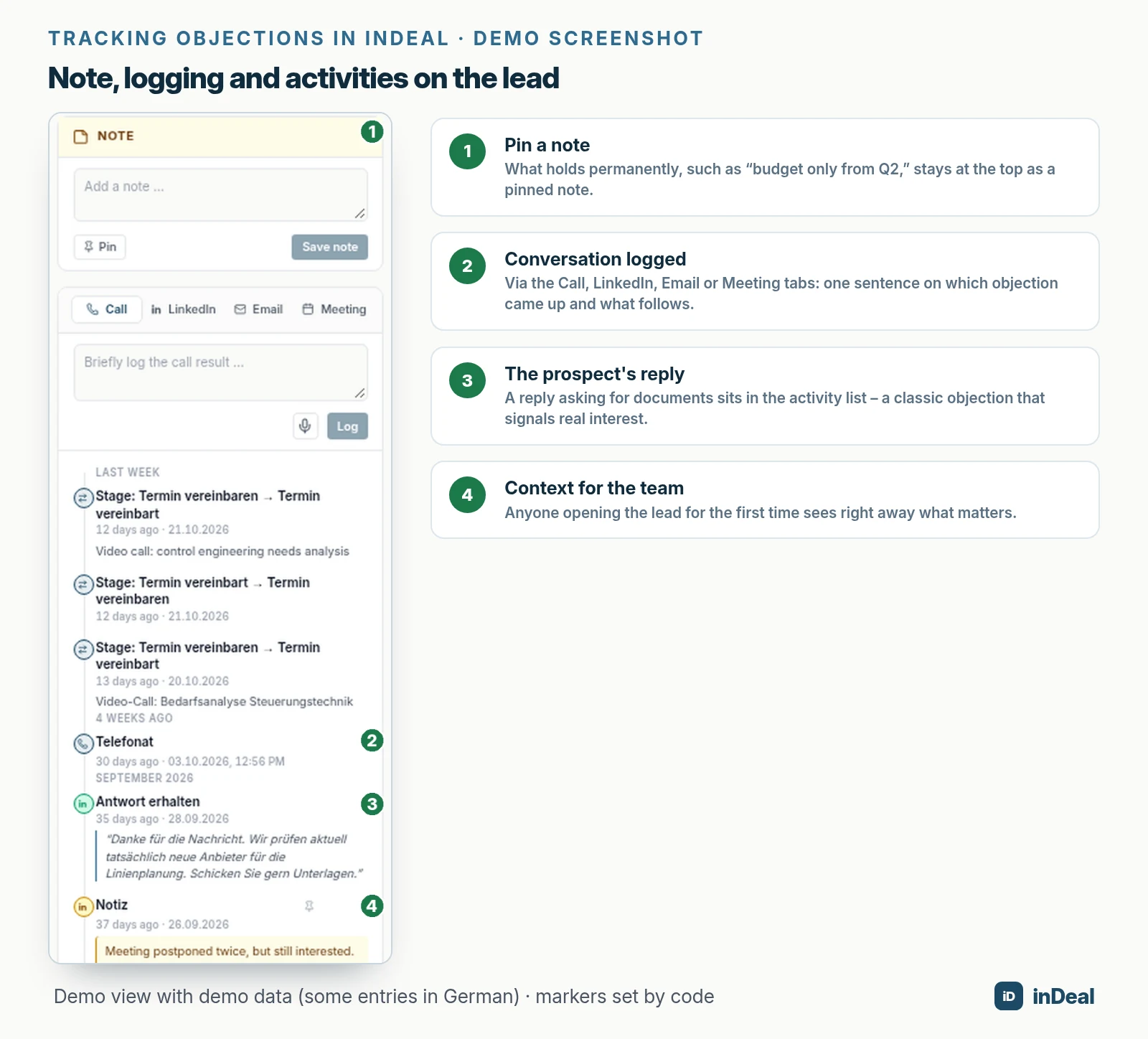
After every objection, set a dated next step in the Follow-up date and Next step fields; inDeal can remind you by email (Set a follow-up with a reminder). If a deal is lost anyway, enter the reason when you move it to Lost (Deal stages). According to indeal.ai, the CRM is free with unlimited users.
Which technique fits which objection?
Always start with a clarifying question; it works for every objection. Then pick the technique based on the reason you uncovered.
| Situation | Recommendation |
|---|---|
| The objection is vague (“too expensive,” “not interested”) | Clarifying question, then an isolating question |
| The objection is legitimate (budget, effort) | “Yes, and,” a smaller option or a later start |
| The prospect is unsure or worried about risk | Feel, felt, found with a real customer example |
| The same objection comes up in almost every call | Address it upfront and save the response as a template |
| Other decision-makers are involved | Ask who else decides and suggest a joint meeting |
| The objection keeps changing | Check for a brush-off and requalify the need |
Objection handling is one building block of your sales process; the full picture is in The Perfect CRM Sales Process. Free options are compared in Free CRM for Small Business, and how AI takes routine work off your plate is covered in AI CRM for Small Business.
A free CRM for your whole team. Start inDeal in 2 minutes. Just an email address, no credit card to sign up, unlimited users.
Start freeKeep reading
- Sales Follow-Up: How Often and Why Every Deal Needs a Next Step
- Lost Deal Analysis: Why You Lose Deals
- Sales Win Rate: How to Calculate It
- Sales Cycle Length: How to Shorten Your Sales Cycle
- Lead Qualification with BANT
Frequently asked questions
What is objection handling in sales?
What is the difference between an objection and a brush-off?
What are the most common objection handling techniques?
How do you respond when a prospect says it's too expensive?
How do you handle “just send me some information”?
Should you address objections before the prospect raises them?
How do you track objections in inDeal?
Is inDeal the same as indeal.io?
Sources
- Status quo bias in decision making (Journal of Risk and Uncertainty 1(1), 7–59)
- Prospect Theory: An Analysis of Decision under Risk (Econometrica 47(2), 263–291)
- The Persuasion Knowledge Model: How People Cope with Persuasion Attempts (Journal of Consumer Research 21(1), 1–31)
- Listening to your customers: The impact of perceived salesperson listening behavior on relationship outcomes (Journal of the Academy of Marketing Science 25(2), 127–137)
- Salesperson Empathy and Listening: Impact on Relationship Outcomes (Journal of Marketing Theory and Practice 13(3), 16–31)
- Adaptive Selling: Conceptualization, Measurement, and Nomological Validity (Journal of Marketing Research 27(1), 61–69)
- Salesperson Adaptive Selling Behavior and Customer Orientation: A Meta-Analysis (Journal of Marketing Research 43(4), 693–702)
- When choice is demotivating: Can one desire too much of a good thing? (Journal of Personality and Social Psychology 79(6), 995–1006)
- E-business integration
- Activities, notes and history
- Create and use email templates
- Customizing the layout: sections and custom fields
- Set a follow-up with a reminder
- Deal stages from offer to close
- inDeal: homepage, pricing and FAQ
inDeal is the AI CRM for small and mid-sized B2B companies.
Keep reading
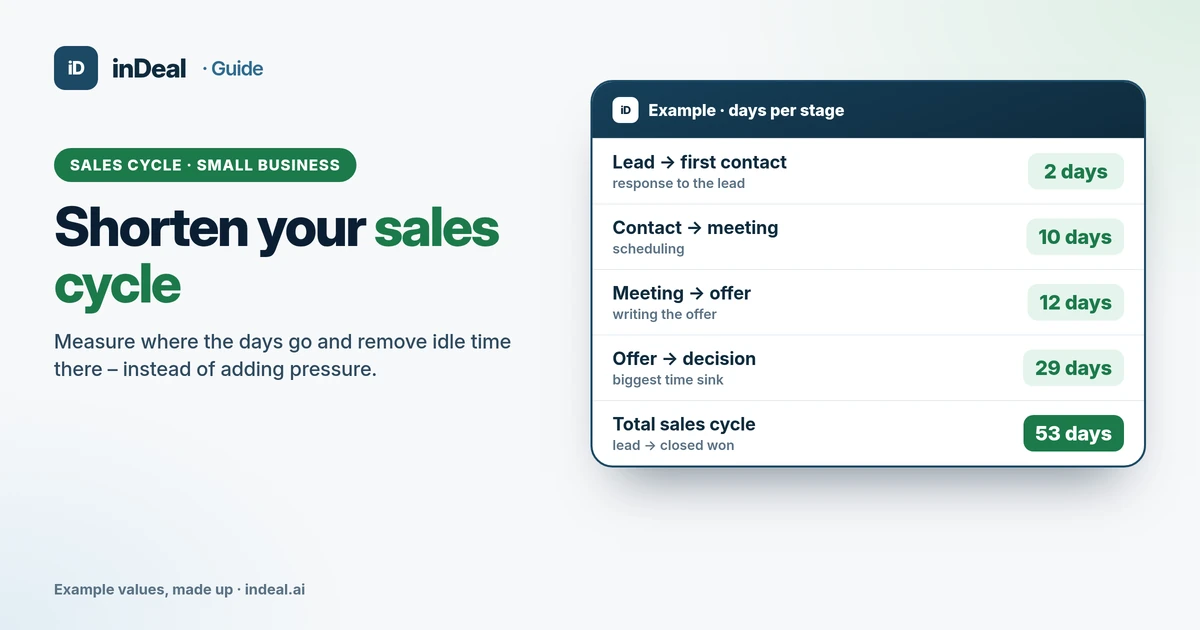 Sales and follow-up
Sales Cycle Length: How to Shorten Your Sales Cycle (2026)
Sales cycle length explained: how to measure it, where deals stall in each stage, and 9 ways to shorten your sales cycle – with research and a free CRM.
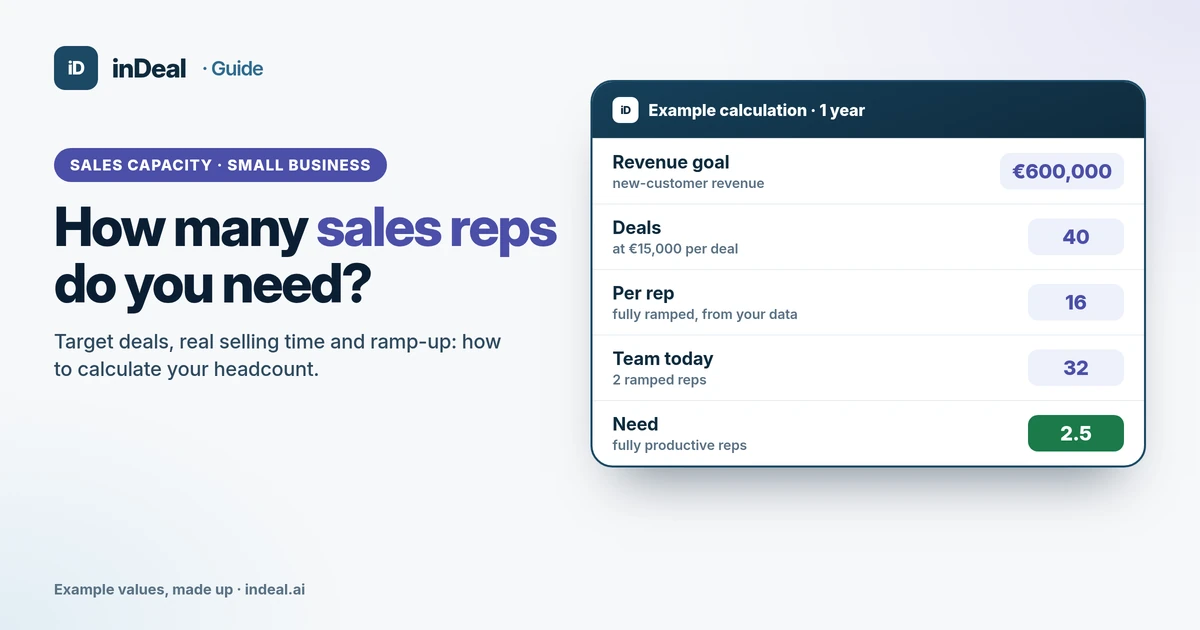 Sales and follow-up
Sales Capacity Planning: How Many Sales Reps Do You Need?
Sales capacity planning for small business: calculate how many sales reps you need, factor in selling time, ramp-up and time off, and spot overload early.
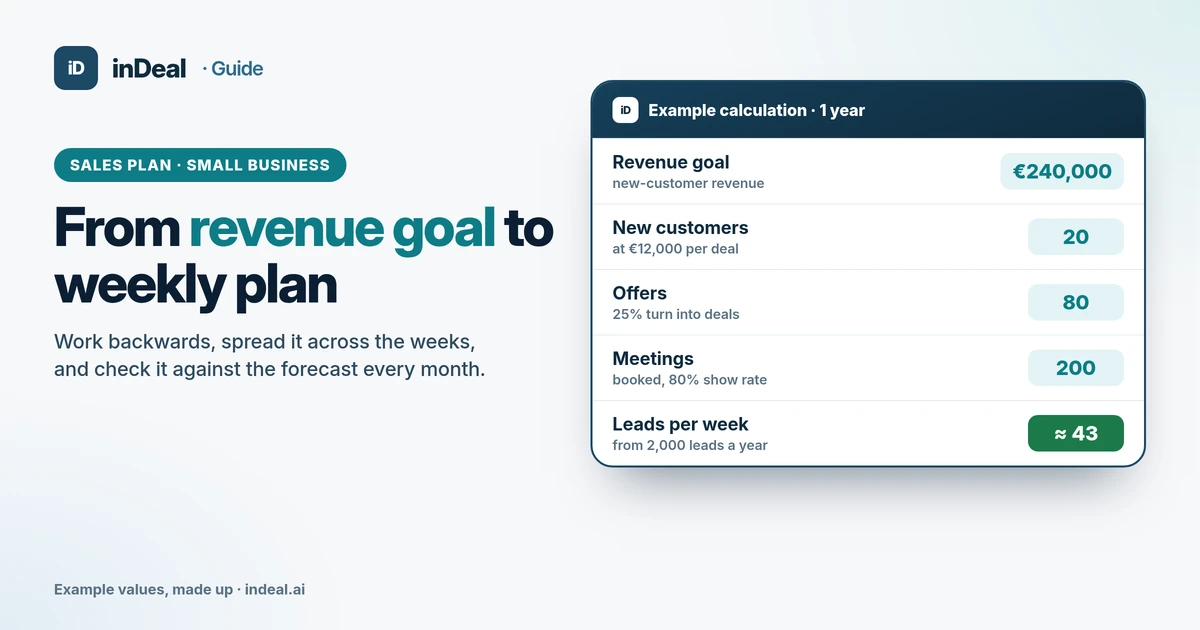 Sales and follow-up
How to Write a Sales Plan for a Small Business (2026)
Sales plan for small business: work back from your revenue goal to customers, offers, meetings and leads, set weekly targets and review monthly.